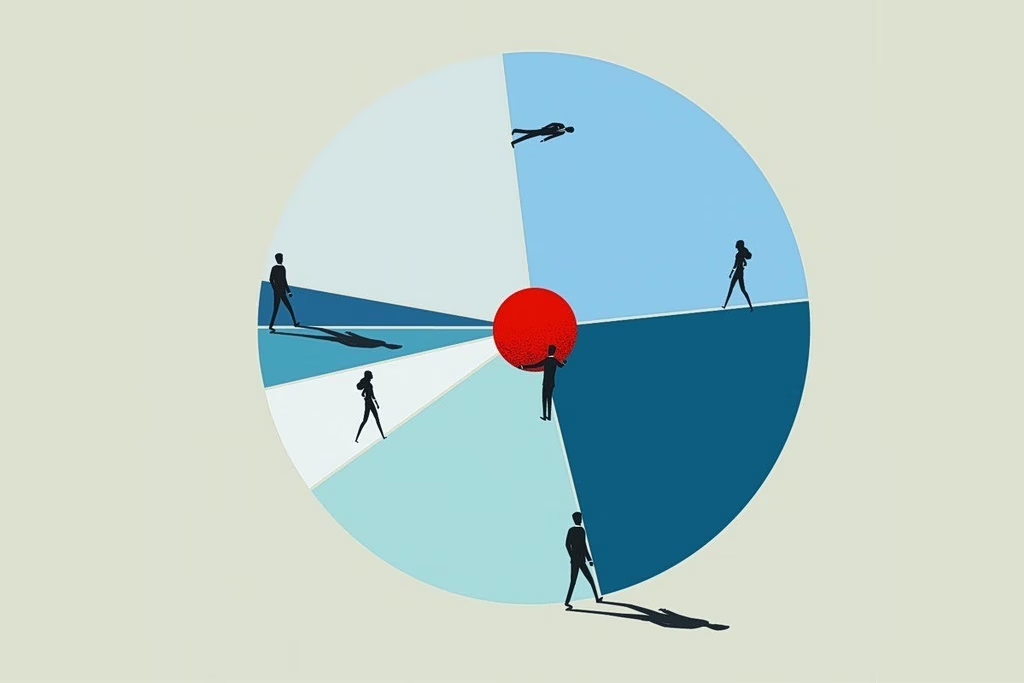
They were not always called “rolling polls.” Back in the era of I-have-a-friend-who-has-a-friend, polls were called “secret polls.” The friend who had a friend who also had a friend—whose friend, in turn, had a friend in one of the powerful embassies—would reveal to you, almost conspiratorially, that “a secret poll” was showing different percentages from those being publicly reported. Well then, wouldn’t you tell a couple of your own friends, if only to honor your friendship?
Without necessarily having any such friend, but with even greater certainty, almost everyone would tell you that polling companies were “cooking the numbers.” Pollsters—as they were called back then—were supposedly “bought and paid for.” This universal conviction eventually became the official line of those who appeared to be losing. In the 2000 elections, New Democracy’s entire communications campaign was built around television advertisements in which green parrots fluttered around unsuspecting voters.
A nice idea—except that New Democracy actually lost the election. And when, four years later, it won, it proceeded to ban the publication of polls for a full fifteen days before election Sunday. Another excellent idea: the “secret polls” and the friends who had a friend, and so on down that endless chain of friendship—which could stretch all the way to the corridors of the State Department—never had it so good.
Since then, political parties, without exception, have never stopped quarrelling with polls. In the 2023 elections, and according to public accusations made at the time, SYRIZA’s certainty was expressed as a threat: “The pollsters had better not dare…” Yet another fine idea, but first, it failed to produce the expected results, and second, it proved somewhat outdated. SYRIZA was crushed at the ballot box, even though the pollsters who could see it coming in their measurements supposedly “didn’t dare say so.” Meanwhile, communication networks, trolls, and bots were having a field day in the realm of political propaganda. What difference could a poll make?
According to PASOK, the party that at this stage appears to be somewhat concerned about the electoral balance of power, two or three polls that emerged before the chairs had even been put away after the launch events of “Hope for Democracy” and ELAS may indeed make a difference. They create, as PASOK argues, a certain “climate” intended to pave the way for an electoral outcome in which New Democracy comes first, ELAS second, and PASOK trails in third or fourth place.
The scenario goes as follows: the third- or fourth-placed party will be called upon to shoulder the burden of preventing a situation of ungovernability, while the first-place party prepares for a third term and the second-place party enjoys its return as the system’s alternative pole. As one observer puts it: “Mitsotakis governs with Androulakis, who secures his political survival with a few ministerial posts, while Tsipras gathers up the entire opposition vote and waits his turn against a coalition government that is weak by definition.”
This, of course, comes from someone who, like all of us, also has friends who have a friend.
One might say that this is not exactly politics—and certainly not the kind of politics needed in a country that requires much more than a few cosmetic repairs. In other words, it is not enough merely to fix the shutters, repair the door handles, and replace the pipes that have rusted from dampness. The structural problems are crying out for attention. Reforms have disappeared from public debate. Yet politics is offered only in the packaging of intrigue, speculation, communication propaganda, personal ambitions, and clashes of interest.
Day by day, the country of the next crisis is being built. It is not hidden; every poll that measures things beyond voting intention says so.
But so be it. Addicted to this political game, we can always call our favorite pollster and ask, “What do the secret polls say?” even on election night.
Surely, he will know someone who knows someone.