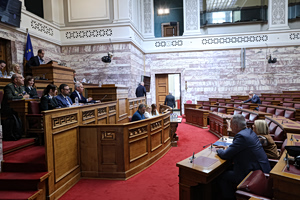
An independent Greek lawmaker reignited the controversy over US Ambassador Kimberly Guilfoyle on the eve of Secretary of State Marco Rubio’s visit to Athens, pressing Parliament’s foreign affairs committee for answers over a reported remark that Washington could topple governments, Greece’s included. The demand drew a sharp rebuke from the committee’s chair, Dora Bakoyannis, who accused her of chasing partisan points.
Sia Anagnostopoulou raised the matter during a session of Parliament’s National Defense and Foreign Affairs Committee, returning to a report published Sept. 25 by The Wall Street Journal. According to the Journal, Guilfoyle got into an argument with Energy Minister Stavros Papastavrou at a dinner in Athens in March attended by Greek and US officials. Referring to the impending collapse of Romania’s government, she told the group, “We can do that to any country we want. We can do that here,” the newspaper reported, citing a person who attended the dinner and others who were told about it. Papastavrou retorted that the United States could not replace Greece’s elected government, according to the report. Guilfoyle’s lawyer disputed the Journal’s characterization of the exchange.
Papastavrou addressed the dinner account in Parliament on Friday, after Alexandros Kazamias of the left-wing party Plefsi Eleftherias demanded a “yes or no” answer on whether the exchange took place. “There was never any issue of pressure or threats against our country to take any action,” the minister said, adding that his responsibility was “not to comment on reports” but to defend the national interest.
On Tuesday, Anagnostopoulou sought an explanation for the statements attributed to the ambassador and linked them to Rubio’s visit. Reaction in Greece to the reports about Guilfoyle, she said, had ranged “from muted to nonexistent.” She pointed to the Trump administration’s interventions in other countries and called the protests organized against Rubio’s trip significant. “Spare us the grandstanding, for pity’s sake, that the country is being saved because Marco Rubio is coming,” she said.
Bakoyannis replied that no foreign power can decide who governs Greece. “Greece is a stable, strong democracy,” she said, adding that no government anywhere in the world could sway the will of the Greek people. She urged lawmakers not to approach the issue with thinking that harks back to the past.
Anagnostopoulou countered that nothing in a democracy should be taken for granted and that citizens must remain constantly vigilant, citing US policy toward Venezuela and Cuba.
“I don’t represent Venezuela or Cuba. I represent my country,” Bakoyannis shot back. She repeated that no outside power could choose Greece’s governments and invoked the struggle to restore Greek democracy, saying insinuations that call into question the popular will on which it rests were unacceptable.
The exchange grew more heated when Anagnostopoulou asked whether the foreign minister should have summoned the US ambassador to clarify whether, and how, the disputed remark was made. “Ms. Anagnostopoulou, don’t keep pressing on matters the government has clarified,” Bakoyannis said, maintaining that the phrase attributed to Guilfoyle had been denied. There was no reason to continue the discussion, she added, “unless you have partisan motives.”
Other opposition lawmakers also brought Rubio’s visit into the debate. Kazamias tied the trip to the reports about the ambassador, arguing it would do nothing for regional stability and would instead perpetuate US interference in the internal affairs of Balkan states. Giannis Delis of the Communist Party of Greece (KKE), called the secretary of state unwelcome and accused the government, and the parties backing its policy, of drawing the country into dangerous plans. Vassilis Viliardos of the far-right Elliniki Lysi party asked whether the timing of a military education cooperation agreement with Serbia, which the committee was reviewing for ratification, was tied to Rubio’s visit and to the government’s effort to close outstanding issues, citing Crete’s importance to US interests.
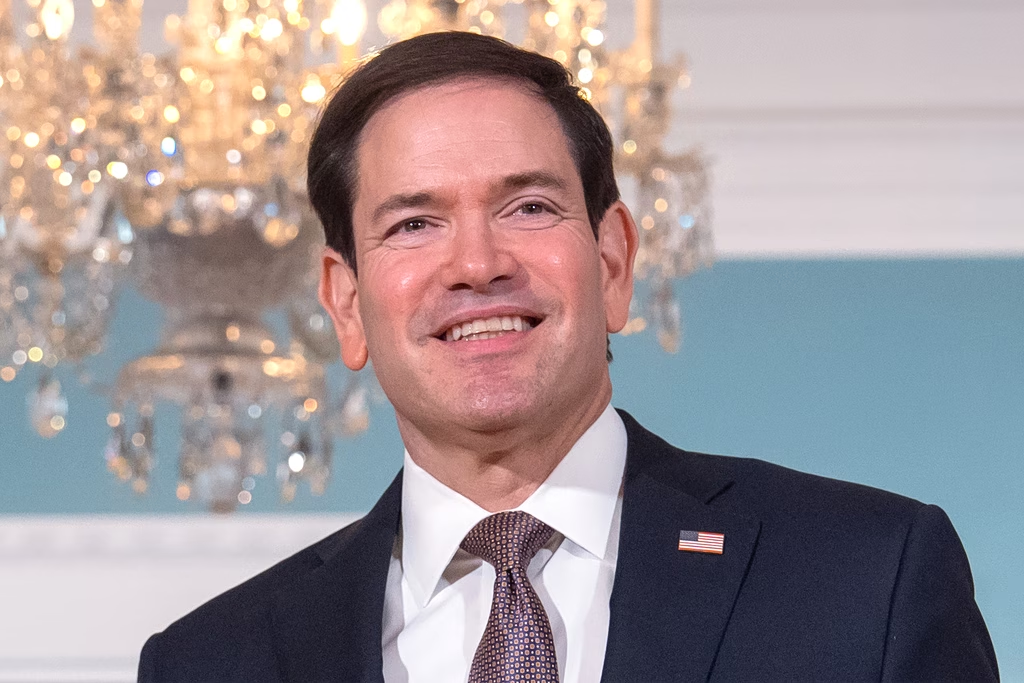
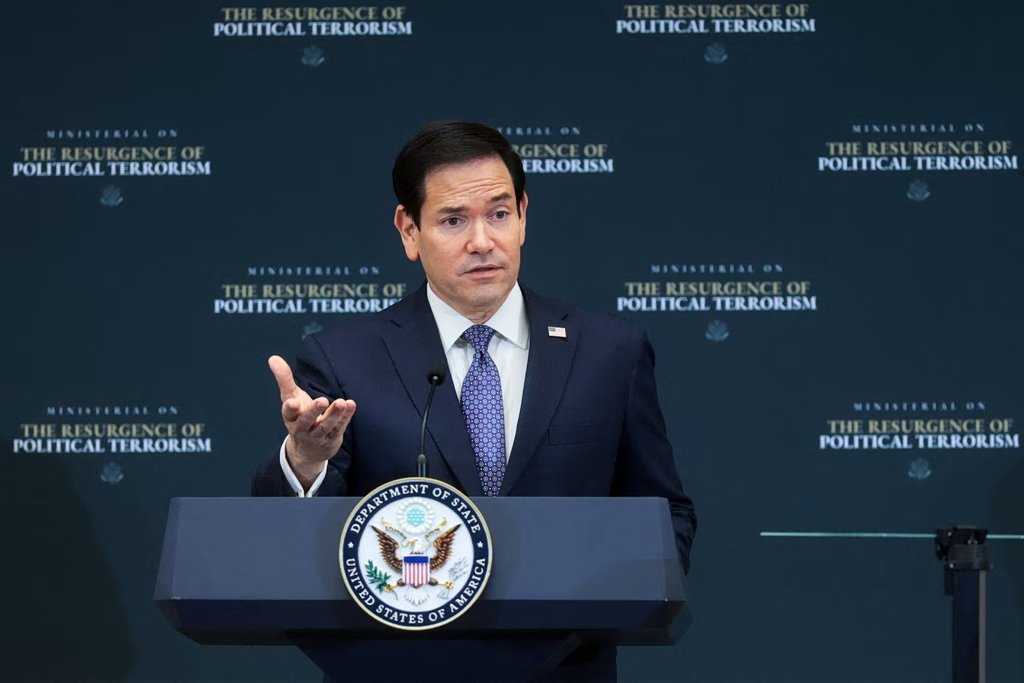
Rubio, who is making his first trip to Greece as secretary of state, has publicly backed the ambassador. In a statement shared by the US Embassy in Athens days before his arrival, he said Guilfoyle “has proven to be extremely effective in advancing the President’s agenda in Greece and across Europe” and credited her with promoting American energy interests through projects such as the Vertical Corridor, which is designed to move US LNG into southeastern Europe.
Rubio is scheduled to arrive in Athens on the evening of Oct. 6 and leave the following day after meetings with Prime Minister Kyriakos Mitsotakis, Foreign Minister George Gerapetritis and other senior officials. He will lead the US delegation at the sixth Greece-US Strategic Dialogue, where defense, energy and regional security are expected to dominate the agenda. Rubio is also scheduled to deliver a speech, billed as “historic,” on Pnyx Hill, where the citizens’ assembly of ancient Athens once met. The address is set to focus on President Donald Trump’s plans for the Mediterranean, according to reports.
With information from TO BHMA