
 Μake us preferred on Google
In its latest assessment, the international rating agency forecasts that Greece’s general government debt will fall from 146.1% of gross domestic product (GDP) in 2025 to 124.6% in 2028, a reduction of 21.5 percentage points. It also expects Greece to cease having the highest public debt-to-GDP ratio in the eurozone by the end of 2026, with its debt ratio falling below Italy’s.
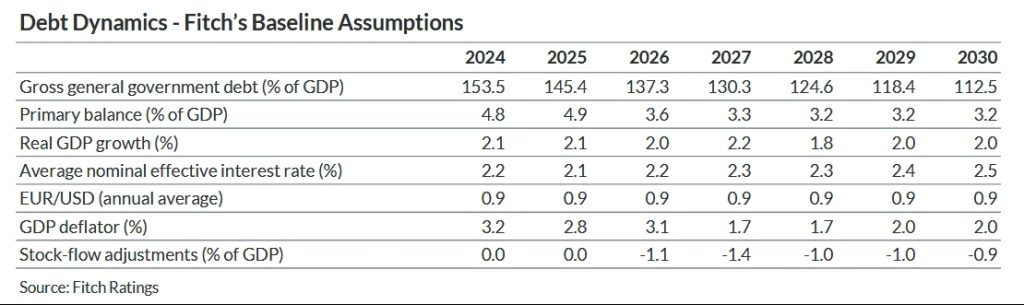
The agency nevertheless cautions that the debt burden remains exceptionally high compared with other investment-grade economies and continues to constrain Greece’s credit rating. The median public debt ratio among countries rated BBB stands at 56.9% of GDP.
The agency attributes the projected reduction to substantial primary budget surpluses, sustained nominal GDP growth, a favorable differential between borrowing costs and economic growth, and active public debt management, including the early repayment of outstanding loans.
Fitch also considers Greece’s debt structure an important safeguard against refinancing risks. The average maturity of government debt stands at approximately 19 years, with a substantial proportion consisting of loans on favorable terms and fixed interest rates. The country’s cash buffer is projected to reach approximately 12% of GDP in 2026.
The implied interest rate on public debt remains relatively low, at around 1.5%, compared with expected nominal GDP growth of approximately 4%. This favorable differential helps reduce the debt-to-GDP ratio and limits Greece’s exposure to fluctuations in international financial markets.
Strong fiscal performance and resilient growth
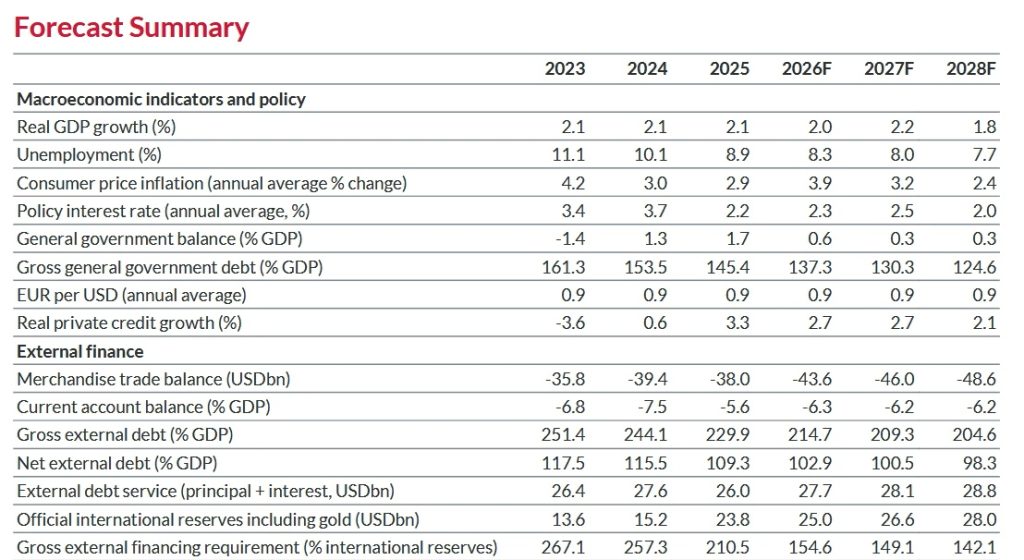
Fitch expects Greece to record a general government surplus of 0.6% of GDP in 2026, compared with a projected median deficit of 3.1% among countries with a BBB rating. The primary surplus is forecast at 3.6% of GDP.
The agency attributes the strong fiscal performance to robust tax revenues, social security contributions and improved tax compliance, with revenue growth continuing to outpace expenditure increases.
It also forecasts average annual economic growth of 2% over 2026-2028, supported primarily by investment and private consumption. The agency considers Greece’s economic performance resilient despite a weaker external environment and heightened uncertainty.
Nevertheless, it identifies persistent external imbalances as a significant vulnerability, forecasting a current account deficit equivalent to 6.5% of GDP in 2026. Low domestic savings and strong import demand associated with investment activity continue to weigh on the external balance.
Structural weaknesses and banking-sector resilience
Despite the improvement in public finances, Fitch cautions that Greece continues to face structural weaknesses inherited from the decade-long debt crisis. Real GDP remains below its pre-crisis peak, while per capita income remains relatively low compared with the EU average.
The agency also points to the country’s persistent external imbalances, limited domestic savings, high dependence on energy imports and structural constraints on its productive capacity as factors weighing on its credit profile.
By contrast, the banking sector is considerably stronger and more resilient than in previous years, with satisfactory profitability, liquidity and capitalization. Fitch considers the risks of banks requiring government support to be contained, although it identifies continued reliance on deferred tax credits and exposure to external shocks as structural vulnerabilities.
Greece’s credit rating trajectory
The latest decision maintains the rating Fitch assigned to Greece in May 2025, when it upgraded the country to investment grade BBB-, subsequently raising it to BBB in May 2026. The Nov. 6 assessment therefore represents a reaffirmation rather than a new upgrade.
The decision also concludes the 2026 round of sovereign credit assessments by the major international rating agencies. Standard & Poor’s reaffirmed Greece at BBB with a stable outlook in October, while Scope Ratings upgraded the country to BBB+ in September. Moody’s maintained its Baa3 rating but revised its outlook to positive, while DBRS Morningstar and Japan’s Rating and Investment Information (R&I) also maintained BBB ratings with positive outlooks.
The assessments reflect the sustained improvement in Greece’s fiscal position, the recovery of its banking system and the continued decline in public debt since the country’s return to investment-grade status in 2023.
Fitch identifies further substantial reductions in public debt, underpinned by sustained primary surpluses and resilient economic growth, as potential grounds for a future upgrade. Improvements in Greece’s productive capacity and labor-market performance could also strengthen its credit profile.