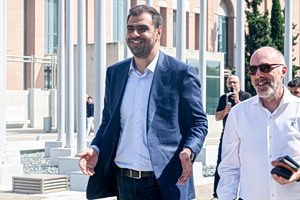
Government spokesman Pavlos Marinakis spent Monday’s briefing with political reporters trying to contain a controversy of his own making, insisting there is no government plan to shorten how long unemployed Greeks can receive benefits, after remarks he made days earlier suggesting exactly that.
The controversy erupted after Marinakis gave an interview to Greek public broadcaster ERT on Friday, in which he said unemployment benefit should be “evaluated from scratch” and argued that they should not run longer than two months. He said the money should instead be redirected to businesses, enabling them to lower social insurance contributions, and pointing to employers across the country who he said are struggling to find staff. He described the idea as a personal position he would actively support and push for its implementation after the next election, should voters return New Democracy to power. The government spokesperson also suggested during the same interview that other benefits, including disability and maternity payments, should be preserved and strengthened.
Backlash
The comments drew swift criticism from the opposition. PASOK spokesman Kostas Tsoukalas argued that a government spokesman speaks for the government, not for himself, and that the remarks signaled the direction New Democracy intends to take after the next election. Anna Papadopoulou, deputy press spokesperson for Greek Left Alliance, the party led by former prime minister Alexis Tsipras, called the comments a form of social cannibalism and said Marinakis should have been removed from his post if they did not reflect the prime minister’s own thinking. ADEDY, the umbrella confederation representing Greece’s civil servants’ unions, condemned the proposal as well, describing it as a mechanism for pushing wages down across the labor market and noting that the benefit is funded mainly through worker contributions, not a state handout.
By Monday morning, Deputy Labour Minister Kostas Karagounis had moved to distance the government from Marinakis’s remarks, telling reporters they were a personal opinion rather than government policy. Unemployment benefit, he said, is a right earned through contributions and will not be cut, adding that the government’s goal, set by the prime minister, is to bring unemployment below 6 percent.
Marinakis’s response
Facing pressure from within his own party as well as from the opposition, Marinakis used Monday’s briefing to push back on how his remarks had been received. He insisted that there is no government plan to put a cap on unemployment benefits, while accusing the opposition and parts of the media of selectively editing what he had said. According to Marinakis, only the first part of his interview was reported, the reference to a shorter benefit period, while a second part was left out, in which he proposed that after a certain period the benefit could be converted into a subsidy tied to employment, with the state helping cover a company’s social insurance contributions to encourage hiring of unemployed workers. He said this arrangement is his personal position and worth examining, while adding that vulnerable groups would still need specific safeguards.
Marinakis also pointed to conditions in the labor market to explain his thinking, saying many businesses, particularly in the restaurant and hospitality sector, now report difficulty finding staff, which he took as evidence that unemployment has fallen. “I did not suggest we should throw someone into the Kaiadas,” he said, invoking the chasm on Mount Taygetus where, according to ancient accounts, Spartans threw condemned prisoners and traitors -a phrase commonly used in Greek to mean abandoning someone without recourse.
Marinakis did not stop there. He also went on the offensive, attacking both PASOK and SYRIZA. The government spokesperson framed the backlash he was receiving as an attempt to stifle free speech and defended the right of government officials to open public debates even on matters that are not formal government policy.