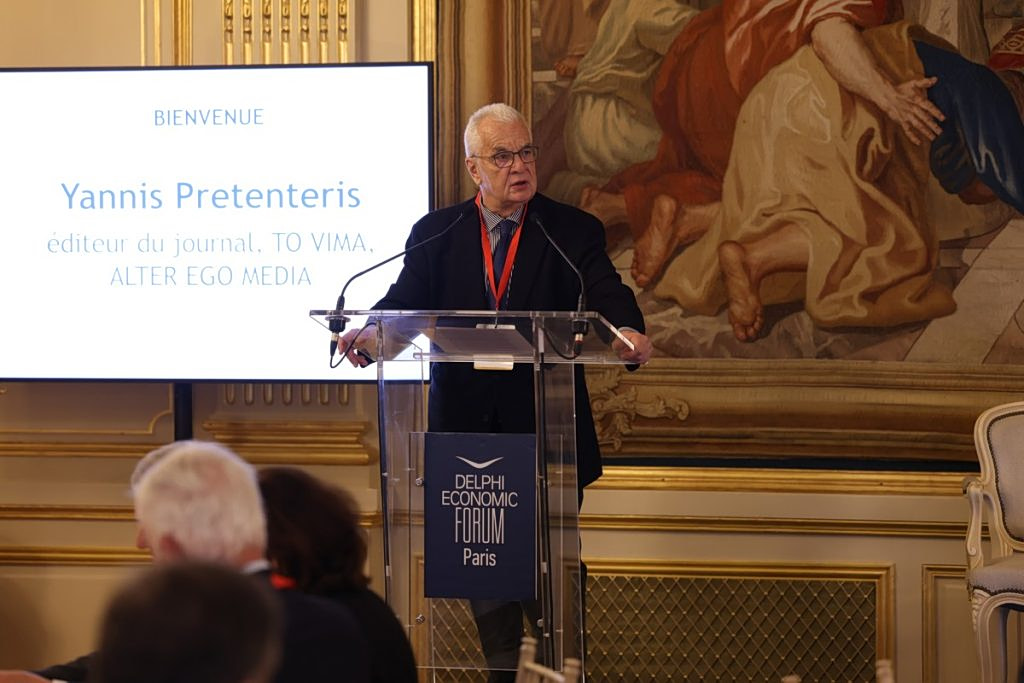
The strong relationship between Greece and France, geopolitical challenges, and the need for European autonomy in areas such as defense, security, the economy, energy, and culture dominated the interventions of politicians, diplomats, and experts at the third consecutive discussion forum on Greek–French relations, held on Thursday in Paris by the Delphi Economic Forum, in cooperation with To Vima and Ta Nea.
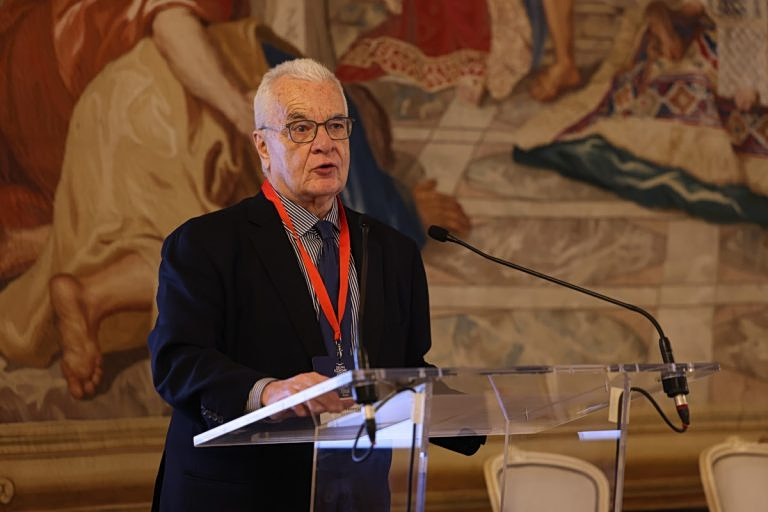
In the hall of the Cercle de l’Union Interalliée in Paris, Symeon G. Tsomokos of the Delphi Economic Forum spoke of “geopolitical plates moving at dizzying speed,” while Yannis Pretenteris of To Vima referred to the “chaotic behavior” of the new U.S. policy. Taking the floor immediately afterward, the French Ambassador to Greece, Laurence Auer, and the Chargé d’Affaires of the Greek Embassy in Paris, Alexandra Mantzila, confirmed that relations between the two countries are strong, deep, and strategic in nature. Indicative of the depth of relations in the field of culture, as Laurence Auer announced, is France’s decision, on the occasion of the 200th anniversary of the founding of the Greek state, to transfer for a period of time from the Museum of Fine Arts of the city of Bordeaux to Greece Delacroix’s painting “Greece on the Ruins of Missolonghi.”
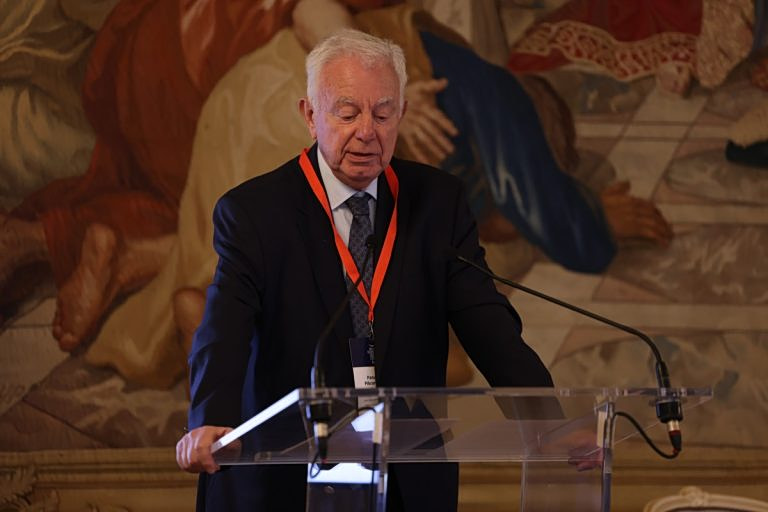
Former Prime Minister Panagiotis Pikrammenos
Former Prime Minister Panagiotis Pikrammenos referred to the stability of relations between Greece and France, making a historical review. Emphasizing that both countries are characterized by a spirit of independence, Pikrammenos recalled that during the dictatorship of April 21, France hosted approximately 5,000 Greeks—mostly persecuted individuals and self-exiles—and subsequently highlighted the fact that Konstantinos Karamanlis returned to Greece in 1974 aboard the aircraft provided to him by the then President of France, Valéry Giscard d’Estaing. In closing, the former prime minister underscored the important role played by Greece and France in the Mediterranean in promoting the role of international law.
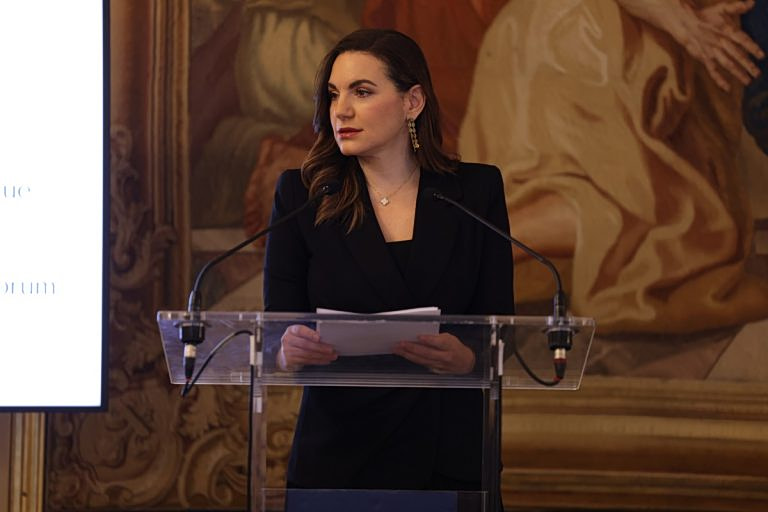
Minister of Tourism Olga Kefalogianni
Tourism Minister Olga Kefalogianni highlighted the common elements in the two countries’ strategies for the development of sustainable tourism, which in Greece translates into investment in quality as well as in new specialized forms of tourism, such as mountain tourism.
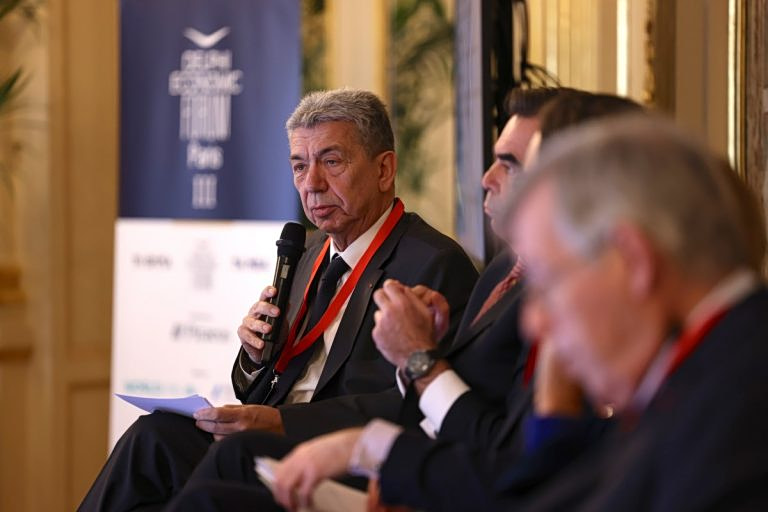
The discussions were dominated by the new geopolitical reality and, in particular, Europe’s role amid global tectonic shifts. Responding to Yannis Pretenteris’s question, “how united Europe is today,” the Secretary General of the Presidency of the French Republic, Emmanuel Moulin, replied that “in difficult times, such as the economic crisis, the health crisis, and the Ukraine issue, we unite.” Moulin noted, however, that with the return of “neo-colonial mindsets,” Europe must take its fate into its own hands by developing strategic autonomy in areas such as defense and the economy, where it must strengthen its competitiveness and reduce bureaucracy, bearing in mind that we are facing a trade war both from the United States through tariffs and from China, which protects its economy. Moulin also emphasized that through the economic crisis, Greece and France learned a great deal, considering that the rescue of Greece during the eurozone crisis was not provided for by the European Treaties.
Regarding Europe’s position in the new global economic order, Greece’s Permanent Representative to the OECD, George Pagoulatos, called on Europe to stop self-flagellating and to recognize how significant the achievement of European integration is. He noted, however, that Europe shows excessive dependence on external trade, which in the current geopolitical context becomes a potential source of vulnerability.
The importance of integrating Europe’s capital markets was highlighted by the Chair of the Hellenic Capital Market Commission, Vassiliki Lazarakou, who stressed that following the Letta and Draghi reports and the broader diagnosis of competitiveness issues in the European market, the time for action has come. She emphasized that the creation of a single capital market and the removal of all obstacles to the fragmentation observed today are vital for achieving the EU’s objectives, from which Greece will also benefit. However, she also underlined the need for this integration to be achieved without any compromise in the quality of the institutional framework or in investor protection.
Issues related to artificial intelligence were also at the center of the discussions in Paris, with Deputy Minister of Culture Iason Fotilas stressing that the key question is under what conditions the implementation of artificial intelligence will take place in the country.
Finally, migration issues were addressed by Deputy Minister of Migration and Asylum Sevasti Voloudaki, who outlined Greek policy on the matter as well as the framework of cooperation with France.