The ambitious Great Sea Interconnector (GSI) project is approaching a point at which a few carefully chosen words could carry considerably more weight than the cable itself, given that Greece is preparing for the next phase of the electricity link with Cyprus and Israel.
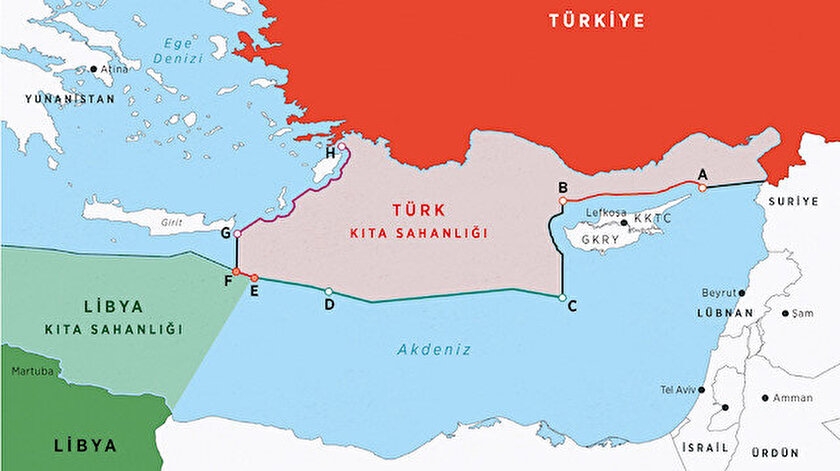
At the same time, the now fully revisionist and aggressive foreign policy followed by Ankara insists on prior coordination over work in maritime areas Turkey unilaterally considers part of its continental shelf, while Athens maintains that the relevant procedure is notification, not permission.
The issue was examined in a report published in Saturday’s edition of the Athens daily Ta Nea, which focuses on the competing interpretations of what Ankara means by “coordination” and what Athens regards as a straightforward notification procedure.
The GSI dispute comes alongside another potential source of friction, namely, plans in Turkey to legislate aspects of the revisionist and expansionist “Blue Homeland” doctrine, which Greece rejects as incompatible with international law. Together, the two issues are testing how far the relative calm in Greece-Turkey relations can extend to questions involving maritime claims and energy infrastructure.
Notification or coordination?
The immediate disagreement is over whether Greece’s obligation is simply to notify Turkey of planned activity or to enter into a prior process of coordination.
The Turkish defense ministry stated last week that cable-laying, pipeline work and scientific research in areas Ankara considers part of its continental shelf must be coordinated in advance with Turkey, as the “coastal state.” It also said Turkey would not allow what it considers unlicensed activity in the area.
According to senior Turkish sources, as cited by Ta Nea, Ankara expects the communication to be made in writing. They describe the process as “mutabakat,” or consensus, while insisting that Turkey is not formally seeking an application for permission.
Athens rejects the implication that such notification requires Turkish approval.
Greek Foreign Minister George Gerapetritis has maintained that informing other countries about maritime activity does not recognize any Turkish licensing authority. The NAVTEX, in the Greek view, is a notification concerning maritime activity and safety, not an instrument conferring jurisdiction.
That distinction is at the heart of the dispute – whether a written exchange would constitute ordinary operational coordination or create a precedent for Turkish involvement in authorizing activity in an area where Greece rejects Ankara’s jurisdictional claims.
The legal divide
The disagreement forms part of a much broader dispute over maritime law. For instance, Greece, Cyprus and Egypt are parties to the United Nations Convention on the Law of the Sea (UNCLOS), while Turkey has neither signed nor ratified the convention and disputes aspects of its provisions, including the maritime effect of islands.
Using UNCLOS as a basis, Athens maintains that islands generate maritime zones under international law; Ankara takes a different view, particularly where Greek islands – even large Crete – lie between the Turkish mainland and the eastern Mediterranean.
The 2019 Turkey-Libya maritime memorandum is one of the clearest expressions of that divide. Greece, Cyprus and Egypt reject its maritime implications, while the European Union has said the agreement infringes upon the sovereign rights of third states and cannot produce legal consequences for them. Recent challenges by Italy and Tunisia to related Libyan maritime claims have further strengthened Athens’ argument that the Turkish-Libyan position lacks broader regional acceptance.
Full throttle revisionism
Turkey continues to invoke the memorandum and its “Blue Homeland,” or “Mavi Vatan,” doctrine in advancing its maritime claims. Turkey’s non-participation in UNCLOS does not place it outside international maritime law, since many rules reflected in the convention are also considered customary law. However, Ankara disputes some provisions and interpretations that Greece and its regional partners regard as applicable.
The resulting divide is therefore not over whether international maritime law exists, but over how particular rules are interpreted and applied to competing claims.
Why the GSI is sensitive
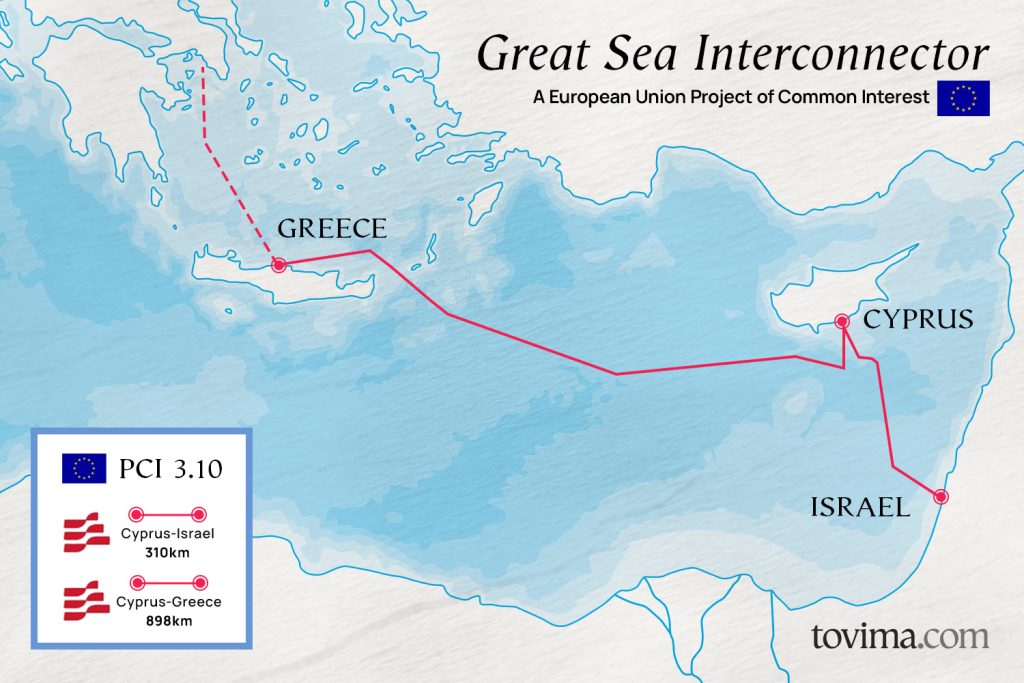
The GSI is particularly consequential because its route passes through maritime areas where Greece and Turkey have competing claims. The project is intended to connect Greece and Cyprus and ultimately Israel to the European electricity grid, making it both an energy-infrastructure project and a strategic issue.
After delays and the 2024 episode involving seabed surveys near the Greek island of Kasos, in the extreme southeast Aegean, preparations have accelerated. French investment group Meridiam now holds a majority stake in the project company, while France has taken a more prominent role in the project’s next phase. The remaining seabed surveys are expected to include areas east of Kasos and off western Cyprus.
Athens is waiting for the request needed to issue the relevant NAVTEX, while Ankara has made clear that it expects prior coordination. To Vima has described the timetable as increasingly tight, with the seabed mapping and final route needing to be completed by the end of the year.
The disagreement therefore goes beyond whether a vessel can operate along its planned route. Both sides are also concerned about what the practical arrangements might establish for future activities in the same waters.
The wider ‘Blue Homeland’ issue
The GSI dispute is unfolding against the backdrop of Turkey’s broader “Blue Homeland” doctrine. Plans to give elements of the doctrine a domestic legal framework have been a recurring concern for Athens since the spring, when Greek officials warned that legislation could seek to formalize disputed Turkish maritime claims.
For Greece, the concern is not simply the terminology of the doctrine but the possibility that maritime claims could become further institutionalized through domestic legislation.
The GSI and the proposed legislation therefore intersect at the level of precedent. Athens is concerned that an operational arrangement surrounding the cable could eventually be cited as evidence of Turkish jurisdictional rights, while Ankara is seeking to establish what it describes as a practical requirement for prior coordination in areas it considers part of its continental shelf.
What is at stake
The disagreement is therefore not simply about whether Athens will inform Ankara before cable-laying begins. It concerns who informs whom, in what capacity and what legal or political meaning is attached to that communication.
For Greece’s foreign policy policy-makers, notification must not become recognition of Turkish jurisdiction or consent over activity in disputed maritime areas. For Turkey, prior coordination is presented as “necessary to protect” what Ankara – unilaterally – considers its rights and interests.
That makes the next phase of the GSI a test of more than the project’s timetable. It will also test whether Athens and Ankara can maintain a broader positive dialogue while managing a fundamental disagreement over maritime claims — and whether the practical arrangements surrounding the cable create a precedent that either side can invoke in future disputes or legal tribunals.