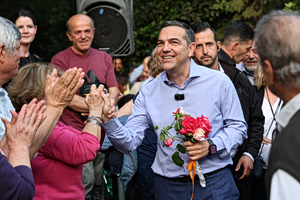
Alexis Tsipras has spent the past several months in plain sight. Crisscrossing Greece on a tour ostensibly devoted to Ithaca, his political memoir, the former prime minister has been doing something that looked considerably more like a campaign than a book launch. Town halls and speeches all across the country, conversations with officials and voters, selfies and informal chats. The groundwork has been methodically laid for what he will officially announce on Tuesday: a new political party.
Tsipras, who governed Greece from 2015 to 2019 and was leader of the SYRIZA party during the acute years of the debt crisis, will make the announcement on Tuesday, May 26, at 8 p.m. from Thisseio Square in central Athens, as To Vima first reported. The choice of venue is deliberate: an open civic square rather than a party auditorium, signaling a break with the political machinery of the past.
His inner circle is keeping the name and structure of the new party close to their chest. What they have signaled is the breadth of the ambition: a political force that reaches beyond the old SYRIZA base to address what Tsipras’s camp describes as a prolonged crisis of representation on the Greek left: a fragmented opposition that has failed to mount a coherent challenge to Prime Minister Kyriakos Mitsotakis and his ruling center-right New Democracy. The argument, as his associates frame it, is that large sections of the electorate are searching for a new political home with genuine governing experience at its center.
The contacts of recent weeks point to the same direction. Tsipras has held a series of meetings with former ministers, local officials and figures outside the traditional party apparatus. Those familiar with the process describe it as an effort to build something broader than the old SYRIZA, a party with reach into local government, civil society and center-left figures who remained outside the SYRIZA fold.
SYRIZA braces for defections
At SYRIZA headquarters, the mood is one of barely contained anxiety. The party, led by Sokratis Famellos, is confronting a wave of potential departures. Several lawmakers are understood to be weighing whether to resign from the party or leave their parliamentary groups to align themselves with Tsipras’s new vehicle. The scenarios have multiplied rapidly in recent days.
The internal pressure was further sharpened by the expulsion of Pavlos Polakis, a former deputy health minister known as one of SYRIZA’s most combative figures, who was removed from the party this week after a social media post targeting party leader Famellos. Within days of his expulsion, Polakis appeared at a SYRIZA event in eastern Attica, was received warmly, and spoke as though still a member — calling for party unity and repeating his longstanding proposal for a broad left front. His moves are widely read inside SYRIZA as a calculated repositioning ahead of the Tsipras announcement.
SYRIZA’s Political Secretariat and Central Committee are expected to convene to discuss the party’s path forward. The meeting is likely to be contentious: a significant faction within the party is pushing for the suspension of SYRIZA’s operations and a decision not to contest the next election, a demand that reflects how fundamentally the Tsipras factor has destabilized the party he once led.
Nea Aristera caught in the undertow
The disruption extends beyond SYRIZA. Nea Aristera, a party formed in December 2023 by 11 MPs who broke away from SYRIZA in a dispute over the party’s direction, is facing its own reckoning. Several of its founding figures are reassessing their position, according to people familiar with the internal discussions. The prevailing concern is that an independent path is becoming harder to sustain as Tsipras re-enters the field, with a growing number concluding that the center-left electorate will gravitate toward a figure with a national political profile and a record in government. Further departures from Nea Aristera’s parliamentary group are expected in the coming days.
What the square will reveal
The next ten days are widely regarded as the critical window. The May 26 event in Thisseio will be watched not only for what Tsipras says, but for who stands alongside him. The faces on that platform will provide the first real measure of how broad his coalition has become: how many former SYRIZA lawmakers, Nea Aristera figures, regional officials and center-left personalities outside the traditional party machinery have decided to make the move.