A police operation was launched after a case containing an old typewriter – not known at the time – was found outside the former political office of Pavlos Bakoyannis in central Athens, the site where the prominent Greek lawmaker was assassinated by the November 17 – N17 – terrorist gang in 1989.
The suspicious object was discovered at about 5 a.m. Tuesday by officers from the counter-terrorism service on patrol outside the building, at 35 Omirou St. in the central Kolonaki district. Police cordoned off two urban blocks and bomb disposal experts carried out a controlled explosion.
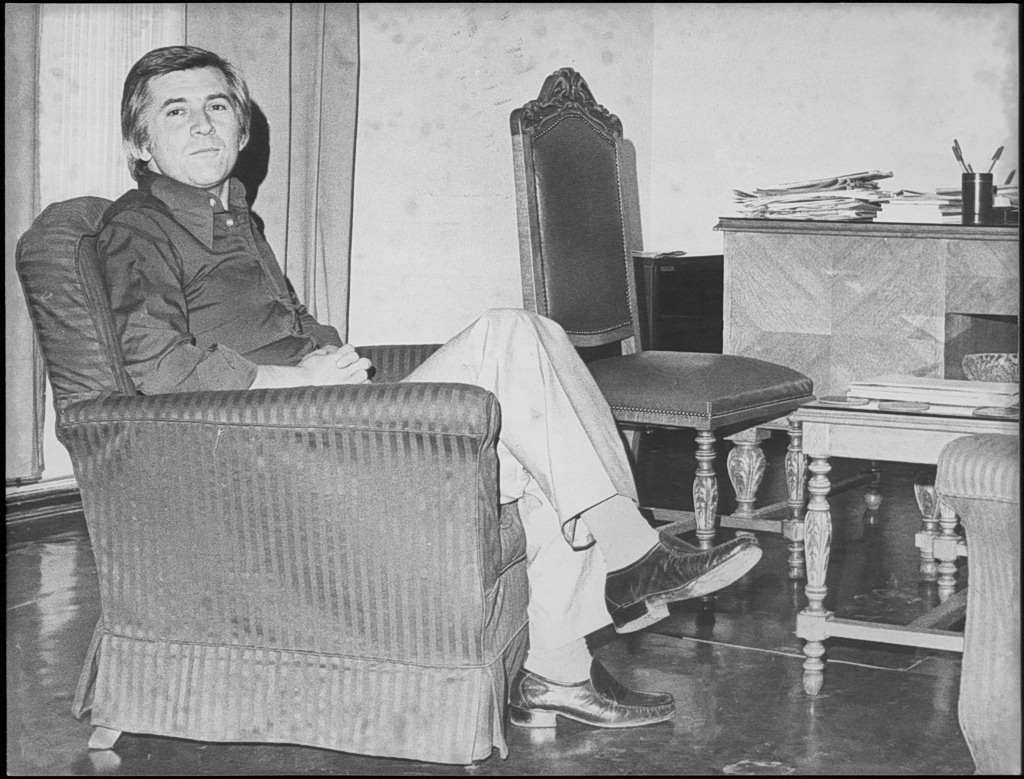
Greek politician and journalist Pavlos Bakoyannis.
The case was found to contain an old Hermes 3000 typewriter, a rare second-generation model manufactured by Swiss company Paillard, probably dating from 1966-1970 and equipped with a Greek keyboard. The typewriter was only lightly damaged and was taken to a nearby police precinct for examination.
Authorities are now examining whether the object, the old typewriter, was simply abandoned by a private individual or whether its location, directly outside the site of Bakoyannis’ assassination, has a symbolic connection to N17. The once-shadowy group, also known as 17N, was Greece’s most notorious far-left urban terrorist organization and operated from 1975 until its members were arrested in 2002. The urban terrorists carried out assassinations, bombings and armed attacks targeting Greek politicians, businessmen, police officers and foreign diplomats, including US, British and Turkish nationals. In fact, the group was linked to 23 murders during its 27-year reign of terror.
Bakoyannis, a prominent New Democracy lawmaker and former journalist who first achieved distinction for his anti-junta broadcasts on the Bavarian radio’s Greek-language service – whose programs were rebroadcast by Deutsche Welle – was shot dead on Sept. 26, 1989, as he entered his office. November 17 claimed responsibility, making the killing one of the organization’s most politically significant assassinations. The same building now houses the law firm of a government minister.
The discovery has particular significance because the original typewriter used by N17 to prepare its first proclamations has never been found. According to a report in “Ta Nea”, the terror group’s first typewriter was recognizable because the upper-case “P” – the Greek letter “rho” -was not fully imprinted when typed, leaving a distinctive mark on its early statements, including the proclamation claiming responsibility for Bakoyannis’ murder.
A later electronic typewriter, believed to have been adopted around 1990, was eventually recovered from a November 17 safe house along Patmou Street in Athens. Forensic examinations established that its characteristics matched letters appearing in 21 proclamations and letters issued from 1990 onward.
The original typewriter and the group’s notorious .45-caliber handgun were never recovered. According to counter-terrorism assessments cited in the press report, the two objects may have been hidden, discarded or handed to a private individual shortly before November 17 arch-assassin Dimitris Koufodinas went into hiding in the summer of 2002. The beginning of the end for the terror group came after a bomb accidentally exploded in the hands of Savvas Xiros at the port of Piraeus in June 2002, providing investigators with an actual suspect and crucial evidence that led to a wave of arrests.
November 17’s dismantling marked the end of one of Europe’s longest-running urban terrorist campaigns. Alexandros Giotopoulos, identified by Greek courts as the group’s ringleader, was arrested on the Dodecanese island of Lipsi in July 2002 and later sentenced to 17 life terms plus 25 years. Giotopoulos remains in prison, along with Koufodinas and brothers Savvas and Christodoulos Xiros. Three out of the four have received controversial furloughs that subsequently generated stricter measures to prevent them from leaving prisons even for brief periods, while Christodoulos Xiros at one time famously failed to return from a furlough, became an outlaw and even issued a threatening video referring to continued “revolutionary” action. He was eventually tracked down and returned to his jail cell.
The latest discovery has also revived interest in missing November 17 artifacts. The report says references to the possible reappearance of the original typewriter and .45-caliber handgun surfaced in conversations more than a decade ago between members of the “Conspiracy of the Cells of Fire” terror group and Christodoulos Xiros, who was then at large.
Nevertheless, despite the notoriety surrounding the development, authorities have yet to establish whether the typewriter found in Kolonaki has any connection to November 17.