 Μake us preferred on Google
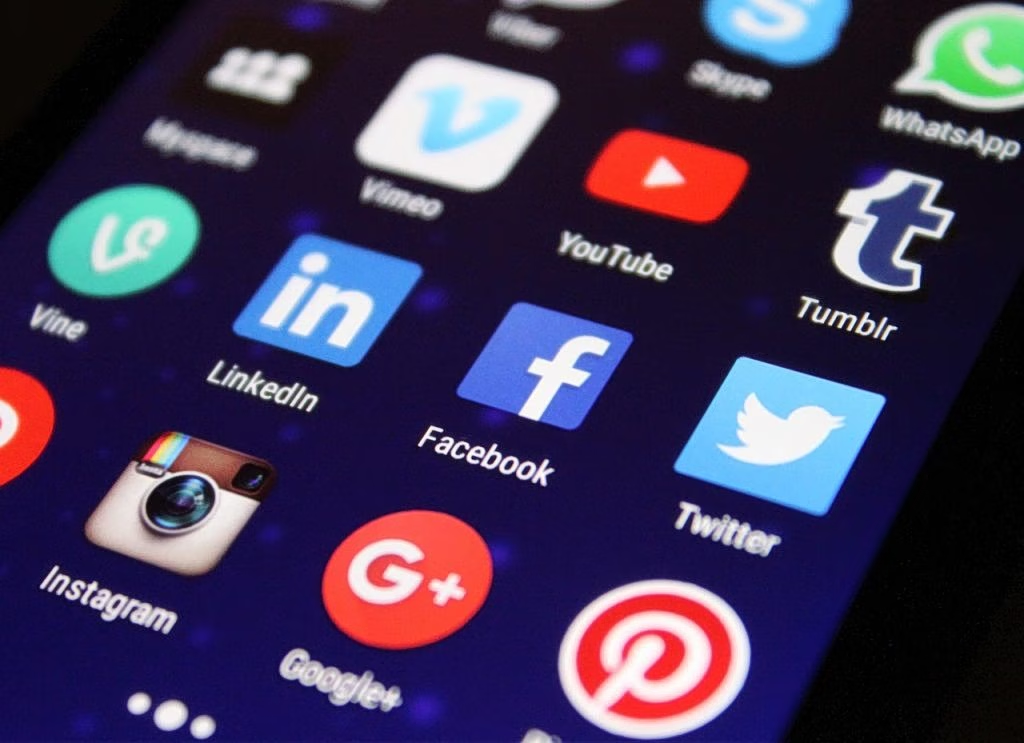
 Greece is pressing ahead with legislation that would bar children under the age of 15 from accessing social media platforms, with a formal rollout set for the start of 2027. Digital Governance Minister Dimitris Papastergiou discussed the details of the policy in an interview this week, shedding light on how the government plans to implement it and the obstacles that could stand in the way.
Speaking on the Greek TV channel MEGA, Papastergiou confirmed that the draft bill has already been submitted to the European Union for a compatibility review with existing EU law, a required procedural step for legislation of this kind. He expects it to clear the Greek Parliament before the summer recess. “Before the summer, the bill passes,” Papastergiou said. “We start on Jan. 1, 2027.”
The delayed implementation date is intentional. Authorities plan to use the intervening months, beginning in September, to inform and educate parents about what the new rules will mean in practice and why their participation will be critical to making the law work.
The Loophole Problem
Papastergiou was candid about the legislation’s most glaring vulnerability: enforcement. He acknowledged that age verification alone won’t be enough if children can simply borrow a parent’s phone to confirm their age and slip through the system. “If the platform asks for age verification and the child picks up mom’s or dad’s phone to confirm, we’ve done nothing,” he said.
To address this, the minister pointed to a parallel track: the development and promotion of specialized devices designed specifically for minors — devices that would block social media access entirely while still allowing general internet use. “The internet is a tool,” he said. “We won’t turn back the clock. But let’s not use social media, at least not until the age of 15.”
Platforms Hold the Key
Papastergiou placed significant responsibility on the social media companies themselves, making clear that the law’s success hinges on their willingness to cooperate. Starting Jan. 1, 2027, platforms would be required to re-verify the age of users whose accounts cannot be confirmed as belonging to an adult.
He was direct about why the government had landed on an outright ban rather than softer measures. “We’ve had many discussions, and we could have gone with milder measures — restrictions rather than bans — if there had been better cooperation,” he said.
He described the road not taken: “If platforms had come forward on their own and said, ‘We’re ensuring verified minor accounts have time limits, we’re disabling infinite scroll, we’re confirming they won’t have access to harmful content,’ we wouldn’t have gotten to a ban.”
The minister acknowledged that psychologists and child development experts have raised concerns about the effectiveness of blanket prohibitions, but argued that the absence of meaningful self-regulation by platforms left the government with few alternatives.
Anonymous Accounts in the Crosshairs
Beyond the social media ban for minors, Papastergiou signaled that anonymous social media accounts are a separate but related concern the government wants to tackle. He argued that online anonymity poses a genuine threat to democratic societies, and said Greece is working to help shape a coordinated European response. The minister however noted that any durable solution would need to be pursued at the EU level, given the bloc’s unified digital market rules. “Democracies have serious problems from the toxicity of online anonymity,” he said. “If we consider this a problem — and we do — we need to find ways to address it.”
He noted that many platforms depend financially on anonymous accounts, making voluntary action on their part unlikely without regulatory pressure from above.