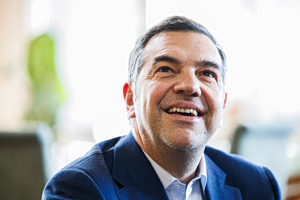
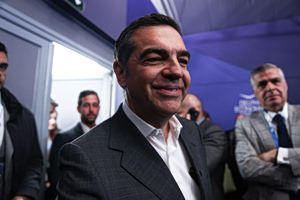
On Tuesday evening, as the sun is starting to set, Alexis Tsipras will walk onto Thisseio Square in central Athens and ask Greeks to believe in him again, as the man best placed to challenge Kyriakos Mitsotakis.
The former prime minister, who governed Greece through some of the most turbulent years in its modern history and took the country to the edge of Grexit, is set to unveil the name of his new political party at 8 p.m., in what his allies are billing as a landmark moment for the Greek left. The party name will be revealed through a specially produced video, with music composed for the occasion by the prominent Greek composer Stamatis Kraounakis. A volunteer team of directors and set designers has been involved in the highly choreographed production. The imagery is deliberate down to the last detail, and so is the venue. Thisseio is an open public square in the shadow of the Acropolis, chosen to project the image of a politics that belongs to everyone rather than to party insiders and the privileged few.
The political weight of the evening will rest on the founding declaration and on Tsipras’s speech, which is expected to contain sharp attacks on his opponents. He is also expected to invite Greeks to sign the declaration, framing the new party not as a top-down political machine but as a call for broad social mobilization. His central message, according to reports, will revolve around the need for “a great democratic and social restart.” Whether Greece is ready to listen is another question entirely.
A line drawn against the entire establishment
The founding declaration will not train its fire exclusively on the ruling New Democracy party. It will also take direct aim at PASOK, arguing that both of Greece’s dominant parties of the post-junta democratic era have become part of a single system of power, with shared political figures, large party debts and deep entanglement with the banking and financial establishment. “They became the system within the system” is the phrase that reportedly encapsulates this positioning.
The declaration has reportedly been built around the concept of a “new patriotism” tied to social justice, democratic accountability and a challenge to what it describes as the unchecked power of economic elites. It frames recent controversies under the current government, including the 2023 Tempi train disaster that killed 57 people, the Predator spyware surveillance scandal and the ongoing OPEKEPE agricultural subsidy fraud case, not as isolated failures but as evidence of a deeper crisis of institutional credibility.
Tsipras’s team is also trying to broaden its appeal well beyond the traditional left. The central concept of the new venture is “We of the New Era,” an emphasis on collective action, social protection and a vision of democracy rooted in citizens’ everyday lives. The invitation is directed not only at traditional left-wing voters but at the broader center-left and at those who have drifted away from political participation altogether.
A government that has decided not to take the bait
Tsipras’s return has not gone unnoticed at New Democracy, with the government of Kyriakos Mitsotakis quietly but deliberately shifting its tone already. Rather than engage aggressively, it has opted for restraint, in an effort to avoid feeding what it expects will be an increasingly toxic political climate in the months ahead.
Government spokesman Pavlos Marinakis signaled the new approach at a recent briefing for political correspondents, dismissing the venture as communication without substance, a personal agenda dressed up as a political party. “The issue is not whether someone switches from Atletico Madrid to Barcelona or changes a jersey,” he said. “People want to hear and see realistic, fully funded policies being implemented.”
The government will wait to see whether Tsipras presents a fully funded policy platform before sharpening its response. What remains unresolved internally, however, is a strategic question: whether New Democracy will elevate Tsipras as its primary political opponent, pushing PASOK leader Nikos Androulakis to the sidelines, or do the opposite. Officials privately acknowledge that Tsipras is not a political unknown seeking electoral recognition for the first time. He has governed for five years.
PASOK: a wait-and-see approach
At PASOK headquarters on Charilaou Trikoupi Street, the mood is one of cautious observation. Party officials are less focused on what Tsipras says tonight than on the public response it generates, which they expect the first opinion polls to measure. They anticipate political reshuffling and harbor no illusions. They also believe the new party will receive favorable treatment from New Democracy’s communications apparatus, which, they argue, prefers Tsipras as an opponent because it allows the ruling party to relitigate his record in government rather than defend its own.
PASOK spokesman Kostas Tsoukalas did not hide his skepticism toward the elaborate staging of tonight’s event. “When you surrender to marketing, it means you are underestimating political substance,” he said. For PASOK, he made clear, the real battle remains ideological and values-based, fought directly against New Democracy. As for any attempt by Tsipras to present himself as a fresh political force while casting PASOK as a spent one, Tsoukalas was unequivocal: it would not go unanswered.