 Μake us preferred on Google
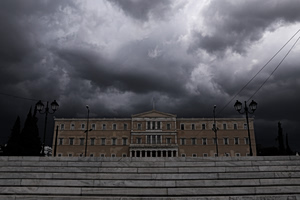
 Barely two weeks have passed since New Democracy’s party conference and the image of unity that the governing party is trying to project is already shattering. Tuesday will be another one of those days for the Greek prime minister, as he attempts to steer his Cabinet through a packed reform agenda while two of his predecessors within New Democracy lob shots from the sidelines, challenging his governing model and the state of the country’s democratic institutions.
Samaras has become increasingly vocal in his attacks on the current leadership, and his latest broadside in parliament last Friday, targeting what he called the “executive state,” a phrase that has become shorthand in Greek political discourse for Mitsotakis’s top-down governing style, is causing visible irritation and discomfort among officials at Maximos Mansion.
Karamanlis, by contrast, prefers a different register. His decision not attend the party congress two weeks ago, spoke volumes. Tuesday evening he is due to speak at 7 p.m. at the Athens Concert Hall, at the presentation of a book on foreign affiars and the new world order co-authored by Konstantinos Arvanitopoulos and Konstantinos Filis. Samaras is also expected to be in the room. The government is bracing for the kind of pointed, carefully worded criticism that Karamanlis prefers to employ: indirect enough to deny, and sharp enough to land. His chosen territory is likely to be geopolitics, Greek- Turkish relations and Greece’s place in a turbulent international order.
According to reports, he will describe the European Union as “awkward” and “absent” from global developments, and express doubt that any new American leadership could restore the kind of strategic defense support Europe has relied on in the past. On Greece’s immediate neighborhood, he will issue a pointed warning against sending “the wrong messages” to Turkey, arguing that while national defense must be strengthened, peace agreements that amount to concessions are dangerous. He will also take aim at the Turkish legislation seeking to formalize the maximalist “Blue Homeland” doctrine into law, a claim to sovereignty over large swaths of the Aegean and Eastern Mediterranean that successive Greek governments have firmly rejected.
At a moment when the domestic debate also centers on rule of law and institutional trust, every word will be parsed. Months ago, he warned that restoring public confidence in political institutions would require “herculean effort,” and cautioned that if ignored, Greece would be “rushing headlong into a first-order political crisis.”
The government’s response has so far been calibrated irritation. Spokesman Pavlos Marinakis pushed back Monday, drawing a pointed distinction between parties built on “an ideological base and a platform of ideas” and those that reduce themselves to “the personal agenda of some individual.” He then added, that he wasn’t refering to the rumored new party by Antonis Samaras but also that he has belonged “since childhood not to the ‘Karamanlis party’ but to New Democracy, founded by Konstantinos Karamanlis” , a reference to Kostas Karamanlis’s late uncle and the party’s founder.
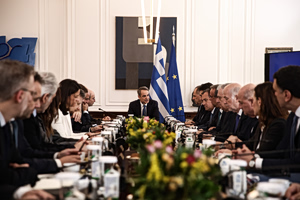
In the midst of all this, Mitsotakis is due to sit down with his Cabinet at 11 a.m. and insist, against the noise, that the government is simply getting on with the job. Ministers are expected to hear updates on a bill transposing a European Union directive on pay transparency between men and women, the state of implementation of Greece’s Recovery Fund, which government sources say is entering its final stretch, and a framework for the new Common Agricultural Policy covering 2028 to 2034. The message to ministers, according to government sources, will be blunt: “You have pending obligations.” Aides say Mitsotakis wants to stay out of direct political confrontations for now, leaving commentary on the broader landscape to party officials, though he is expected to weigh in himself before the end of the week.
The day’s political calendar does not end there. Later Tuesday evening, former Prime Minister Alexis Tsipras is expected to formally launch his new party at an event in Thisseio, a historic neighborhood in central Athens. Tsipras, who led the radical-left Syriza party and governed Greece from 2015 to 2019, is aiming to consolidate left and center-left voters around a new political vehicle ahead of the next general election. For Mitsotakis, it is one more variable in an already crowded political day, a reminder that the pressures on New Democracy are not coming from one direction alone.