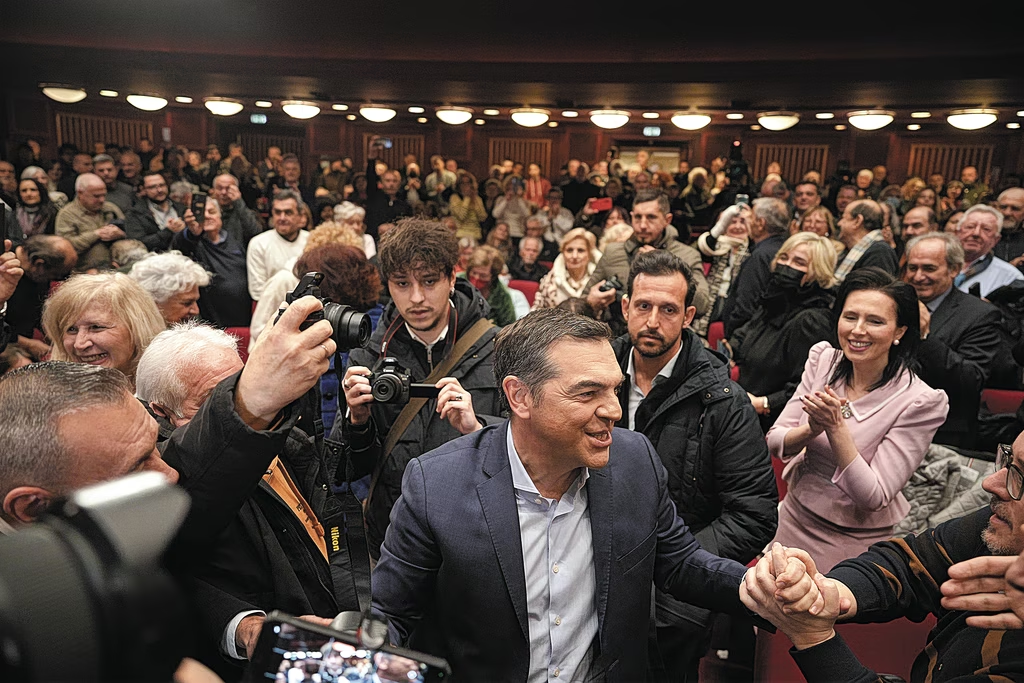
Former prime minister Alexis Tsipras appeared to confirm that he will unveil his new political party on May 26, ending months of speculation over his return to frontline politics and setting the stage for a major realignment on Greece’s center-left.
In a social media post published Monday morning, Tsipras wrote: “Neither early, nor late, now is the time,” accompanying the message with a short video showing two boys wearing sports jerseys bearing the numbers 26 and 5, an apparent reference to the date of the announcement.
The post, the latest in a series of carefully choreographed online messages, effectively confirmed a May 14 report by To Vima that Tsipras was preparing to formally launch his new political movement before the summer.

Over the weekend, the former PM shared a video montage featuring messages from supporters urging him to move forward politically, including comments such as “We are waiting for you, president,” “You are the only hope,” and “Announce it.” Tsipras captioned the post with the phrase: “In March it was too early.”
A day later, he followed with another cryptic message on Facebook. The video showed a hand tapping impatiently on a table, while text on screen read: “In September it will be too late.”
Potential Parliamentary Backing
According to reporting by To Vima, at least 20 current SYRIZA lawmakers are prepared to support Tsipras’ new effort, underscoring the extent to which the former prime minister continues to command influence across the fragmented Greek Left.
The list reportedly includes prominent party figures from SYRIZA such as Olga Gerovasili, as well as sitting MPs from across the country, among them Symeon Kedikoglou, Popi Tsapanidou, Katerina Notopoulou and George Karameros.
Among those mentioned as politically close to the project are SYRIZA spokesperson Konstantinos Zachariadis, Effie Achtsioglou, Alexis Charitsis and potentially even Nasos Iliopoulos from New Left, as well as labor law expert Dionysis Teboneras, former MEP Petros Kokkoalis and former minister Giannis Ragkousis.
The report also points to contacts with mid-ranking figures linked to PASOK, including lawyers Anna Papadopoulou and Antonis Saoulidis, while former ministers and ex-lawmakers are also said to be considering joining the initiative.
Government Watching Closely
Prime Minister Kyriakos Mitsotakis and his team is reportedly treating Tsipras as its most serious potential political rival in an increasingly fluid political landscape.
Officials close to the PM reportedly reject the assumption that a Tsipras-led party would only draw support from the traditional left. Instead, internal analysis suggests the former premier could appeal to disillusioned centrist and moderate conservative voters, constituencies that have underpinned the electoral dominance of New Democracy in recent years.
Polling data from Metron Analysis seem to confirm the administrations assessment. The latest polls show that Tsipras’ prospective party registers positive views or voting intent not only among left-wing voters, but also among respondents identifying as centrists, center-right and right-wing. Among respondents expressing a positive view of the party or an intention to vote for it, 17% identified as centrists, 4% as center-right and 5% as right-wing.
For the government, the numbers carry a more unsettling message than the possible consolidation of the left. What appears to concern the prime minister’s office most is the growing sense that Greece’s political boundaries are no longer holding in the way they once did.
For years, New Democracy relied on a broad coalition stretching from the traditional right to moderate centrists exhausted by the instability and brinkmanship associated with Greece’s crisis era. The fear now is that Alexis Tsipras is beginning to penetrate precisely that middle ground: voters who may not identify with the left, but who appear increasingly open to political realignment.
That prospect is expected to shape the government’s response in the months ahead. Rather than focusing exclusively on pressure from the nationalist right, officials are likely to direct their message toward moderate voters uneasy with confrontation and economic uncertainty. The core argument will be familiar: that a return to Tsipras would not represent renewal, but a step back toward the volatility, polarization and political experimentation of the previous decade.