Every heavy rainfall is now treated as an “extreme phenomenon.” It is not always so. What is extreme is our refusal to accept that water has memory. Experts say it clearly: the most effective flood protection consists of open streams and free floodplains.
In densely built cities, however, where streams are “suffocated” between concrete and asphalt, properly designed flood-control works help, but only up to a point. Streams cannot be tamed with an underground tunnel when rainfall is intense. They overflow and the asphalt becomes a river. Bold decisions are required to free up space for water, along with projects that delay or prevent its flow toward the city.
Torrential waters
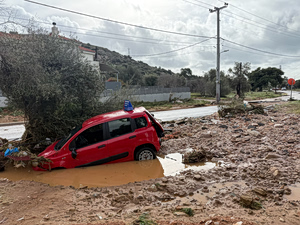
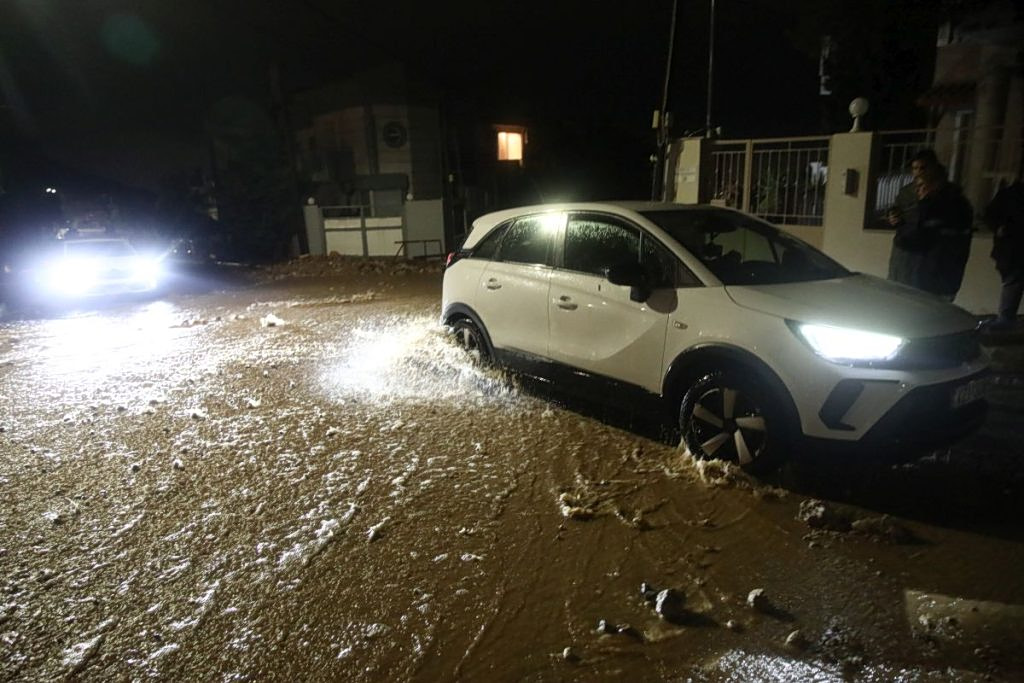
Last week, rivers and streams once again swelled in Attica. Many areas of the Basin were “drowned,” among them Ano Glyfada, where in a newly built area at the foothills of the mountain a 56-year-old woman lost her life after being swept away by torrential waters. As Giorgos Tsakiris, president of the European Water Resources Association and emeritus professor at the National Technical University of Athens, states to To Vima, intense flood phenomena are accompanied by the transport of large volumes of sediment, carried by streams that originate outside the urban fabric and will continue to threaten settlements, as in the case of Glyfada, which flooded during the recent severe weather.
To protect them, according to the professor, a combination of appropriate small-scale works is required, such as small check dams, peripheral ditches, sorting and sediment-retention barriers, so that materials are not transported downstream to residential areas, among others. That is, works that either obstruct the flow or, in some cases, facilitate it. “Concreting streams is not a solution, especially when there is a slope, because floodwaters will be transported at greater speed,” he emphasizes.
The same applies to an asphalted road with a significant slope and without flood-protection infrastructure. “It constitutes a linear element of rapid flood transmission due to its low roughness coefficient (i.e., the resistance encountered by water as it flows over a surface), which is three times lower than that of a natural stream. Essentially, there is no obstacle to the water,” notes Mr. Tsakiris.
He adds: “The high flow velocities observed on residential streets—especially those with steep slopes descending from the mountainous masses of Attica (Hymettus, Penteli, etc.)—are due not only to the volume and speed of runoff, but also to the construction of roads without or with inadequate flood-protection infrastructure, that is, without drains, proper gradients, and transverse sections with grates so that water can enter and be conveyed to flood-control works.”
Without infrastructure
A characteristic example is Kyrillou-Methodiou Street, the road where the 56-year-old woman lost her life in Glyfada. It is a downhill road that begins at the foothills of Mount Hymettus and ends at Agiou Nektariou Street, in front of three houses, which flood every time a torrent forms. “We have lived here for 40 years. When we arrived, Kyrillou-Methodiou Street did not exist. There were plots of land that were later built on, and for the needs of the houses this road was created without the required flood-protection infrastructure. The road ends at houses. One of them is mine. With every cloudburst, including this one, all the water ends up with us. We nearly drowned,” says Ms. Stavroula Mouzouki.
“Bricks came down”
Another long-time resident of the area is Theodoros Filios. “Something similar happened again in 2009, when the forest burned. Then, after the first downpour, all the houses were filled with mud,” he recalls. As he says, this time the rain “brought down” materials from construction sites. “The area is under development; many new houses are being built. So bricks and other materials that had been illegally deposited at the foothills of the mountain ‘came down,’” he points out. The horrific hours experienced on Wednesday night are described by Fratzeskos Divanis, a neighbour of the unfortunate 56-year-old: “What happened on Wednesday was tragic. Within the first 20 minutes after the rain started, the water reached above the knee.”
As for large-scale flood-control projects, according to Mr. Tsakiris, a change in their design philosophy is required “so as to ensure acceptable cross-sections of the works and sufficient storage capacity of the drainage basin to retain water, even temporarily, until the flood subsides.”
Areas in the “red”
The areas along the Kifissos River, especially those near its estuary, are in the “red” zone in the Basin’s flood-risk management plans. After last year’s cleaning of the Kifissos underground channel by the Region of Attica, the situation has improved. However, projects that were planned to be tendered by the Ministry of Infrastructure for the channelization of the open section of the river have been “frozen,” as the Council of State (Supreme Administrative Court) has yet to rule on two applications for annulment. The decision approving the environmental terms of the project for its regulation in the section “Three Bridges upstream of Red Mill to Attiki Odos” has been challenged by the Municipality of Nea Filadelfeia, local residents, and the association “Roi.”
The case that will determine the fate of the projects is being heard, after many postponements, on March 4. As stated by the deputy mayor for Technical Services of the municipality, Eutixia Papalouka, during the recent severe weather the natural sections of the river functioned as relief zones and problems were limited. The proposed regulation, according to the appellants, does not address the root cause of flooding, and they are calling for a combination of small and flexible works, as well as the removal of certain illegal structures that press on the riverbanks.
Works in progress
Judicial obstacles also exist for other projects promoted by the government or the region, such as two of the few streams that still flow freely in Attica, Erasinos and the Great Stream of Rafina. By contrast, in Faliro, at the estuary of the Ilissos River, works to deepen the riverbed and reconstruct three bridges are under way by the Region of Attica and will be completed by next summer.
According to Regional Governor Nikos Hardalias, another 12 projects are under construction in Varkiza (regulation of the Korpi stream), Saronida, Acharnes, Patima Vrilission, Ano Liosia, and elsewhere. Still unresolved is what will happen with the Pikrodafni stream, where entire city blocks are “hanging” inside the streambed.