
 Μake us preferred on Google
 Why do nearly nine out of ten people rely mainly on their right hand? The answer isn’t found in habit or upbringing, but deep within human evolution. A new study published in the journal PLOS Biology argues that right-handedness is the result of millions of years of evolutionary change tied to the growth of the human brain and the shift to walking on two legs.
The research, examined 41 individuals from different species of apes and hominins and compared their traits with those of modern humans. The results showed that, unlike Homo sapiens, most primate species show no clear preference for either the right or left hand.
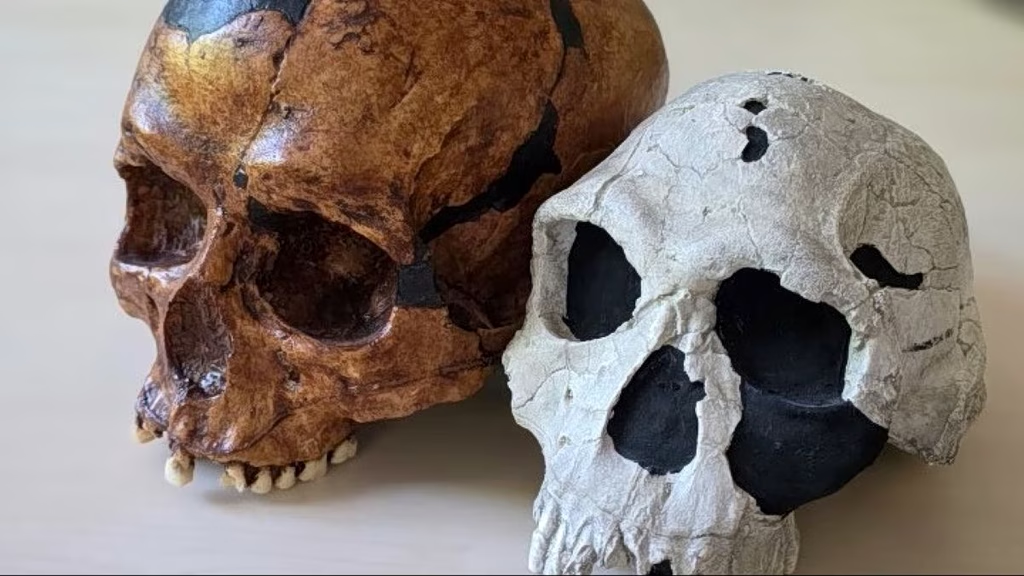
The scientists found that early hominins, such as Ardipithecus and Australopithecus, showed only a mild tendency toward right-hand use, similar to what is seen today in great apes. This preference for the right hand grew stronger in later species, including Homo ergaster, Homo erectus, and Neanderthals, eventually becoming nearly universal in modern humans.

According to the researchers, this shift is closely tied to two key features of human evolution: the growth of brain size and the permanent adoption of upright walking. Once human ancestors began moving steadily on two legs, their hands were no longer needed for movement and became free for other activities, such as making tools, carrying objects, and performing finer motor tasks.
This “freeing” of the upper limbs, according to the study, created strong evolutionary pressure for greater precision in hand movements. The gradual increase in brain size and complexity then reinforced this specialization further, eventually leading to the dominance of right-handedness.
The case of Homo floresiensis, also known as the “Flores Man,” stands out as particularly interesting. Researchers found that this species had a smaller brain and a much weaker preference for the right hand. Its anatomy was suited not only to upright walking but also to climbing, which likely explains why it did not develop the same specialization seen in modern humans.
The scientists describe the evolution of right-handedness as a two-stage process. First, upright walking freed the hands from their role in movement. Then, brain evolution enabled more complex motor functions and cemented the preference for using the right hand.
As Professor Thomas Puschel, one of the study’s authors, points out, the findings suggest that right-handedness is tied to traits that make humans unique. Comparing different primate species allows scientists to distinguish which elements of our behavior are shared inheritance from our ancestors and which evolved exclusively along the human lineage.
The study offers a new explanation for an everyday trait that is often taken for granted, revealing that right-hand preference is not a simple biological quirk but the outcome of a long evolutionary process that began millions of years ago and is directly tied to the development of the human brain, technology, and civilization itself.