On Sunday, September 13, a woman collapsed and died on Klima beach in Aegina despite bystanders’ efforts to save her with CPR. For many on the island, the tragedy felt painfully familiar.
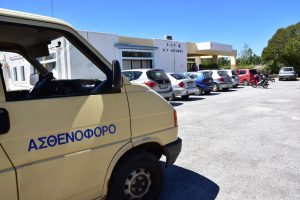
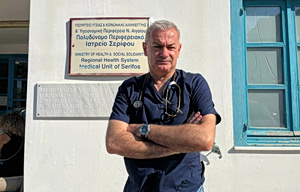
It happened during the height of tourist season, when the island’s chronically understaffed Health Center was stretched to breaking point. According to accounts that have since surfaced, beachgoers who tried to help called the Aegina Health Center, only to be told no ambulance was available. One finally arrived 55 minutes later. By then, the woman had died. The 2nd Health Region, which oversees the facility, later offered an informal explanation: the delay wasn’t due to a missing driver, but to the absence of a second doctor who could stay behind at the Health Center so one of the two on duty could accompany the ambulance.
The same story, one year on
A strikingly similar scene had played out the previous summer. On August 22, 2025, a 79-year-old woman died on a beach on the island; her body was eventually taken to the Health Center with a long delay — not in an ambulance, but in a hearse, again for lack of one being available. A doctor who spoke to in on condition of anonymity, and who has since resigned from the Health Center, described “dismal conditions” there. This summer, he said, operations depended on nurses temporarily reassigned from other facilities to cover the season.
He called inter-hospital transfers a dangerous “sport” on the island: paramedics, he said, often move multi-trauma patients entirely on their own, without assistance, since Aegina has no certified helipad. Serious cases bound for Athens must travel by sea, which becomes especially perilous when winds exceed Force 6.
As for the internal investigation ordered after last year’s incident, the doctor was blunt: colleagues were smeared with accusations of lacking professionalism, effectively scapegoated. “It was for show — a communications exercise to manage the story at the time,” he said. “Nothing was resolved. This summer began with the same gaps. The Health Center still has no complete ambulance shift schedule — thirty eight-hour shifts a month go uncovered.”
The tip of the iceberg
Ambulance staffing, both the doctor and Antonia Dimitroulakou — former president of the Argosaronic Islands’ Primary Education Teachers’ Association and a member of the campaign initiative for the Aegina Health Center — say, is only the most visible symptom of a deeper shortage. Two of the facility’s three doctors have already reached retirement age and continue working under extension arrangements, while the rural-service doctor is perpetually overburdened.
Every permanent medical post advertised for the island has gone unfilled, Dimitroulakou notes. “That’s precisely the health minister’s argument — and it’s a convenient one,” she said. “What’s actually needed is to recruit a whole team of doctors at once. No one wants to come alone to an environment like this. Unless a joint call for applications goes out, these postings will keep coming up empty.”
A year of unheeded warnings
Between last summer’s tragedy and this one, in February 2026, the Athens-Piraeus Union of Hospital Doctors (EINAP) issued another warning to the Ministry of Health. Its board noted that serious shortages had been formally reported for a full year, with complaints raised by both Health Center staff and Aegina residents.
EINAP said officials at the 2nd Health Region and the ministry only engaged with the issue after last summer’s fatal incident, when a patient died on a day and at an hour with no ambulance driver on shift — and that the response then was to shift blame onto the Health Center’s own staff rather than accept political responsibility for the understaffing. The ministry and the Region, the union added, have continued to paper over the problem with stopgap measures — temporary doctor transfers, informally contracted on-call shifts — with no plan to advertise permanent positions. The result, EINAP warned, is substandard public healthcare for both the island’s 15,000 permanent residents and the visitors who multiply that population many times over each summer.
Earlier incidents had already sounded the alarm: a lengthy delay transporting an 83-year-old woman who drowned off an island beach in July 2025, and accident-injured tourists who, for lack of an ambulance, had to be carried to the Health Center in a police patrol car.
Blaming the drivers
After last year’s hearse incident, health authorities’ response was to blame the ambulance drivers themselves, arguing they had been called out and failed to respond, and pushed for a disciplinary investigation into them. But colleagues and residents alike say the real problem isn’t reluctance — it’s exhaustion. Drivers are expected to remain on call 24 hours a day, 365 days a year, without rest days or leave, and have repeatedly stepped in even while officially off duty.
According to Dimitroulakou, the same conditions persist this year, even though the number of drivers has risen from three to four — because, as before, there is no second doctor free to accompany them. Yet, she notes, in the great majority of cases paramedics have long driven ambulances entirely alone, with no doctor present at all. Whatever the official explanation, the recurrence of the problem, year after year, speaks for itself.