Two measures with a direct impact on the finances of households and businesses are among the issues being discussed Wednesday by Greece’s Cabinet.
They concern a new subsidy for diesel fuel and a bill that finalizes the tax cuts and income support measures announced at the Thessaloniki International Fair (TIF).
The economic package affects, among others, self-employed workers, employees, pensioners, farmers, families with three children, businesses and public-sector employees. It will be presented by Minister of National Economy and Finance Kyriakos Pierrakakis and Deputy Ministers Thanos Petralias and Dimitris Markopoulos. The government will also present the “Savings Fund for the New Generation,” which is scheduled to become operational in January 2027.
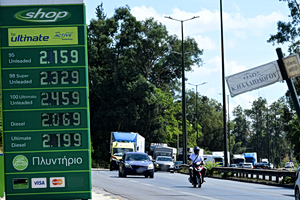
On the fuel front, Wednesday’s announcements are expected to bring an increased government subsidy for diesel, which, combined with the discount provided by refineries, will bring the total reduction to 20 cents per liter for the first half of the month.
For unleaded gasoline, the discount from refineries is expected to continue, while a second round of announcements is scheduled for October 14, 2026, one day before heating oil sales begin.
Opening the Cabinet meeting, Kyriakos Mitsotakis will reiterate that the government’s priority is addressing the rising cost of living, particularly high energy costs. He is expected to outline both immediate measures on fuel and the government’s next steps at the national and European levels.
The Bill
More specifically, the bill containing the tax cuts and income support measures, which is expected to be put out for public consultation in October before being submitted to Parliament, provides for the following:
1. Pensioners. At the end of November 2026, all pensioners over the age of 65 will receive a permanent annual financial benefit, which is being increased by €100 to €400.
2. Self-employed workers. For income earned in 2026 and declared in 2027, the presumptive income used for tax purposes will be reduced for around 156,000 compliant self-employed professionals, as surcharges linked to turnover and employee payroll are abolished. At the same time, the presumptive tax assessment will be reduced by 50% in small settlements with up to 2,000 residents, up from the current threshold of 1,500, excluding settlements in the Attica Region except for the Regional Unit of the Islands. Specifically for Western Macedonia, the threshold will rise to 2,200 residents from 1,700. From the 2027 tax year, the advance tax payment will be reduced from 55% to 50%, while self-employed professionals with three children will benefit from a zero tax rate on income up to €20,000. For taxi operators, the presumptive tax assessment will be reduced in proportion to their ownership stake in the vehicle.
3. Businesses. The business tax, known as the telos epitidevmatos, will begin to be phased out for legal entities from 2027, initially in the regions outside Attica and in Thessaloniki. In Attica, it will be reduced by 50% in 2028 and eliminated in 2029. At the same time, from the 2028 tax year, the advance tax payment will gradually be reduced by five percentage points per year, falling from the current 80% to 50% by 2033.
4. Private-sector employees. Starting April 1, employees in the private sector will see their social security contributions reduced by 0.5 percentage points.
5. Families with three children. From the 2027 tax year, the tax rate will be reduced to zero for families with three children and income of up to €20,000.
6. Public-sector employees. Starting in December 2027, a Christmas bonus of €500 gross will be introduced for public-sector employees.
7. Farmers. From the 2026 tax year, the tax rate will be reduced to zero on income of up to €20,000, while the tax-free threshold will increase by €13,571 to €22,204.
8. Disability benefits. Starting in 2027, disability benefits will be indexed to inflation, affecting 218,000 people, with an average annual benefit of €220.
9. ENFIA property tax. From 2027, the abolition of the ENFIA property tax on primary residences will be extended to another 131 settlements, bringing the total number to 12,855. The exemption will apply to 650,000 owners of primary residences in settlements with up to 2,000 residents, and up to 2,200 residents in Western Macedonia.
10. Homebuyers from third countries. The property transfer tax on home purchases by citizens of third countries will increase from 3% to 15% starting July 1, 2027. The measure does not apply to commercial premises, plots of land or other types of property, and excludes those who fall into categories eligible for a first-home tax exemption.
11. Tax-free tips. The tax-free threshold for tips voluntarily given by customers to employees will increase from €300 per month to €6,000 annually starting with the 2026 tax year.