The wildfire that swept through the Oraiokastro area near Thessaloniki has reignited concerns over Greece’s preparedness to protect industrial zones located close to forests and agricultural land, as experts warn that existing prevention measures and inspection systems remain inadequate.
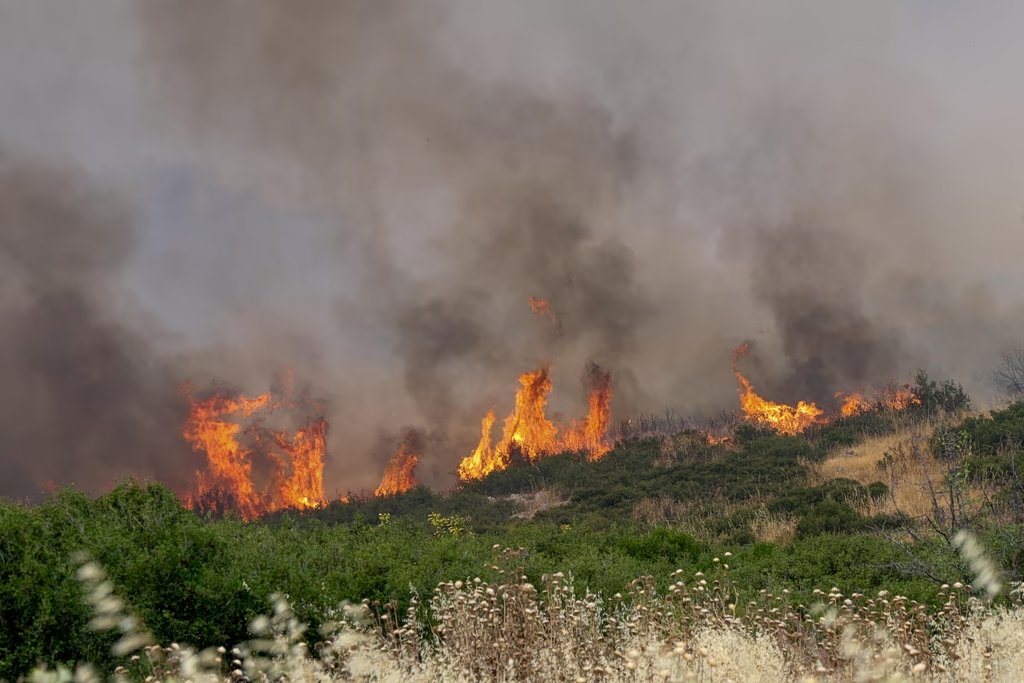
The fire destroyed woodland, damaged homes and businesses, disrupted electricity infrastructure and completely burned down a recycling plant. Authorities have said the blaze began in dry vegetation due to the negligence of a 76-year-old man before spreading through forested areas, residential neighborhoods and eventually into an industrial zone.
Questions over fire prevention measures
According to sources cited in the report, the fenced area surrounding the recycling plant had not been cleared of dry vegetation, while recyclable materials and other combustible items, including textiles, were reportedly stored in exposed outdoor areas.
The nearby stream through which the fire advanced toward the factory was also reportedly overgrown with vegetation, allowing the blaze to spread rapidly.
Throughout the night, explosions were heard from inside the burning facility, highlighting the additional risks posed when wildfires reach industrial sites.
Fire Brigade Commander Vasilis Vathrakogiannis noted that such fires are particularly difficult to combat.
“How can aircraft safely operate over an area where so many residents are present?” he said, describing just one of the operational challenges.
A growing trend of “mixed-zone” fires
According to fire meteorologist Theodoris Giannaros of the FLAME research team at the National Observatory of Athens, so-called “mixed-zone” fires—wildfires that spread from forests or agricultural land into industrial areas—have become increasingly common in recent years.
The report points to several recent examples:
- In July 2023, wildfires in central Greece reached an Air Force ammunition depot.
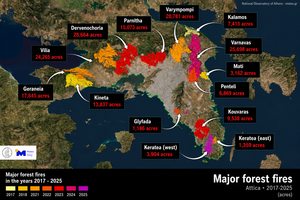
- In August 2024, a wildfire spread into suburban Athens, destroying homes and businesses after moving through an urban stream corridor.
- In August 2025, a major wildfire burned for more than 48 hours before reaching the industrial zone of Patras, destroying a disused factory and a fertilizer warehouse.
Fires have also repeatedly threatened industrial areas around Volos since at least 2022.
Who is responsible for inspections?
Under a joint ministerial decision published in April 2026, industrial property owners are subject to the same obligations as private landowners regarding the clearing of vegetation from their properties.
However, according to Fire Service officials cited in the report, routine inspections focus primarily on a facility’s internal fire safety systems rather than vegetation management.
Checks on whether industrial plots have been properly cleared generally take place only after a complaint has been filed.
Otherwise, responsibility largely falls to municipalities, which are required to conduct random inspections on at least 5% of declared properties between June 16 and October 31 each year.
The regulation states that municipalities should prioritize inspections in high-risk locations, including industrial parks, facilities handling hazardous or flammable materials, areas bordering forests, densely populated neighborhoods, protected natural areas, locations with overhead power lines and places with a history of wildfires.
Despite these priorities, the report argues that the Oraiokastro fire suggests not only the factory site but also nearby land and vegetation corridors may not have been adequately maintained. Responsibility for clearing such areas may lie with municipalities, regional authorities or private landowners, depending on ownership.
Fragmented responsibilities
The report notes that preventing fires from reaching industrial facilities often depends on multiple parties maintaining adjacent land, creating a chain of responsibility that can leave critical gaps.
It cites a July 2024 wildfire that began in an uncleared open area belonging to an abandoned factory before spreading through an overgrown stream corridor and destroying three operating factories. In that case, regional and municipal authorities reportedly disputed which authority was responsible for maintaining the stream.
Municipalities argue they lack sufficient funding, personnel and equipment to carry out both vegetation clearance and extensive inspections, while strained relations between the central government and local authorities have further complicated coordination.
Experts call for a comprehensive strategy
Giannaros says Greece urgently needs a dedicated fire protection plan for industrial zones located near forests and agricultural land.
He argues that facilities should be surrounded by a defensive buffer zone at least 5 to 10 meters wide, free of low vegetation that could allow surface fires to spread into industrial sites.
He also stresses the need for a nationwide mapping of industrial facilities exposed to wildfire risk.
“Otherwise, we’re working blindly,” he said.
Following the mapping process, authorities should assess the vulnerability and risk level of each site before prioritizing protective measures.
Many industrial facilities, he noted, were built near forests long before today’s wildfire risks were understood, making updated protection measures essential.
The report concludes that many experts also support mandatory inspections of vegetation clearance around industrial properties, with Fire Service officials acknowledging that “in general, there is unfortunately no strong culture of safety in these businesses.”