 Μake us preferred on Google
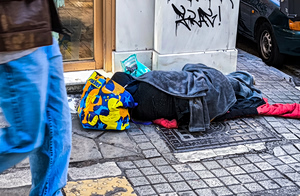
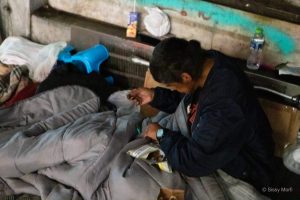
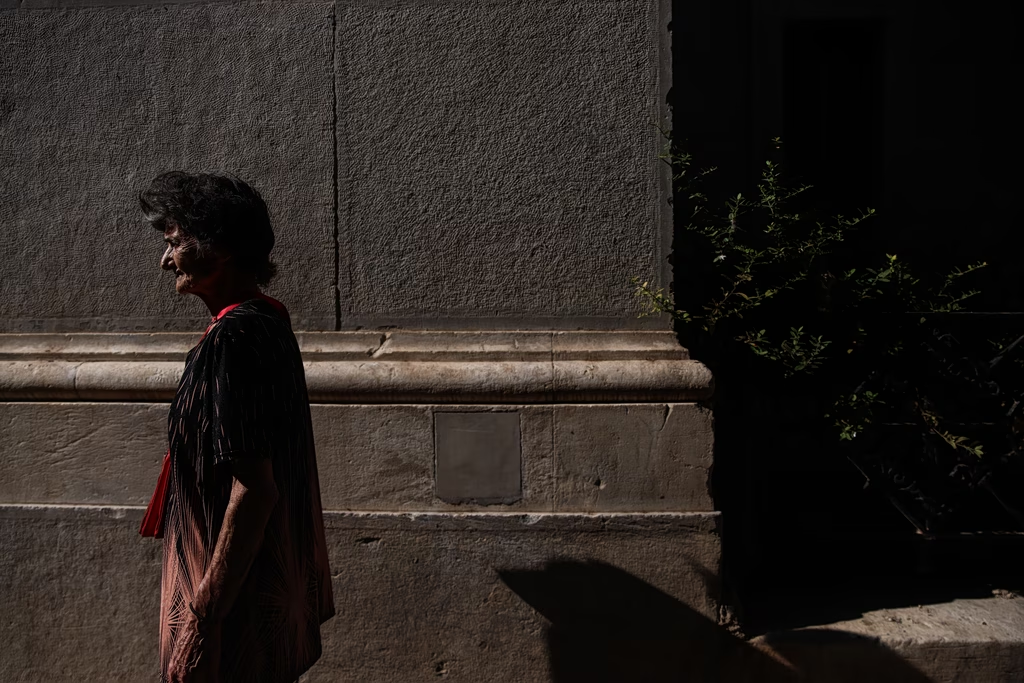
 At 77 years old, a woman identified only as Mrs. D. is living on the street in Athens’ Omonia district, homeless, together with her two dogs. Beside her she keeps a few personal belongings, some bedding, and her two pets.
Last week she was evicted from the home she had been renting after falling behind on three months of rent, according to her own account. Even before ending up on the street, she was already dealing with serious health problems, including partial vision loss from cataracts and breathing difficulties. Her limited eyesight makes even simple daily tasks difficult, to the point that she struggles to use her phone.
Emfasis, a homelessness nonprofit that monitors her situation daily, describes her condition as critical and says she urgently needs a medical evaluation and a safe place to stay.
Surviving on the street
Living on the street brings gradual physical and psychological decline. In Mrs. D.’s case, the weight loss is visible, and the lack of access to a bathroom or running water is wearing down her health day by day. Emfasis describes the first days and weeks of homelessness as a jarring transitional shock, one in which losing a home can feel like losing one’s identity.
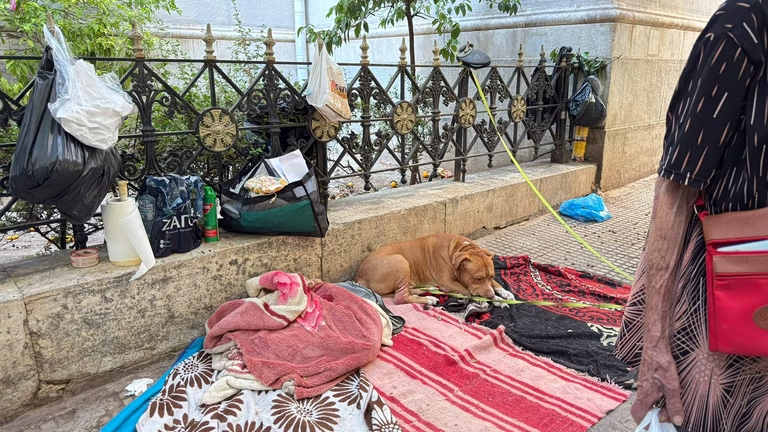
The 77-year-old homeless woman is left with only a few blankets and personal belongings in the Omonia area.
Empfasis notes that a person living on the street enters a state of constant hypervigilance, unable to relax as the brain reads every stimulus as a threat, which leads to profound exhaustion and a lasting sense of insecurity.
Beyond the psychological toll, losing documents, medication, or belongings can trap someone in a maze of bureaucratic obstacles that make it even harder to access benefits, medical care, or housing programs.
“They could kill me at any moment”
The streets around Omonia carry real danger, especially at night, and more so for an elderly homeless woman with limited vision. Residents in the area describe the surroundings near the National Theater as full of people struggling with drug addiction.
Mrs. D. told To Vima that people constantly pass by, especially at night, asking her for drugs, shouting at her, or bothering her dogs. She said fights break out and drug use happens right around her, and that she could be killed at any moment.
Activists with years of experience on homelessness issues say her dogs are the only thing protecting her.
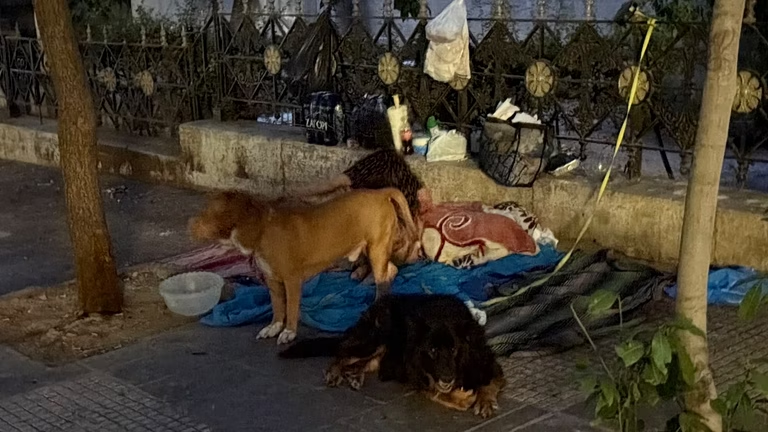
The location of the 77-year-olds temporary stay during the night
What happens to homeless people with pets?
Placing Mrs. D. in a state-run shelter is complicated by the presence of her dogs. According to the City of Athens, homeless shelters do not accept pets. However, the Ministry of Social Cohesion and Family gave To Vima a different account after contact with the office of the Secretary General for Demographic and Housing Policy: there is no explicit legal ban on housing companion animals at homeless shelters, but the current regulatory framework does not provide for specific services or unified standards for caring for them at these facilities, so each case is handled individually depending on available infrastructure and each shelter’s operating rules.
Mrs. D. insists she wants to keep her dogs with her, saying they are her life and she cannot be without them. Maria Karra, co-founder of Emfasis, stresses how important a companion animal is for someone living on the street, describing it as their main source of support, offering safety, purpose, and unconditional acceptance.
The Ministry acknowledged to To Vima that when separating a person from their pet is expected to seriously affect their mental state, officials look for the best possible solution in cooperation with the relevant ministries and agencies.
What the city says
Mina Fountzoula, deputy mayor for social solidarity and urban wildlife and animal welfare at the City of Athens, said officials are aware of the case and are working to resolve it, adding that staff visit Mrs. D. twice a day. Mrs. D. disputes this, saying the city has visited her only two or three times total. She said they promised clothes and shoes that never arrived, and that no one came back after that.
A member of the city’s street outreach team told To Vima they had proposed that Mrs. D. move into the Polydynamo homeless center while her dogs go to the Socrates animal shelter, with daily visits possible between the two since they are near each other. In practice, the two facilities are a 44-minute walk apart, or about 10 minutes by car, raising the question of how a woman with limited vision could make that trip, and whether the city’s already understaffed services could escort or transport her.
“The person should not become a ball tossed back and forth”
Opposition figures at the City of Athens argue that handling such cases requires clear coordination between services and assigning a dedicated social worker. Fotini Leobilla, a sociologist working with the opposition group Athina Psila, led by Kostas Bakoyannis, says the first step should have been a full assessment of Mrs. D.’s needs along with a social and medical evaluation, followed by an individualized solution.
She argues a city social service should take ownership of the case, and that even if it exceeds the city’s capacity, all possible solutions still need to be investigated.
She is calling for more temporary shelter facilities, stronger social services, and cooperation between local government and the relevant ministries, criticizing the current administration for closing temporary shelters rather than expanding them. The goal, she says, should be that the person and their needs are never lost or bounced between one agency and another.
Where responsibility lies
The General Secretariat for Demographic and Housing Policy says that while primary responsibility for identifying, engaging, and directly supporting homeless individuals rests with the relevant municipality, the Ministry of Social Cohesion and Family steps in to coordinate and works directly with municipal social services to find the best solution in each case.
Regarding Mrs. D.’s case specifically, the Secretariat told To Vima it will take whatever initiative is needed, within its authority, to coordinate with the relevant agencies once it has assessed the facts. The stated goal is cooperation between city services, social and health services, the OPEKA welfare agency, and animal protection organizations to reach a sustainable solution for both Mrs. D. and her pets.
The ministry did not offer a specific timeline for how long it typically takes to move someone from initial registration to housing, saying there is no single reliable average, since the pace depends on the individual’s needs, the availability of suitable housing, and each program’s requirements.
For someone already living on the street, though, every night without safe shelter takes an exponential toll on physical and mental health, according to homelessness organizations.
Gaps in the system
Mrs. D.’s case exposes the limits of a system that works more effectively for people who can adapt to its requirements, and less effectively for those with more complex needs. Emfasis describes enormous institutional gaps, particularly when health issues, limited independence, and pets all come together in a single case. In informal conversations, government officials have acknowledged these systemic shortcomings.
“I want a home to move into right away. To live like a human being,” remains Mrs. D.’s request.