At a time of renewed geopolitical tensions in Europe, civil protection and security infrastructure have returned to the spotlight, a development that has also piqued public interest into the hundreds of air-raid shelters in Greece dating from World War II and the Cold War.
One underground facility in central Athens, in fact, stands out for its scale and military origins.
The military shelter beneath Lycabettus Hill, near the grotto chapel of Agios (St.) Isidoros, is a large underground complex built into the limestone rock of the prominent hill. Constructed around 1936, ahead of World War II, it served as the headquarters of Greece’s air defense.
Unlike the basements of apartment buildings and smaller public shelters that were built in Athens, the Lycabettus facility was designed to military specifications.
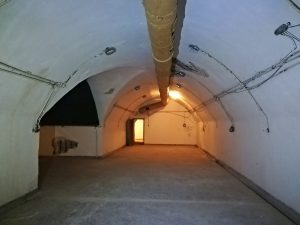
The complex extends deep beneath the surface and is protected by the surrounding rock, reinforced concrete structures and heavy sealed metal doors. Its design reflects the defensive requirements of an era when air raids posed a major threat to the Greek capital.
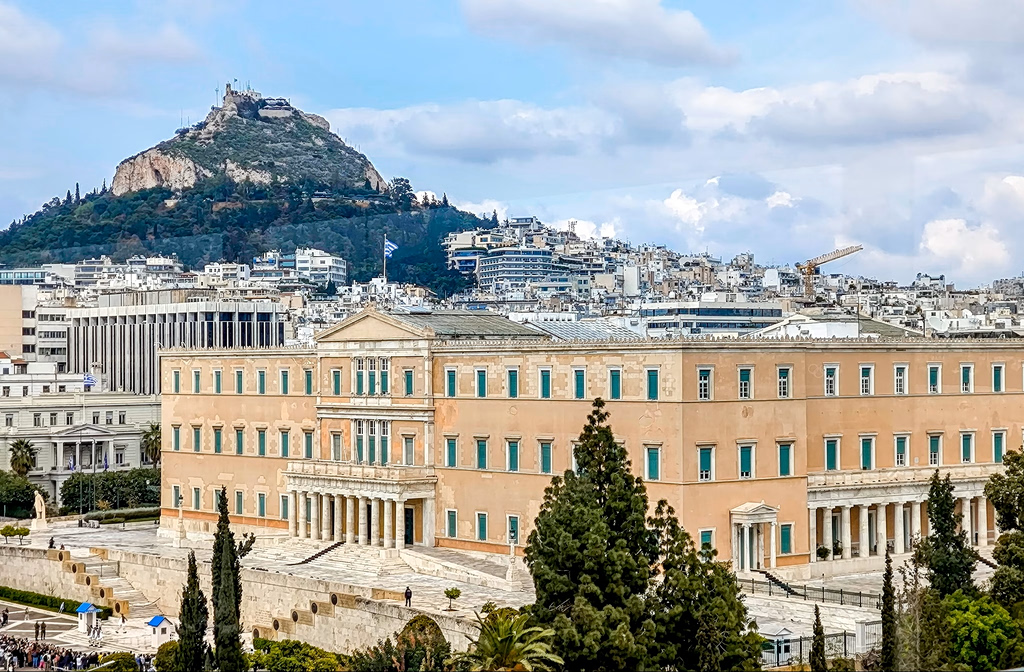
Lycabettus Hill, in the background to the left, with the Parliament Building in the foreground, in central Athens.
Built For Extended Emergencies
The facility includes multiple rooms and corridors, ventilation systems, water tanks, toilets and bathing facilities, as well as telecommunications and power infrastructure.
These features were intended to allow personnel to remain underground during an emergency and maintain essential functions for an extended period.
Its ability to withstand a modern attack, however, is more difficult to assess. The protection provided by any underground shelter depends on factors including its depth, construction and the geological characteristics of the surrounding terrain.
The combination of natural rock and reinforced construction provides substantial protection against the effects of explosions at the surface. At the same time, modern weapons include specialized systems designed to penetrate hardened structures, meaning no underground facility can be described as absolutely impervious to attack.
The Lycabettus shelter’s principal defensive characteristic is therefore its location deep inside the hill, where the surrounding rock provides an additional layer of protection beyond the facility’s structural defenses.
The installation also illustrates the extent to which Athens’ civil and military infrastructure was shaped by the security concerns of the era. Its construction in the 1930s reflected preparations for a potential major conflict that would soon become reality with World War II.
Today, the shelter falls under the civil emergency planning structure of the ministry of citizen protection (public order). It remains largely unseen beneath central Athens, a fortified remnant of an earlier era of military planning and civil defense.