The lawyer and close friend of Greek singer Giorgos Mazonakis said Thursday that the singer had no known health problems, as authorities continued investigating the circumstances of his sudden death during a medical procedure at a private practice in Athens.
Charalambos Lykoudis told Greek television station ANT1 that he had seen Mazonakis about a week before his death and had not noticed anything that caused concern.
“He had absolutely no health problem,” Lykoudis said.
He added that Mazonakis’ personal doctor and godfather, Dr. Zafeiriou, who had known the singer for many years, would have the most complete picture of his medical history. Asked specifically about possible heart problems, Lykoudis said that, to his knowledge, Mazonakis had no such condition.
Family considering legal action
Lykoudis said any legal action following the singer’s death would be decided exclusively by his family.
He said he would contact the family to discuss the next steps, including the possibility of appointing a technical adviser to assist with the investigation into the circumstances of the death.
“The family can exercise its procedural rights. I will contact them today,” he said, adding that different legal representation could also be considered.
The family will ultimately decide whether to appoint a technical adviser and what other actions to take, Lykoudis said.
“We should not leave any responsibilities without investigating them,” he added.
Doctor says Mazonakis appeared unwell
Authorities are meanwhile investigating the events surrounding Mazonakis’ death on Wednesday at a private medical practice in Athens’ Kolonaki neighborhood, where he was undergoing plasmapheresis.
The two doctors who operate and own the practice were at the facility Thursday in the presence of a prosecutor, police officers and a special team from the Hellenic Police’s organized crime division. They were asked to indicate the different areas of the practice as the on-site investigation continued.
About 10 police officers were also at the practice, while a specialized team examined digital devices and other evidence. Representatives of the Athens Medical Association were also present.
The two doctors had previously given lengthy statements to police and were released pending a decision on how the case would proceed.
According to the female doctor’s statement to police, she spoke with Mazonakis by phone Tuesday afternoon, when he told her he wanted to visit her practice. She said she had last seen him in 2021, when she had provided him with hydrotherapy.
She said Mazonakis arrived at around 7 p.m. Tuesday and that “he was not in good shape” and did not have clear speech. According to her account, he told her he was struggling to meet his professional obligations and asked for her advice and help.
After an initial examination, the doctor said she found that his body was significantly burdened. When Mazonakis asked what he could do immediately because of his professional commitments, she recommended plasmapheresis, saying that it could quickly remove toxic substances from the blood.
The doctor said she told him that the machine had no side effects or contraindications.
The two agreed to carry out the procedure the following day, Wednesday, September 9.
Sudden drop in blood pressure and oxygen
According to the doctor’s statement, Mazonakis returned to the practice Wednesday and again did not have clear speech. He said he had not slept and was in a state of hyperstimulation.
When the procedure began, she said, his vital signs were normal. She inserted a venous catheter into his right arm. When she attempted to place a second catheter in his left arm, however, she said she observed a sudden drop in his blood pressure and oxygen saturation.
The doctor and her husband began performing CPR and called Greece’s emergency medical service, EKAV. She told police that Mazonakis was still alive when the ambulance arrived.
Police investigate possible offenses
The Hellenic Police’s Athens Security Subdivision is leading the investigation into the circumstances of the death and the preparation of the case file, assisted by officers from the Directorate for Combating Organized Crime.
Authorities are examining whether any criminal offenses may be connected to Mazonakis’ death.
A search of the medical practice was conducted after the singer died, and the investigation continued Thursday with the two doctors present alongside a prosecutor and police officers.
Authorities are also expected to take statements from other people who came into contact with Mazonakis before he arrived at the practice, while he was there and during his transfer to Elpis Hospital.
The forensic examination of Mazonakis’ body is expected to provide crucial information about the circumstances and cause of his death.
Questions over plasmapheresis procedure
One of the main questions for investigators is whether the plasmapheresis procedure Mazonakis underwent was performed in accordance with the applicable rules.
The report says plasmapheresis as a treatment intended for rejuvenation is generally performed by a hematologist at a public hospital rather than at an ordinary private medical practice.
Authorities are examining whether a complete medical history was taken, whether potential risks associated with underlying conditions were documented and whether all required procedures were followed.
Giorgos Patoulis, president of the Athens Medical Association, said the practice was licensed as an internal medicine office and that its file with the association listed an internist and a doctor without a specialty.
He said the practice’s operating license “in no way” authorized it to perform plasmapheresis.
Patoulis described plasmapheresis as a highly specialized medical procedure requiring significant infrastructure and specialized medical personnel. He explained that blood is removed from the body, the blood cells are separated from the plasma, the plasma is processed and the blood is then returned to the body.
He also stressed that the procedure requires a complete medical history and appropriate infrastructure to deal with possible complications.
Doctors’ lawyer rejects allegations of illegality
After the two doctors gave their statements, their lawyer, Nikos Agapinos, said the key issue was whether a connection exists between Mazonakis’ death and the medical procedure.
“The forensic examination will show whether there is,” he said, arguing that if no such connection is established, then, according to the doctors’ position, there would be no criminal liability.
Agapinos also said the equipment had been legally declared to the Athens Medical Association and that “there is nothing hidden.” He maintained that there was nothing illegal about the practice or its operation and that everything had been done lawfully, pending the outcome of the investigation.
The owner of the practice, the male doctor, had reportedly told police that he had no involvement in the operation of the clinic and that his wife managed it, cared for patients, performed treatments and monitored their health.
Authorities are examining those claims. The two doctors were released temporarily after giving their statements.
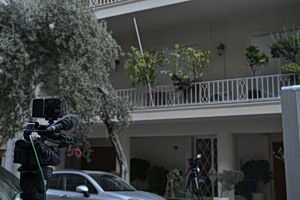
Police also remain outside Mazonakis’ home in Voula, where members of the public have left flowers and farewell messages. The residence is expected to be searched as part of the investigation once the competent prosecutor grants permission.