 Μake us preferred on Google
PARIS—Protests against the cost of living got under way across France on Saturday for a second consecutive weekend, with authorities deploying tens of thousands of police officers to prevent a repeat of last week’s widespread rioting and looting.
By 1 p.m., an estimated 35,000 people had joined protests nationwide, down from 60,000 at the same time last Saturday, but soon swelled over the course of the afternoon. Police had made 135 arrests, but there had been “no major incidents so far,” Interior Minister Laurent Nuñez said.
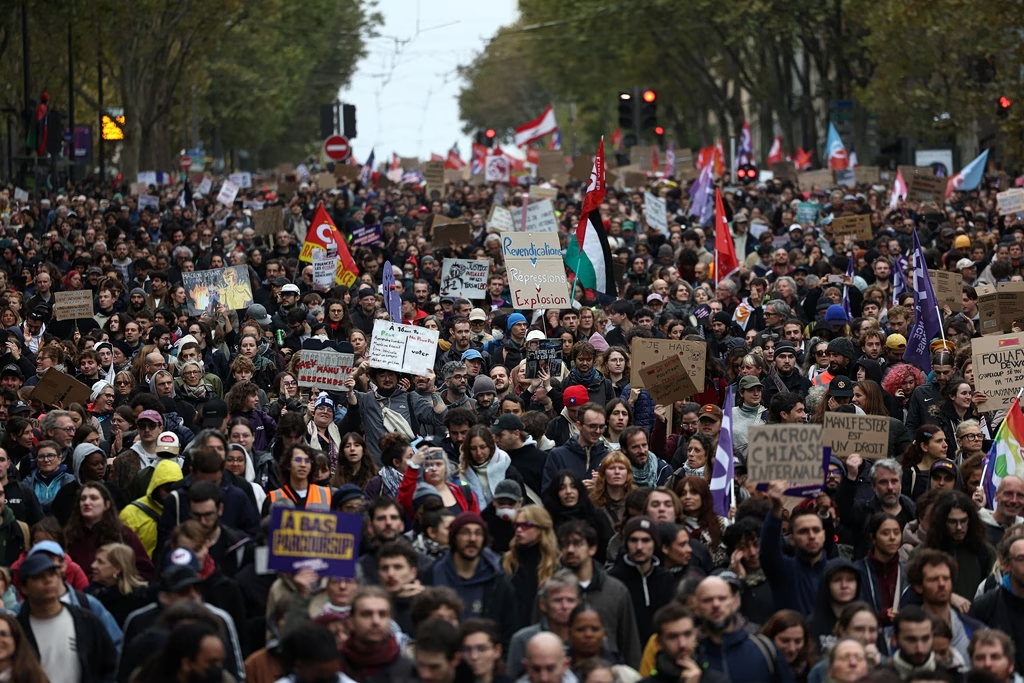
In Paris, thousands of protesters formed a large procession that set off from Porte d’Italie, on the southern edge of the city. Shops across the city were boarded up amid fears of fresh violence, while the Louvre and other major museums closed for the day.
In Lyon, police fired tear gas to disperse dozens of demonstrators near an area of the city center where protests had been banned. Police also fired tear gas during skirmishes with protesters in Lille, Nice, Rennes and Dijon.
The government deployed 70,000 police and gendarmes nationwide, 10,000 more than last weekend, backed by armored vehicles, water cannons and drones. Soldiers were also deployed to guard sensitive sites, freeing up police to respond to unrest.
“We know there will probably be various groups trying to provoke incidents, whether by looting shops or targeting institutions and security forces,” Nuñez told police officers in Paris. “We must be absolutely uncompromising and extremely responsive.”
Saturday’s protests pose a fresh test for President Emmanuel Macron’s government, which has come under fire from both sides of the political spectrum for its handling of the violence. Officials have acknowledged underestimating the scale of the demonstrations and deploying police forces that were too static to contain the unrest. The government has since imposed curfews in several cities, helping restore relative calm.
The demonstrations Saturday drew high-school and university students, trade unionists and members of the gilets jaunes , or yellow vest, movement , which has listed more than 800 planned actions across France, from street marches to gatherings at traffic circles and highway toll booths.
In Paris, authorities banned a yellow-vest march that would have passed through Place de la République and some of the capital’s main shopping boulevards. Police initially approved a separate union-organized march, but reversed that decision on Friday evening, citing fears of violence. They instead authorized a route along the city’s eastern and southern outskirts, which unions agreed to follow after losing a court challenge.
In Marseille, where more than 300 shops were looted, authorities initially banned all demonstrations before allowing a union-led march along a designated route. In Limoges, where rioters set fire to the town hall, gatherings of more than 10 people have been prohibited in the city center, while Saint-Étienne has banned groups of more than five. Some local authorities have also imposed restrictions on the sale and transport of gasoline and fireworks.
The restrictions on marches in France have sparked a backlash from opposition parties and civil liberties groups, which accused Macron’s government of undermining the right to protest.
“Civil liberties cannot be an adjustment variable for a failing government,” Jean-Luc Mélenchon’s far-left France Unbowed party said, warning that the bans risked fueling further unrest.
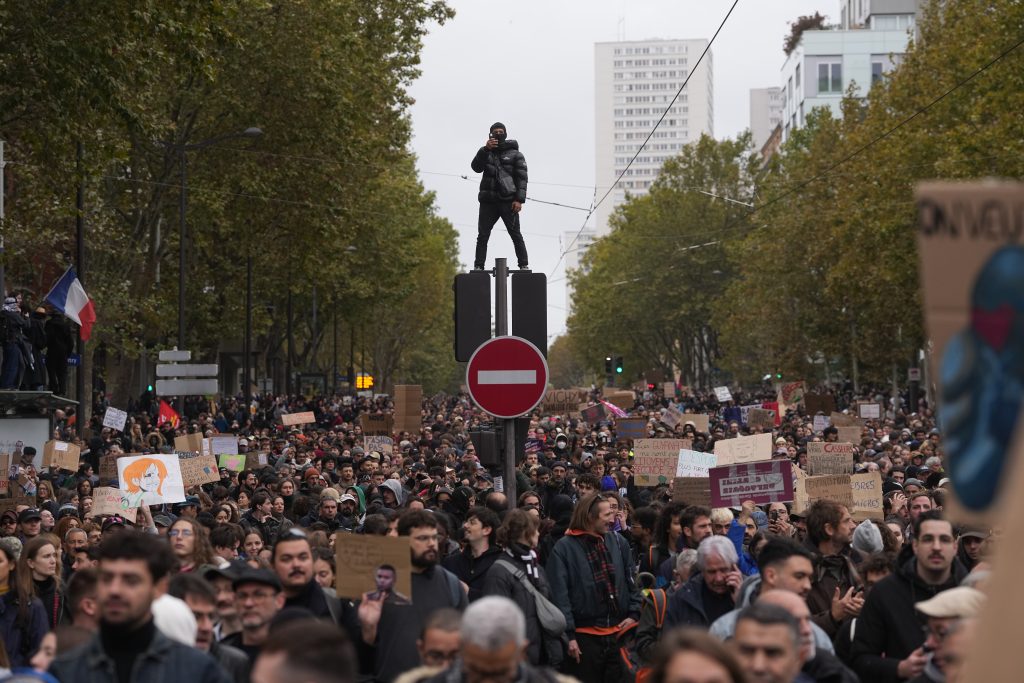
Protesters march during a demonstration against rising living costs in Paris, Saturday, Oct. 24, 2026. (AP Photo/Thibault Camus)
In Italy, authorities also stepped up security in Milan, Rome and other cities to ward off the sporadic looting that accompanied similar protests last weekend. Luxury stores boarded up their windows with plywood while law enforcement conducted identity checks at train stations and other locations.
The wave of protests sweeping France began last month with high-school students demanding more teachers, better facilities and improved learning conditions, before growing into a broader movement against the rising cost of living and deteriorating public services . Last Saturday’s demonstrations drew about 550,000 people nationwide, according to the government, but were marred by widespread rioting and looting that left nearly 1,000 police officers and gendarmes injured.
The government has blamed radical far-left groups for much of the violence, accusing militants of attacking police and public buildings while opportunistic looters took advantage of the unrest to ransack shops. Officials have also raised concerns about the role of social media in spreading calls for violence and looting, meeting with representatives from Meta Platforms , TikTok, Snapchat and other platforms this week.
The unrest comes at a precarious moment for Macron’s government, which lacks a parliamentary majority and is struggling to rein in France’s mounting debt. French borrowing costs, already among the highest of Europe’s major economies, rose again this week, with the yield on benchmark 10-year government bonds briefly topping 5% for the first time in more than two decades.
Opposition parties have seized on the unrest to attack Macron’s government. Left-wing leaders accuse the government of ignoring the protesters’ demands and relying too heavily on policing, while the right has denounced its failure to maintain order. Marine Le Pen, leader of the far-right National Rally, said this week that the government had lost its grip on the country.
Write to Nick Kostov at nick.kostov@dowjones.com