
 Μake us preferred on Google
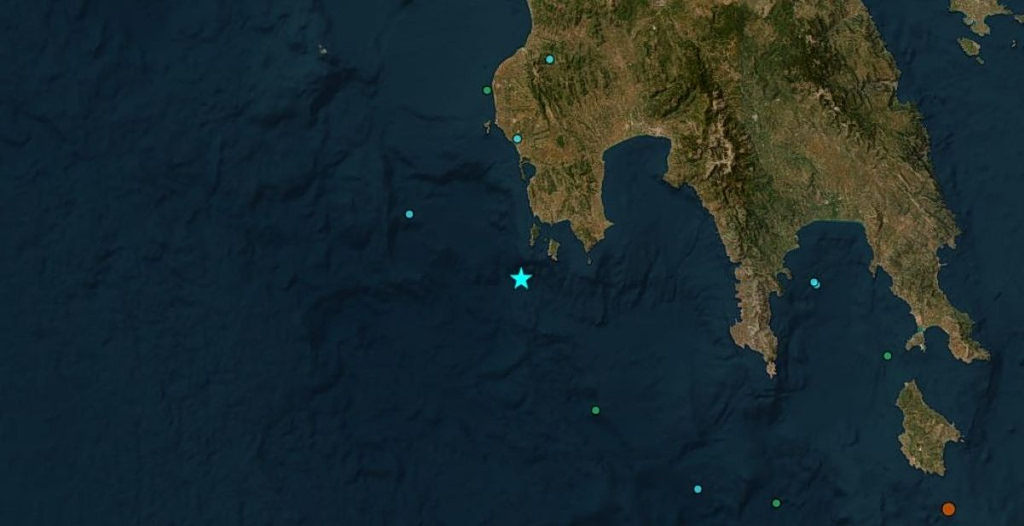
 A strong earthquake measuring 5.3 on the Richter scale rattled the wider region of Messinia in the southwest Peloponnese on Sunday night, raising questions about whether the tremor was the main seismic event or the beginning of a broader sequence. Although the quake was widely felt across the Peloponnese and lightly in Attica, early assessments from Greece’s leading seismic institutes indicate that the event falls within the expected activity of the Hellenic arc- one of the most seismically active zones in Europe.
According to the Geodynamic Institute, the earthquake struck at a shallow depth of nine kilometers in the offshore area southwest of Methoni, a region with a long history of powerful seismic events. Research Director Athanasios Ganas described the tremor to news agency AMNA as “typical” for the southwestern segment of the arc and emphasized that authorities will need to monitor aftershock activity through Monday to determine whether the event was indeed the main shock .
Vasilis Karastathis, Director at the National Observatory of Athens, noted that earthquakes of this magnitude occur relatively frequently in the area due to its proximity to the arc’s subduction zone. He pointed to major historical events — including the 6.7‑magnitude earthquake of February 2008 and an even stronger tremor recorded in 1947 — as evidence of the region’s significant seismic potential. While urging calm, he stressed that early indications do not suggest cause for heightened concern, though caution is always warranted when a new sequence begins.
Local authorities reported no damage. The mayor of Pylos–Nestoros, Panagiotis Karvelas, said the tremor was “intense but brief,” causing momentary alarm among residents before calm was restored. He was near the epicentral area at the time of the quake and confirmed that no incidents or structural impacts had been recorded so far.
Seismologist Gerasimos Papadopoulos described the quake as strongly felt across the Peloponnese, with reports of shaking lasting up to ten seconds in some areas. He noted that it is still too early to determine whether the tremor was the main event, reminding that the region’s most recent major earthquake (in 2008) reached magnitude 6.6. Continuous monitoring of aftershocks will be key in assessing the evolution of the sequence .
Authorities and scientific teams will continue to analyze data throughout the day as residents remain alert but reassured by early expert assessments.