New wildfires erupted across Greece on Wednesday, stretching firefighting resources just one day after dozens of mostly low vegetation fires prompted heightened emergency operations in several parts of the country, underscoring the mounting pressure of this year’s wildfire season.
The most significant new blaze broke out near the village of Latas in central Evia (Euboea), Greece’s second-largest island, where a wildfire burning in an agricultural and semi-forested area triggered a large-scale response. The fire brigade deployed 45 firefighters, 13 engines and a specialized ground team, supported by five firefighting aircraft and one helicopter conducting continuous water drops.
⚠️ Ενεργοποίηση 1️⃣1️⃣2️⃣
🆘 Πυρκαγιά στην περιοχή σας
‼️ Αν βρίσκεστε στο βόρειο τμήμα της #Σουρωτής της Περιφερειακής Ενότητας #Θεσσαλονίκης απομακρυνθείτε προς #Βασιλικά
‼️ Ακολουθείτε τις οδηγίες των Αρχών
ℹ️ https://t.co/GY26GrlKvl@pyrosvestiki@hellenicpolice
— 112 Greece (@112Greece) July 15, 2026
In northern Greece, another wildfire erupted at about 4 p.m. local time in an agricultural and forested area near Souroti, southeast of Thessaloniki. Twenty-one firefighters with eight engines, assisted by two helicopters and municipal water tankers from the municipality of Thermi, were deployed to contain the blaze.
A separate wildfire later broke out in an agricultural area near Perea, southeast of Thessaloniki and close to the Thermaikos (Thermaic) Gulf coast.
Later in the day, a new wildfire also broke out near Thessaloniki, burning through low vegetation close to the Gallikos River near Neochorouda, in Oreokastro municipality, northwest of the city.
The fire erupted shortly before 6 p.m. local time, prompting a major response.
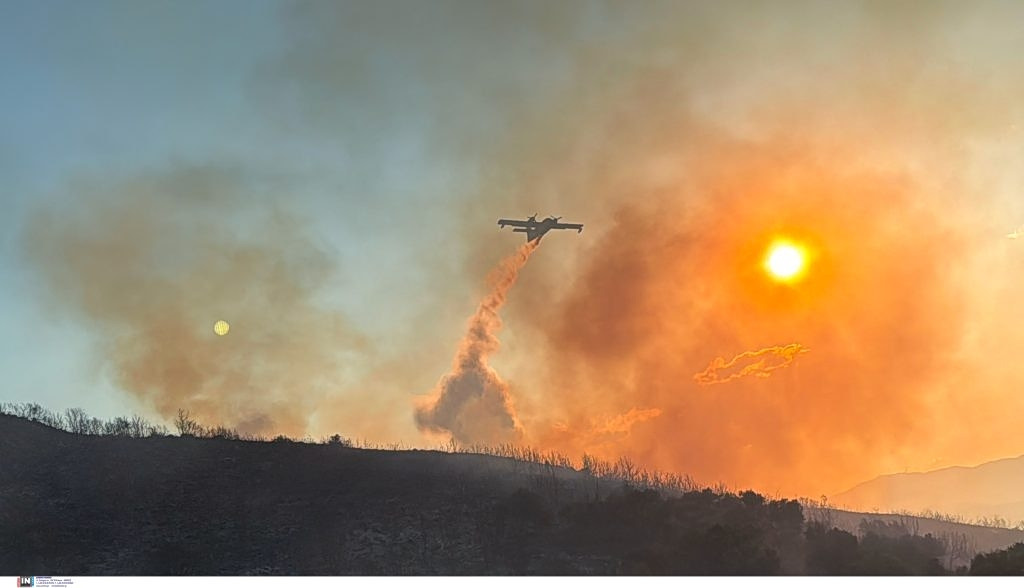
Because scattered homes lie near the blaze, authorities issued a 112 emergency alert at 6:22 p.m. urging residents to remain vigilant. An arson investigation unit was dispatched to determine the cause.
On Crete, firefighters continued battling a wildfire that broke out Wednesday afternoon between the villages of Melidochori and Genna in the Gortyna municipality, in the Irakleio (Heraklion) prefecture. The operation involved 44 firefighters, 16 fire engines, two specialized ground teams, volunteers and two helicopters. Strong winds funneling through a nearby gorge complicated aerial firefighting operations.
⚠️ Ενεργοποίηση 1️⃣1️⃣2️⃣
🆘 Δασική πυρκαγιά στην περιοχή σας
‼️ Αν βρίσκεστε στις περιοχές #Μελιδοχώρι και #Βοριάς #Ηρακλείου απομακρυνθείτε προς #Χαράκι και #Δαμάνια
‼️ Ακολουθείτε τις οδηγίες των Αρχών
ℹ️ https://t.co/GY26GrlKvl@pyrosvestiki@hellenicpolice
— 112 Greece (@112Greece) July 15, 2026
Authorities also activated the 112 emergency alert system, instructing residents of Melidochori and Voria to evacuate toward Charaki and Damania. Crete was under a Category 4 (very high) wildfire risk warning on Wednesday, and a fire brigade arson investigation team was sent to the scene.
The latest outbreaks followed an exceptionally demanding previous day, when firefighters responded to dozens of wildfires nationwide, including a handful of major incidents that required extensive aerial support and precautionary evacuations.
Meteorological conditions have kept much of the country under elevated wildfire danger, with civil protection authorities maintaining heightened readiness and urging the public to avoid activities that could ignite fires.
Greece has expanded its operational readiness for 2026, deploying additional firefighters, aircraft, specialized ground teams and surveillance resources before the peak summer period. Authorities have repeatedly stressed that rapid initial attack remains the cornerstone of the country’s wildfire strategy, aiming to contain new ignitions before they develop into large-scale blazes.