 Μake us preferred on Google
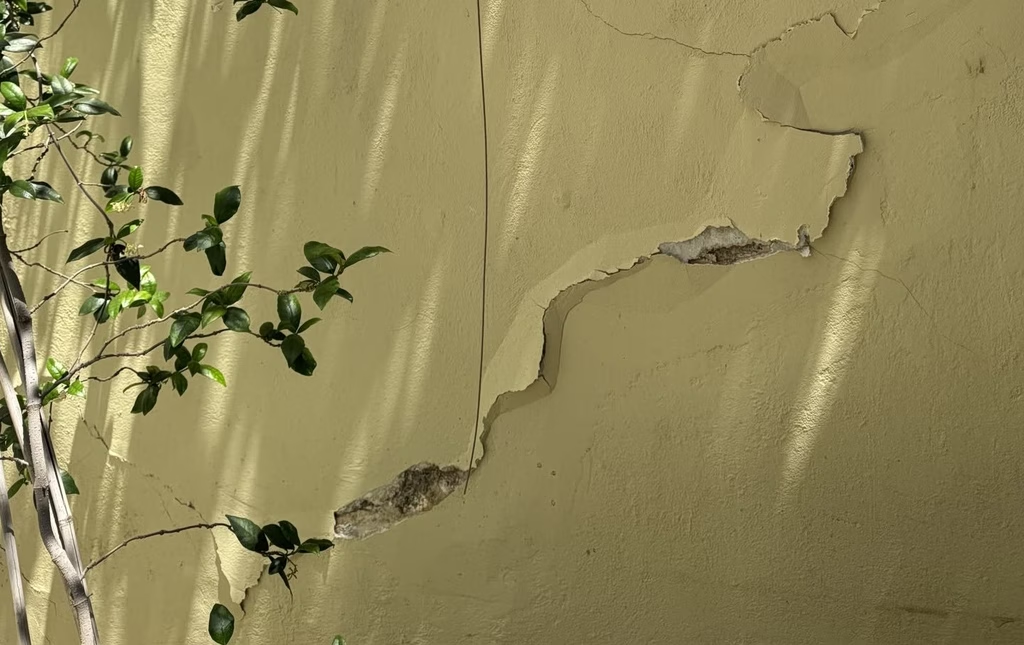
 On Wednesday, many residents in Kypseli neighborhood reported damage to their homes in the form of cracks, ground subsidence and structural damage.
The problems, they note, began while the tunnel boring machine was digging beneath the ground between the Kypseli Square station and Evelpidon street, and the recent building collapse in Petralona turned their worry into outright dread.
As of Wednesday afternoon, damage has already been recorded in around 200 apartment buildings with 20 having suffered serious damage.
The situation has driven many residents to abandon their homes, as the visible state of the buildings has left them feeling unsafe.
According to Kostas Spyrakos, professor emeritus of earthquake resistant construction at the National Technical University of Athens (NTUA), speaking to “To Vima”, there is a serious possibility that damage has developed even in the foundations of apartment buildings in Kypseli because of the construction work on Metro Line 4,
“Before the metro starts work in an area, it defines a zone of influence. That means it monitors, using various instruments, the buildings located within that zone throughout the works. It also enters homes before work begins, takes photographs, and records the existing condition, so that if damage does occur, it can determine whether it was caused by the metro construction,” he explains.
“The Settling Hasn’t Finished”
According to Spyrakos, in the case of Kypseli, the work on Line 4 has caused ground settling, which began once construction started and continues as the work progresses. “This settling,” he clarifies, “unfolds over a period of time and may not be finished yet. That depends on the subsoil, meaning what lies beneath the foundation. If, for example, the subsoil is clay with a high water table, the settling can continue for a long time. If it’s rocky ground, it settles much faster.”
“We Have Buildings With Reduced Strength”
The professor stresses that this settling has caused damage to masonry and non load bearing elements. “It is very likely,” he notes, “that damage has also developed in the columns, beams, slabs, and foundations. Because of this damage, the building’s original strength has been reduced.”
To properly assess the damage, he continues, a visual inspection is not enough. Checks must also be carried out with specialized instruments. “The metro authority needs to hand over the settling data it has measured to the engineers who will assess the structural adequacy of the buildings, so the building’s resistance to a possible earthquake can be calculated, since the structure now has less strength than it did before the damage. We have buildings with reduced strength.
Resident’s Express Fears Over Construction
Alexandros Koutroularis, a Kypseli resident, describes their daily life in stark terms.
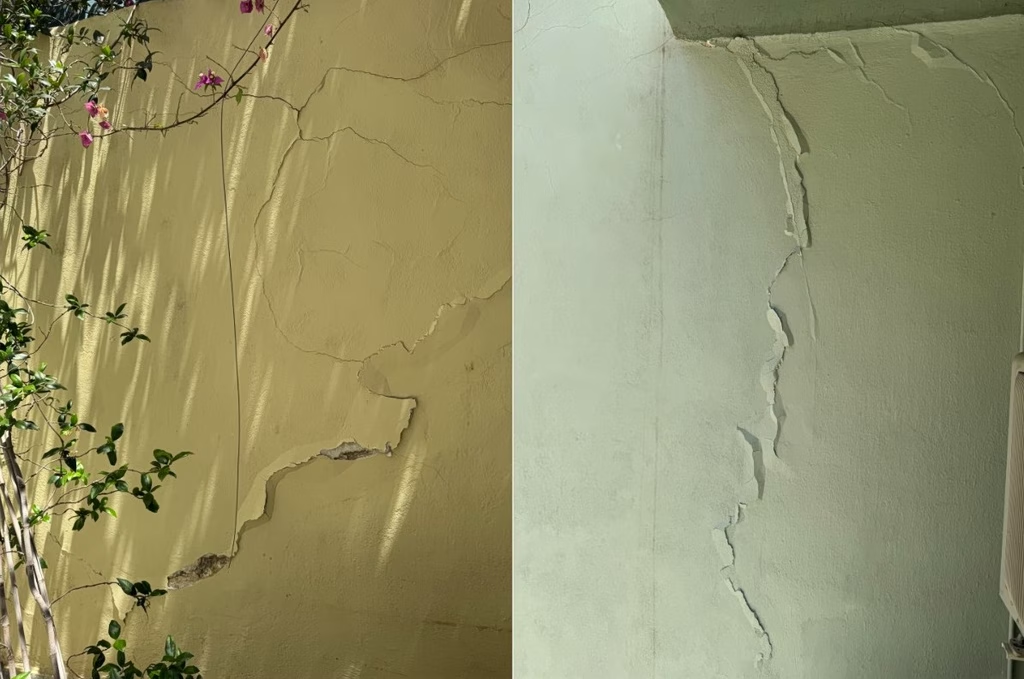
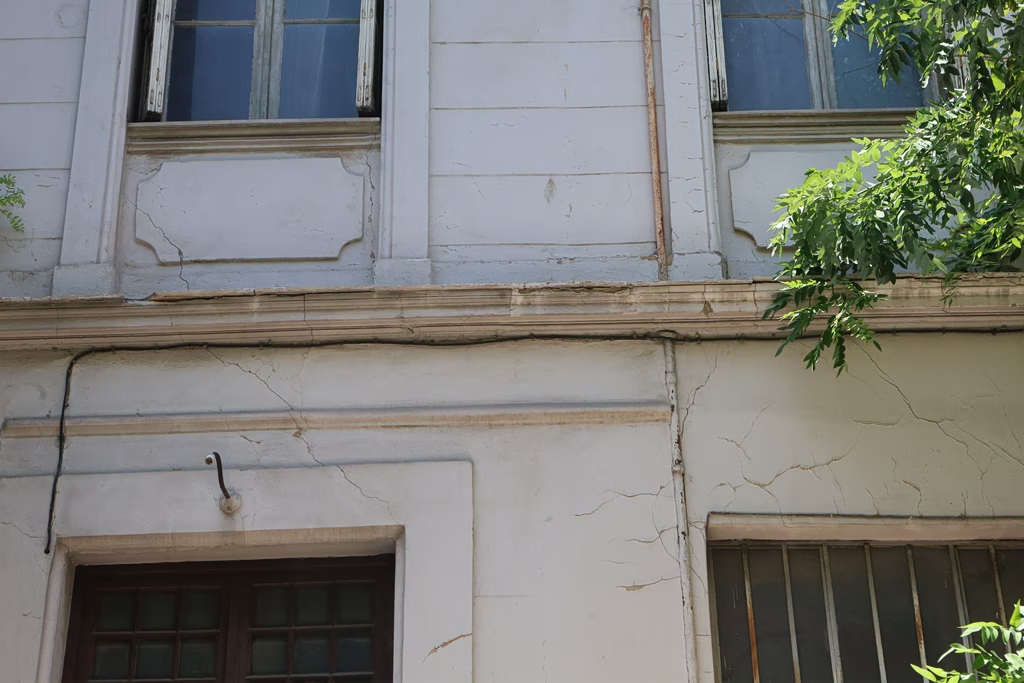
“My home is about a hundred meters from Kypseli Square, and as you’ll see, once work began to extend the metro line, large cracks started appearing across the whole building. Most of the cracks are diagonal and start from the door and window frames. This is mainly due to the ground settling caused by the work,” he says.
As he explains, the damage appeared almost instantly: “It started right after the boring machine passed through. It must have been March or April. The cracks appeared from the very first week, and since we don’t know whether the settling is still active, new cracks keep appearing or existing ones keep widening.”
“The Ground Shook One Night, They’re Digging Two Meters Under Our Feet”
Residents say they got no information at all about the phases of the underground excavation, even though the work was happening right next to their foundations.
“They came and did a visual inspection before starting the work, to check whether there were already cracks in the buildings. Then they installed sensors to measure the settling. After that, without any warning, the ground suddenly started shaking one night.
We went down to the second basement level and could feel it in our feet, because they must have been digging around ten meters down, and our lowest basement level only reaches eight meters deep. That means there were only two or three meters between the tunnel and our basement ceiling. We felt it right under our feet, and they hadn’t even told us what day the machine would pass beneath us,” Koutroularis recounts.
“They Refuse to Give Us the Measurement Data”
When residents began complaining about the visible damage, the response from those responsible was discouraging.
“After the cracks appeared, we started calling them. They’d come, do a quick visual check, and tell us, ‘we can’t guarantee the structural safety of the buildings, go to a private engineer,’ where a structural study costs around 30,000 euros.
They also won’t give us any of their measurement data, not on the settling, not on anything. They refuse, saying it’s for their own internal company use. We filed a request with the planning office, and they gave us an assessment that essentially confirms there is damage and cracking, but says that for the structural adequacy of the building, we need to go to private engineers.”
The financial burden of such a study is crushing for the area. Koutroulakis sresses that “Kypseli’s population is mostly pensioners, people on low pensions, who can barely cover the costs of their building’s upkeep as it is. We don’t even know what would happen in a small earthquake, two or three on the Richter scale. Because right now the building looks like it’s already been through a major earthquake. When you have a boring machine digging just five meters away from you and the whole ground is settling… and think about it, they won’t even agree to do geotechnical studies to check whether the ground is suitable. They won’t agree to any study unless someone forces them to”.
Buildings Pulling Apart and the Risk of Further Demolitions
The damage isn’t confined to the inside of apartments, as the ground movement has affected the structure of the whole neighborhood:
“The doors and windows had all jammed, they wouldn’t open. All this cracking is because the whole ground has lifted. If you walk around, you’ll see it’s uneven. Right next to us, the building right here is going to be demolished and a shopping building put up in its place. It’s an old cinema, a company is buying it.
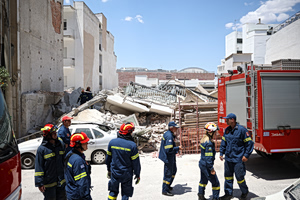
That means the whole area will need shoring, so we don’t end up with what happened in Petralona. And also, before any demolition or new construction starts, studies need to be done on whether the ground can even withstand demolishing a building like that. Look at the crack running all the way up onto the rooftops. There’s separation between the apartment buildings, they’re no longer fully touching each other.”
Demands to the City Council: “No Patch Jobs and Quick Fixes”
Residents make clear they aren’t against the project itself, but are demanding that their physical safety be guaranteed:
“We’re about to present the issue to the Athens City Council, where we’ll essentially lay out our demands, which come down to two things: safety, and then restoration.
By safety, we mean all the geotechnical studies need to be done, structural studies need to be done on every building, and it needs to be reassessed exactly what’s required for the metro extension to continue, with new studies. Because right now it looks like the people running this are unfit for the job and dangerous, and they’ll wreck half of Athens.
We are absolutely not against the metro, it’s a huge public benefit project, but it has to stay a public benefit, not just a benefit for some, with the ‘public’ part dropped. Once we know exactly what state our buildings and the ground are in, the repairs should be done properly, by the book, not just patched wherever a crack shows up, only for it to reappear two months later. No patch jobs, no quick fixes.”
Koutroularis also accuses officials of trying to dodge responsibility by claiming ignorance of the area’s geology:
“They told us they didn’t even know there were streams and rivers running through Kypseli, which is simply not true. There’s no one who doesn’t know that Fokionos Street used to be a streambed. The consortium needs to take responsibility for this, meaning Ellinikon Metro and AVAX, under state oversight, the Ministry of Infrastructure… I don’t even know who’s supposed to be in charge of this.”
Timeline of the Settling and the Boring Machine’s Halt
Serious problems on the new Line 4 (Alsos Veikou to Gouda) first came to light in early April 2026. On April 16, the concern became concrete reality when the streets between Kypseli Street and Evelpidon were suddenly flooded with tons of cement slurry. Ellinikon Metro attributed the incident at the time to the injection of a special foam “under controlled pressure” meant to stabilize loose overlying soil.
The distance between the future Kypseli station and the Dikastiria station is just 800 meters, a stretch normally covered in two months. However, because the settling exceeded safety limits, the boring machine was forced to halt operations beneath Zakynthou Street, roughly halfway through the route.
Ellinikon Metro has already commissioned a special study to determine under what conditions the machine can resume. This setback adds a further delay to the project.