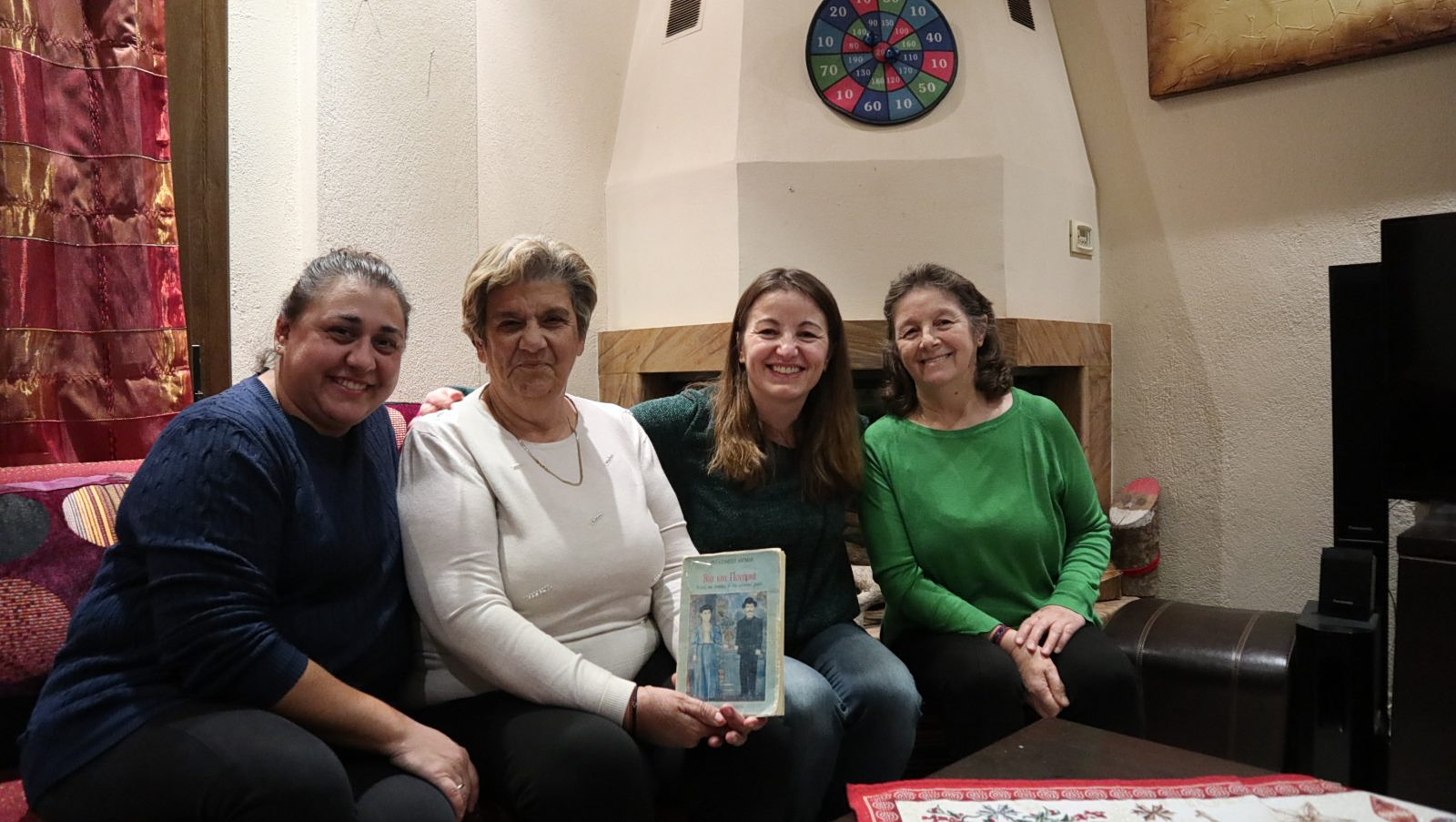
“If I were 20 years old today, I’d leave Pouri,” says 72-year-old Giannoula without hesitation. She is the oldest of the group. Around her, seated in a loose circle in the warm living room of Alexandra—who runs the village grocery store—four women smile in quiet understanding.
“We had good times back then, of course,” Giannoula continues. “We stayed out until three in the morning. Laughter, singing, trouble…”
In the 1970s, this village had nine cafés—although they were places for men only. According to Greece’s most recent census in 2021, Pouri, a lush mountain village in eastern Pelion, six kilometers north of Zagora, now counts 364 residents: fewer than one hundred families and a single taverna that also serves coffee in winter.
“My children left. Now we live alone,” Giannoula says with a sigh.
And yet, this seemingly quiet, shrinking village became one of the most important “model cases” for understanding gender relations and gender-based violence in Greece—a living laboratory where scholars were able to study patriarchy not as an abstraction, but as everyday practice.
Everyday Life and Invisible Violence
Giannoula and Eleni—Alexandra’s mother—do not speak in academic terms. They speak through memories, gestures, and lived experience, revealing the subtle, normalized forms of gender violence embedded in daily life.
“There is definitely verbal violence,” Alexandra says. “When someone keeps calling you ‘useless.’”
“Devaluation. Dependence,” adds Popi.
“In the past, if a woman was afraid to speak, it meant that someone wouldn’t let her,” explains Katerina Psatha, secretary at the Culture and Tourism Department of the Municipality of Zagora–Mouresi. “And that someone was usually a man.”
“We carry a kind of defense, a social inhibition,” she adds. “That’s common in rural areas.” Her words point to the deeply ingrained traces of patriarchy that shape women’s lives, in Pouri and beyond.
From Paris to Pelion

In 1973, French anthropologist Marie-Elisabeth Handman (1942–2025) arrived in the then-isolated village of Pouri to study relationships between men and women. Until 1971, the village was connected to Zagora only by a dirt road. Its population exceeded 600 residents, mostly large farming families, and it had long carried the reputation of being “backward.”
Handman lived in Pouri intermittently from 1973 to 1978, often staying for extended periods in a two-storey house at the village entrance. In 1983, she published her findings in France. Four years later, the Greek translation appeared under the title Violence and Cunning: Men and Women in a Greek Village—the first systematic study of gender relations ever published in Greece.
“Men are superior to us. That is why they must make the decisions that concern the family,” the reader encounters early in Handman’s 299-page ethnography.
The book offers a penetrating, critical analysis of gender relations in a closed rural community perched some 450 meters above the Aegean Sea. Handman concluded that violence—both overt and symbolic—went hand in hand with cunning. Men imposed authority through physical and psychological violence; women, lacking institutional power, developed strategies of endurance, emotional labor, and manipulation in order to survive and influence outcomes within the limits imposed on them.
Beaten for Bearing Daughters
“How many women from Pouri were beaten with the birth of each daughter, since the woman was considered responsible for the child’s sex?” Handman writes. Locals remember her as “Maria the Frenchwoman.”
When a son clashed with his father, the mother would secretly side with him—comforting him, hiding his misdeeds, slipping him money for cigarettes. When the son married, that informal power shifted to the daughter-in-law. The mother became a mother-in-law who judged everything: from how the garden was kept to how the baby was changed, exerting pressure on the younger woman.
As described in the book, women’s responses to male violence were not limited to shame or submission. In a closed and competitive social system, where male egos constantly collided, cunning became a survival tool. Deprived of a public voice, women relied on intelligence, covert alliances, and even the manipulation of men themselves to achieve their goals within strict boundaries.
Early Signs of Change

At the same time, Handman observed that change had already begun. Around 1970, paved roads and electricity brought Pouri closer to Volos. Younger women began demanding small pockets of freedom. For the first time, they were not forced to work exclusively in the fields like beasts of burden for their in-laws.
Between 1965 and 1975, village girls stopped marrying at 15 or 16. They completed primary school; some even attended secondary school. They no longer gave birth every year.
“Social transformation—especially compulsory schooling—allows them not to give birth every eighteen months,” Handman notes. “Their mission shifts from quantitative to qualitative.”
The most assertive young women limited childbirth to three children—especially if the first two were girls. For the village and the era, this constituted a small but significant revolution.
Patriarchy Reconfigured, Not Overthrown
These changes did not dismantle patriarchy; they reshaped it. Young women gained moments of freedom but not an independent voice. The pattern remained intact: the man as head of the household, the woman as servant.
Domestic “liberation” from fieldwork had a double edge. Women rested physically, but many began to experience life as monotonous. Men, meanwhile, grew more demanding of domestic services. Economically, dependence persisted. In earlier decades, women did not dare ask for pocket money twice; a single look from a husband was enough to silence them. By the late 1970s, they had at least begun to negotiate.
Public Disapproval of Violence
“Men no longer beat their wives when they give birth to a girl,” Handman observed. Not because daughters were suddenly valued, but because violence began to be publicly condemned. The urban ideal of the “child-king” extended, to some degree, to girls.
In the 1980s, a girl’s position in the village was ambivalent. Parents admired academic success but feared that education might make their daughters “too bold.” They wanted them educated—but not more than what was deemed necessary for a good wife.
When Violence and Cunning was published in Greek in 1987, it attracted attention far beyond academia. For the first time, a study accessible to the general public illuminated the inner workings of gendered life in a Greek village. Its observations—women’s exhausting labor, lack of rights, internalized inferiority, and covert resistance—became foundational for Greek social anthropology.
Four decades later, the question lingers: what has truly changed?
Pouri Today: Institutions and Statistics

According to reporting by To Vima, Greece has taken institutional steps forward. Since 2019, specialized domestic violence units have been established in selected police departments nationwide. One operates in Magnesia prefecture, where Pouri is located.
The most recent public information session for residents of eastern Pelion took place in Zagora in late November. Attendance was overwhelmingly female. Statistics presented there showed that between 2023 and 2025, domestic violence incidents in Magnesia increased by 177%, while arrests rose by 258%.
In the Municipality of Zagora–Mouresi, 32 official complaints were recorded over the past five years. Only two resulted in criminal punishment.
“Many women don’t want to pursue the process and withdraw,” a local police officer explains. “What they want is for the police to scold their husbands, to frighten them.”
In only one of the 32 cases did police transport the complainant to a safe shelter in Volos—at her explicit request. Social pressure discourages rupture. Divorce remains stigmatized, especially among older couples. Violent masculinity is now viewed more as a social problem than as a man’s inherent right—but it has not disappeared.
Family, Work, and Property

Family and economic structures remain key battlegrounds between old and new norms. Nearly all families in Pouri participate in the Zagora Agricultural Cooperative, producing apples and chestnuts.
“It has its good sides and its bad,” says Katerina, whose family grows apples. “You inherit the job, and that’s a heavy burden,” especially for young people who feel obliged to continue the family path even if they had other dreams.
Men and women work together but in distinct roles. “Men harvest; women sort,” Katerina says. At the cooperative’s sorting facilities, offices, and warehouses, women work alongside men. As she notes, “50% of the cultivable land now belongs to women.”
This shift followed the abolition of dowries. “In the past, when girls married, everything was transferred to the groom,” Eleni recalls. Dowries secured marriage but perpetuated inequality: property passed to men; women became their economic and legal dependents.
Today, daughters inherit equally. “Here in Zagora, women lead,” Katerina says proudly. Many of her peers are presidents of local associations, cooperative board members, and entrepreneurs in tourism. In the women’s agritourism cooperative, village women produce spoon sweets and woven goods, earning independent income.
Who Follows Whom?

Yet patriarchy retains force. “There’s an unwritten rule,” Katerina says. “Whether or not you find work as a woman, if you choose a partner, you follow him to his place. He doesn’t come to yours.”
Katerina fulfilled her dream of studying History, Archaeology, and Social Anthropology, but chose to return to Zagora for her husband. She considers herself fortunate that he supports her.
Most young women, however, leave Pouri. “We have more men than women here,” Alexandra notes. The village loses brides, mothers, and agricultural labor; many young men remain unmarried.
A Patriarchal Palimpsest
Social anthropologist Fotini Tsibiridou describes this reality as a “palimpsest of patriarchy”: old gender rules overwritten—but never fully erased—by new social dynamics.

In 21st-century Greece, overt customs of female oppression are rare. In today’s Pouri and Zagora, young women are freer than their grandmothers—they go out, drive, study, work—but they still navigate an unequal field.
What has changed is consciousness. Younger women recognize both past and present inequalities and view them critically. They no longer accept inferiority as fate.
One December evening, weeks after Marie-Elisabeth Handman’s death, five women gathered in Alexandra’s living room.
“I loved Maria,” Giannoula says softly. “She was a good person.”
“For me, she was a golden woman,” Eleni adds, smiling.
Nearly half a century later, the village remains layered with memory, struggle, and change—each generation writing its own line over the last.