 Μake us preferred on Google
 A garden hose lies coiled beside the front door, ready in case petrol bombs are thrown during A garden hose lies coiled beside the front door, ready in case petrol bombs are thrown during the night. Curtains remain drawn. Lights stay off. A suitcase stands packed in the hallway.
Across parts of Belfast, fear has become part of daily life.
“We don’t sleep properly anymore,” one resident told TO VIMA. “Every noise outside makes you jump.”
Ten days after racist violence erupted in the wake of a knife attack on 8 June, many migrant families are still living in a state of anxiety, unsure whether it is safe to return home or whether they will be targeted next. While the disturbances have subsided, the psychological scars remain visible in neighbourhoods where burned-out houses and smashed windows serve as reminders of one of the city’s most troubling weeks in recent years.
Children wake in tears after watching footage of attacks on social media. Parents spend sleepless nights listening for sounds outside their homes.
“My son saw videos of houses burning,” a mother told TO VIMA. “Now he wakes up crying and asks if our house is next.”
Community groups describe families too frightened to sleep in their own beds and others who spent hours driving around the city because they felt safer in their cars than behind their front doors.
“We felt safer driving around Belfast than sitting in our own living room,” another resident said.
What began as unrest following a knife attack quickly escalated into attacks on homes, businesses and vehicles, forcing families to flee and prompting an emergency response from volunteers seeking shelter for those with nowhere else to go.
Behind the headlines, arrests and political statements lies a quieter story – one of fear, displacement and uncertainty among people who suddenly found themselves questioning whether they still belong in the city they call home.
“This is our home too,” one migrant worker told TO VIMA. “But for the first time, we are wondering whether we are still welcome here.”
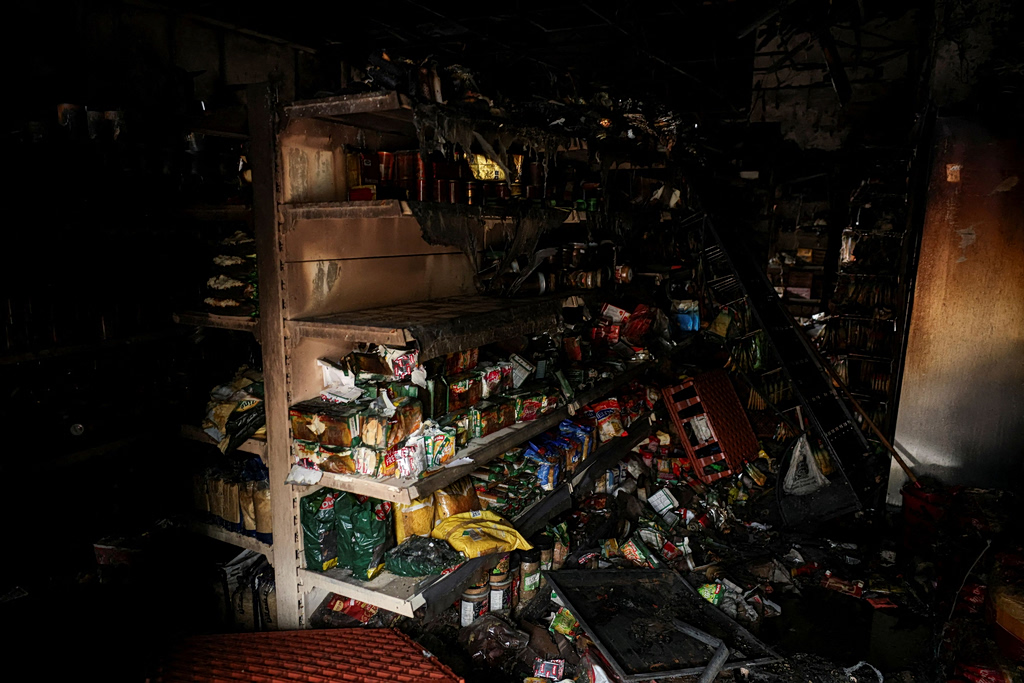
Destroyed produce at Sham supermarket, which was burnt down in the aftermath of anti-immigrant protests following a knife attack on June 8, which left a man seriously injured and prompted police to declare a critical incident, in Belfast, Northern Ireland, June 11, 2026. REUTERS/Isabel Infantes TPX IMAGES OF THE DAY
A city gripped by fear
The violence that erupted in Belfast following the knife incident quickly developed into what police described as racially motivated attacks.
Homes, businesses and vehicles were targeted. Police officers came under attack. More than 30 people were arrested.
Yet statistics and arrest figures tell only part of the story.
The deeper impact can be found in conversations taking place behind closed doors, in temporary accommodation, church halls and community centres where frightened families are trying to rebuild a sense of safety.
One woman described the fear that spread through migrant communities as addresses circulated online.
“We were terrified and my children kept asking me mummy are they gonna come to our house.” The fear was not abstract. “Because they posted addresses,” she said.
One mother living in Belfast with her teenage daughter said the family had experienced occasional racist abuse before, but nothing comparable to the atmosphere that followed the unrest.
“There was shouting outside the house,” she told TO VIMA. “‘Go back to your country. You don’t belong here.'”
Her daughter said the events had left many young people living in fear.
“It makes everyone paranoid,” she said. “You never expect to deal with something like this in the 21st century.”
Elsewhere in the city, a migrant worker who has lived in Belfast for more than a decade keeps a garden hose beside his front door.
“I’m ready, just in case,” he said, fearing that his home could be targeted with a petrol bomb.
His wife has spent recent days helping friends and colleagues find safety. At the height of the violence, she drove through affected areas collecting people who were too frightened to remain in their homes.
“People were calling in tears,” she said. “Some didn’t know where they were going to sleep that night. We just tried to get them somewhere safe.”
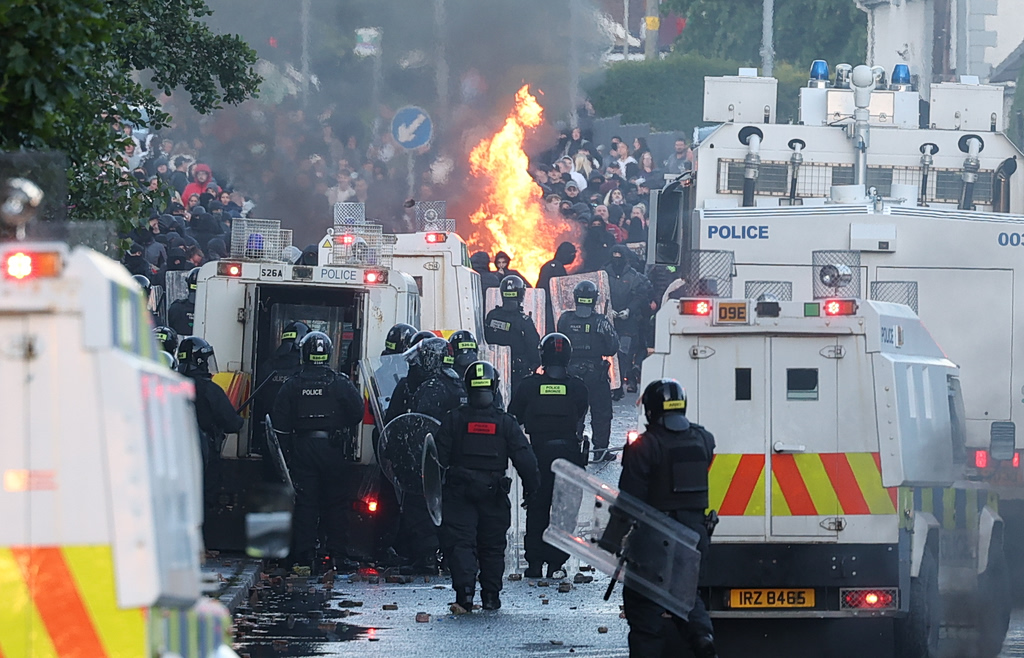
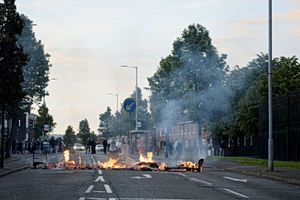
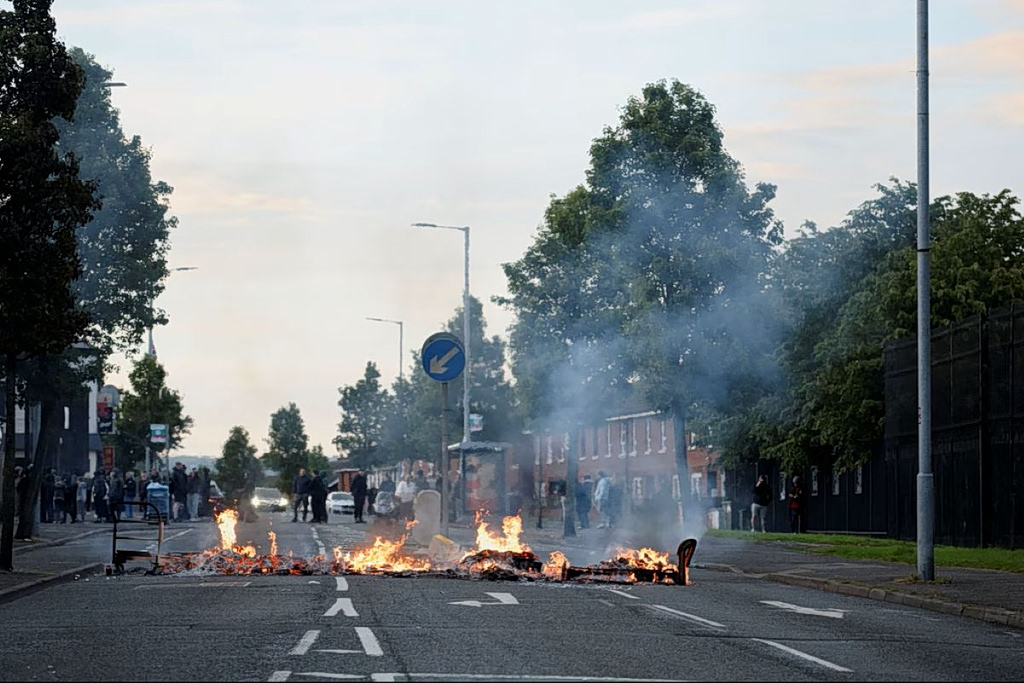
Protesters set fires during disorder on Antrim Road in Newtownabbey, north Belfast, Northern Ireland, 10 June 2026. A 30-year-old Sudanese national has been charged with attempted murder following a knife attack in Belfast on 08 June. Homes and vehicles were set on fire during anti-immigration demonstrations following the attack. EPA/ADAM VAUGHAN
Burned out of their homes
Among those helping victims is Fazir, who has launched a fundraising campaign for friends Sumayah and Stella.
Their experience reflects the nightmare many families endured.
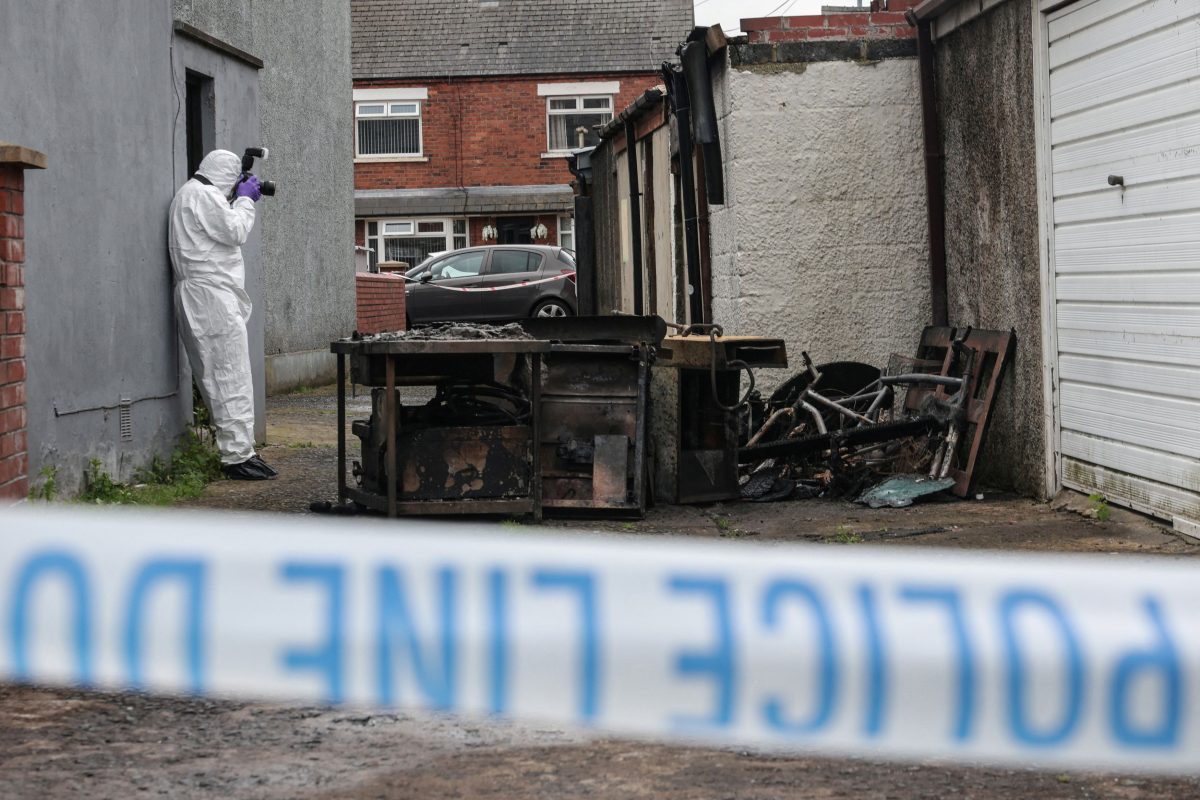
According to Fazir, their home was attacked and burned during the riots. They became trapped inside while a mob gathered outside.
Emergency services eventually rescued them. The house was destroyed.
Stories like theirs have become painfully familiar to community groups that have spent days responding to emergencies.
Paul Doherty, former Deputy Mayor of Belfast, Independent Councillor, founder of Foodstock Charity and Community Solidarity Hub, has been helping families cope with the aftermath.
“There’s a lot of work to support families who have been displaced,” he told TO VIMA.
“We’ve set up a clinic to support those who have experienced trauma as a result of those issues in Belfast last week. So we’re kind of dealing with the aftermath of those race riots.”
One incident remains vivid in his memory. “A woman stopped her car in the middle of traffic on the front of our building just a few days ago,” he said.
“She was crying. She was hysterical and her children were in the car hysterical.”
The reason was simple and devastating.
“One of the children had seen their address shared on social media by some of these groups, and they were afraid of going home.”
Some displaced families have been placed in hotels. Others have been moved outside Belfast altogether. Children have missed school. Many remain deeply traumatised.
Doherty recalled one particularly distressing account involving a school worker who visited the home of a pupil.
“A house was on fire behind her,” he said.
“She knocked on the door of the mother of one of the pupils in her school and said, you need to get out of here.”
The mother’s response revealed the emotional toll.
“She said, I can’t leave the children. They feel safe in this house. This is their home. And they don’t feel safe outside of this house.”
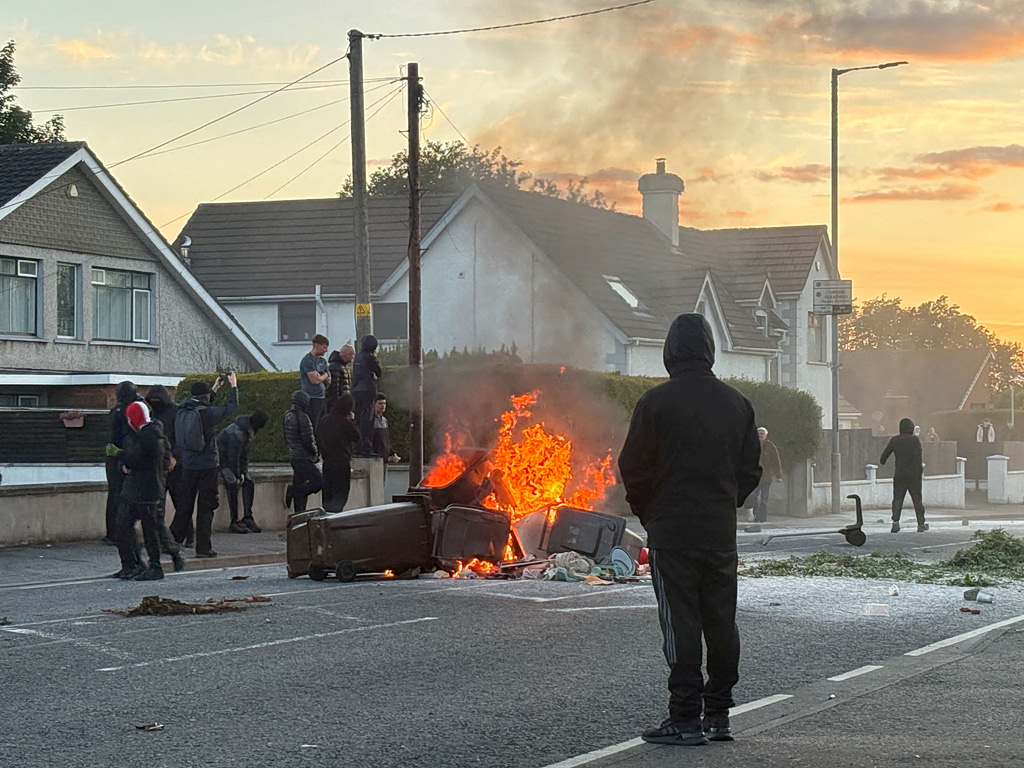
FILE PHOTO: A fire burns in bins as anti-immigrant protesters clash with police at Antrim road, following a knife attack on June 8, which left a man seriously injured and prompted police to declare a critical incident, in Belfast, Northern Ireland, June 10, 2026. Picture taken with a phone. REUTERS/Isabel Infantes/File Photo
The volunteers who stepped into the void
As violence spread, community organisations moved rapidly to provide assistance.
Among them was the Anaka Women’s Collective, which established emergency response networks almost immediately.
Its co-ordinator, Elfie Seymour, described the scenes witnessed across Belfast.
“We’ve seen racist pogroms roaming the streets causing mass destruction and fear in migrant communities,” she told TO VIMA.
She said organised groups moved through some neighbourhoods targeting homes where migrants lived.
“People were going house to house, attacking houses where anyone who wasn’t white lived.”
The most serious incidents occurred in parts of north and east Belfast.
“In certain areas of Belfast, we had houses being burnt down to the ground.”
As addresses circulated online, fear intensified. “A lot of those HMOs might be used as asylum accommodation, and people use that list as kind of a list for vigilantes and gangs.”
Anaka established emergency WhatsApp groups to coordinate help. The messages quickly became desperate pleas for rescue.
“Help, I need help, I’m trapped in my house, my house is on fire.”
According to Seymour, volunteers often reached people before official assistance.
“We managed to get 800 volunteers over two groups.”
The network transported families to safety, established emergency accommodation and organised reception centres.
The scale of the response was remarkable. Community organisations estimate that almost 300 households and more than 500 individuals received assistance. Support ranged from emergency housing and food deliveries to transport, medical assistance and childcare.
Some volunteers opened their own homes.
One Belfast resident, Therese Gorman, hosted displaced migrants after offering spare rooms in her house.
“One of my guests said it was both the worst and best day of her life; worst because she feared for her life, best because she met kind people willing to help.”
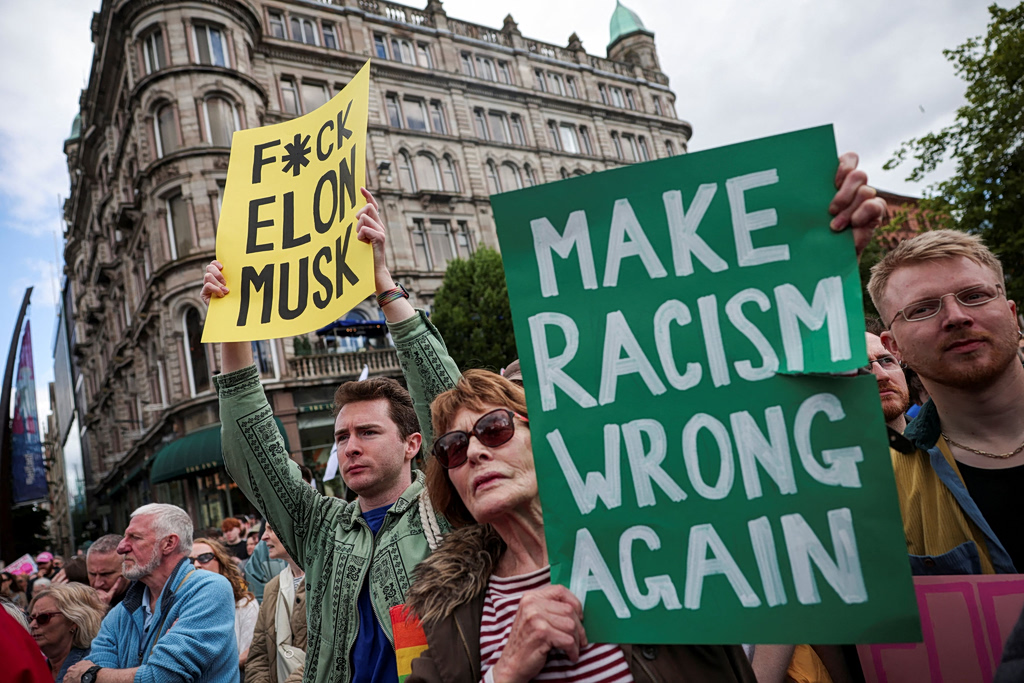
Demonstrators hold placards, as they take part in a ‘United Against Racism’ rally after days of anti-immigration violence, following a knife attack on June 8, which left a man seriously injured and prompted police to declare a critical incident, in Belfast, Northern Ireland, June 13, 2026. REUTERS/Louisa Gouliamaki
A deeper problem beneath the violence
For many observers, the events cannot be understood solely through the lens of one criminal incident.
Eamonn McCann, the veteran campaigner from Derry, believes the unrest reflects wider frustrations within some working-class Protestant communities.
“These were riots involving Protestant people, working class people, Protestant working class people, who felt that they were being left behind by political developments and changes in Northern Ireland,” he told TO VIMA.
He argues that migrants became convenient targets.
“Migrants are a very easy target when there is tension in Northern Ireland.”
The significance of the attacks, however, extends beyond traditional political divisions.
Speaking to TO VIMA Professor of Political Sociology Katy Hayward of Queen’s University Belfast points to a troubling trend.
“Since 2016 racist hate incidents and crimes have exceeded those of sectarian ones,” she said.
Given Northern Ireland’s history, that is a striking statistic.
Professor Hayward warned that the targeting of homes has had a profound effect on public confidence and safety.
“It’s deeply concerning because it means that even people feel unsafe on the streets, they also feel unsafe in their homes.”
She added: “That’s real terror.”
The circulation of house lists on social media worsened the atmosphere.
“We also saw lists of houses going around on social media saying that they were going to be targeted.”
The result, she said, was fear extending far beyond those directly attacked.
“It was this dreadful evoking of fear in Northern Ireland.”
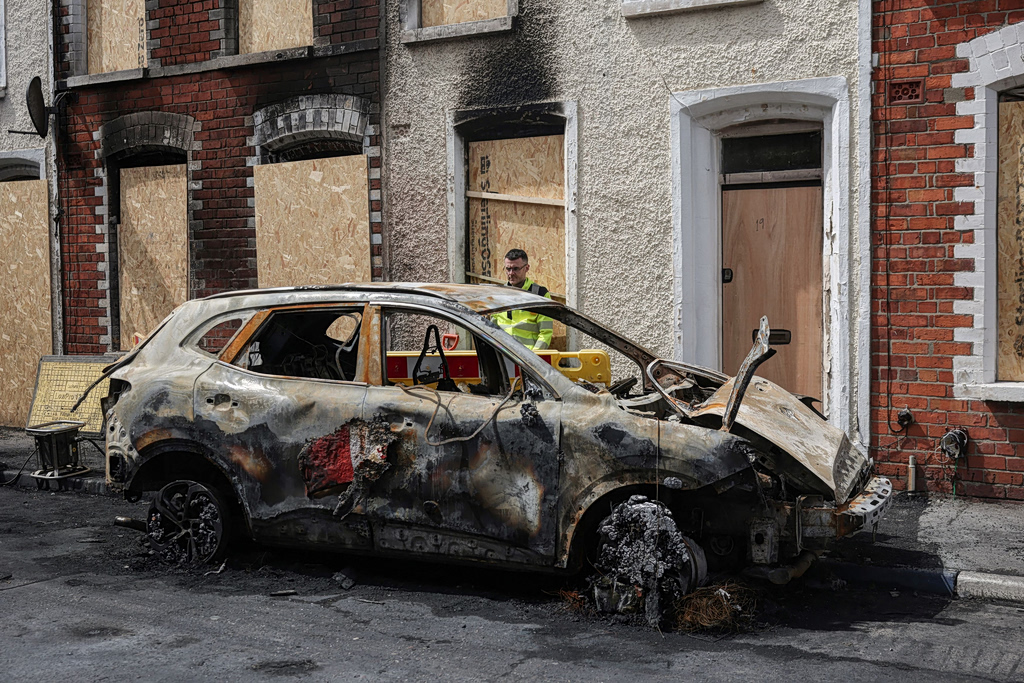
A gas utility worker looks at a burned car at the site of previous days clashes in east Belfast, following a knife attack on June 8, which left a man seriously injured and prompted police to declare it as a critical incident, in Belfast, Northern Ireland, June 12, 2026.REUTERS/Louisa Gouliamaki
The role of online networks
Professor of Sociology Akwugo Emejulu of the University of Sheffield sees the Belfast violence as part of a wider pattern emerging across Britain.
“This is now the third consecutive year of far-right riots in the United Kingdom,” she told TO VIMA.
She stressed that many victims were not asylum seekers but workers filling crucial labour shortages.
“The people who were burned out of their homes were actually migrant workers, many of them working in social and healthcare.”
Professor Emejulu believes social media has become central to the spread of extremist narratives.
“It’s essential,” she said.
“What we know is that there’s a far-right playbook that you take a particular outrage, some sort of crime, and reframe that as an attack on the very idea of whiteness and white people.”
Online networks, she argued, help transform anger into organised action.
“The online social networks are essential in terms of mobilizing people.”
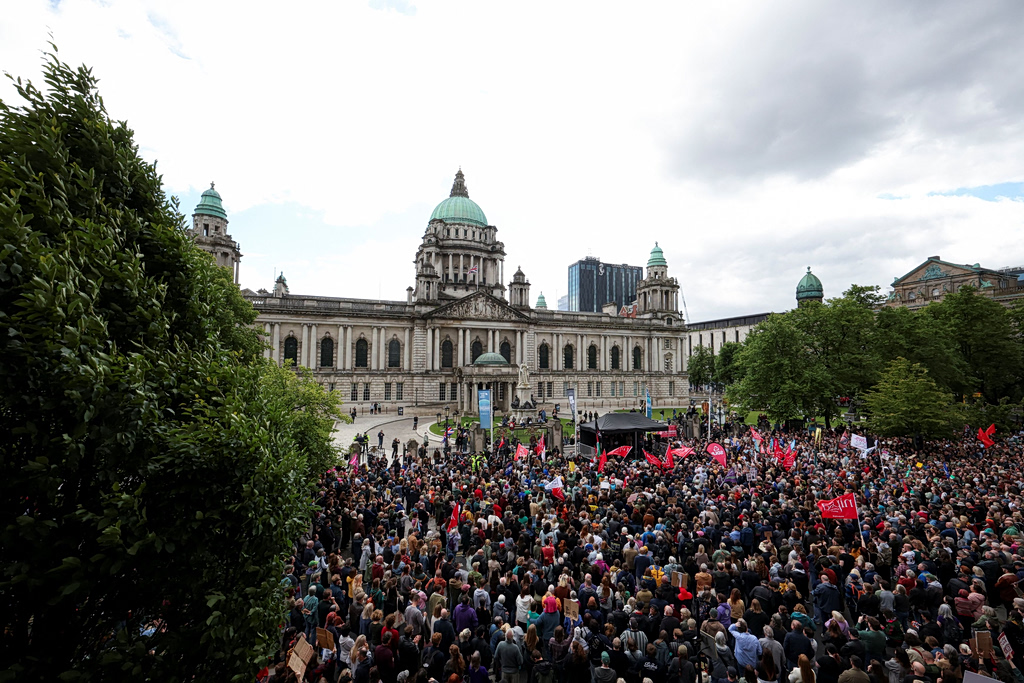
Demonstrators take part in a ‘United Against Racism’ rally after days of anti-immigration violence, following a knife attack on June 8, which left a man seriously injured and prompted police to declare a critical incident, outside the Belfast City Hall, in Belfast, Northern Ireland, June 13, 2026. REUTERS/Isabel Infantes
Solidarity amid the darkness
Yet amid the fear, Belfast has also witnessed another response.
Community organisations, churches, volunteers and ordinary residents mobilised in large numbers to protect vulnerable families.
Doherty insists the violence represents only a minority.
“I do believe that there’s more good than bad in Belfast,” he said.
He pointed to demonstrations and public shows of support that followed the unrest.
“What we’ve seen was incredible solidarity.”
Professor Hayward agrees.
“You’ve seen the best of Northern Ireland in some of the response with the active community organisations.”
Across the city, volunteers stood outside threatened homes, delivered groceries, transported families to safety and opened community spaces as sanctuaries.
For many displaced residents, those gestures have provided the first signs of hope after days of fear.
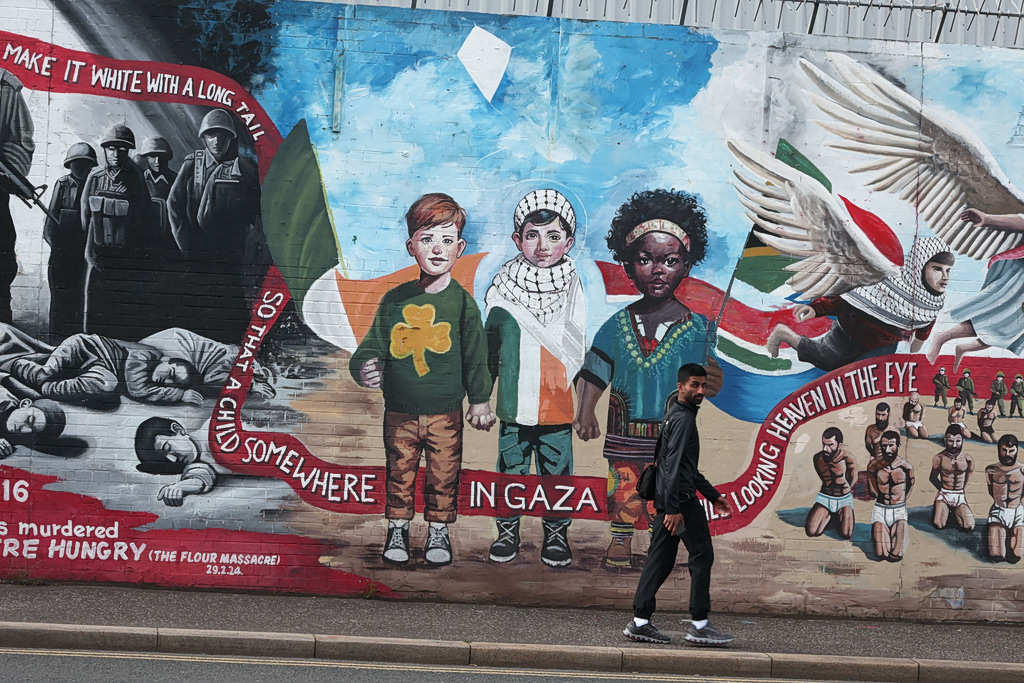
A man walks past the Solidarity Wall in Belfast, Northern Ireland, June 12, 2026. REUTERS/Louisa Gouliamaki
An uncertain future
The immediate crisis may have eased, but the deeper questions remain.
Hundreds of people have experienced intimidation, displacement or violence. Many are still afraid to return home. Community groups continue to provide emergency accommodation and trauma support.
The events have also raised uncomfortable questions about policing, social cohesion and the spread of extremist rhetoric online.
Most of all, they have exposed the vulnerability felt by many migrant families who believed they had built secure lives in Belfast.
The image that remains is not of burning buildings or riot police.
It is of frightened children sitting in a car, afraid to go home after seeing their address appear online.
For them, and for many others across Belfast, the violence was not merely a disturbance on the news. It arrived at their doorstep. And long after the flames died down, the terror remained in their eyes.