With a career as a photojournalist spanning nearly 30 years, 23 of them with the Associated Press, multiple award-winning photographer Petros Giannakouris is one of the best-known Greek photojournalists internationally.
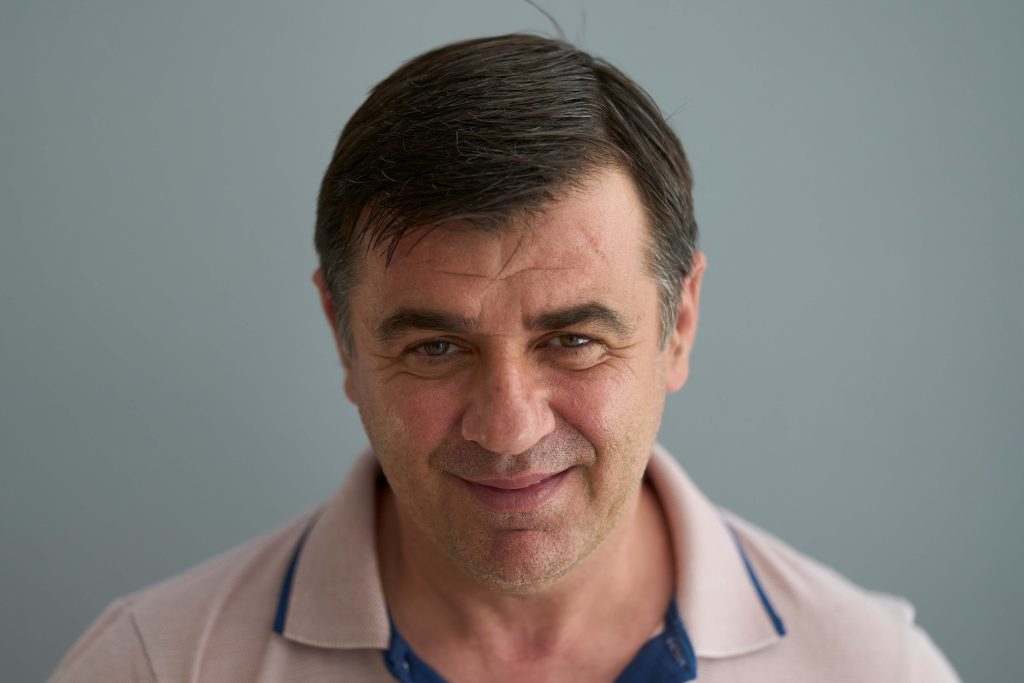
His broad-ranging work covers everything from war zones like Ukraine to the Olympic Games, and from monuments to remarkable shots of everyday life in his native Athens.
A young boy celebrates as he plays cricket with his friend in Chaman-e-Hozori park, Kabul, Afghanistan, Friday, Nov. 19 , 2021. (AP Photo/ Petros Giannakouris)

In an exclusive interview with TO BHMA International Edition, Giannakouris says his job and his camera have opened up horizons he could never have imagined.
What is the key to good photojournalism? Is it innate—an acute sense of perception, or something one learns over time?
Actually, it’s a combination of feeling, perception, and life experiences. And you definitely need to be in the right place at the right time. That requires instinct and experience—the ability to sense where something important is happening, and to know if it will be of interest.
Over the years, you acquire greater experience and the ability to ‘read’ events and know which direction you should be pointing your camera before something happens. You also learn to distinguish being developments people need to know about, and others that aren’t so important. Also, as time goes by, your perception becomes more acute. Experience, knowledge, and the things you have witnessed and the images that have become ingrained in your memory help you to see not only the event unfolding in front of you, but also the broader framework—the big picture.
Actually, that’s the most important thing: being able to narrate not just what happened, but also why what we are seeing is significant.
From the horrors of war to the heights of the human spirit, what has your work taught you about human nature?
You need not be a photographer to understand that humankind is capable of both the best and the worst deeds. History teaches us that, and if we have learned anything from it, it is that we never learn from our mistakes. The difference in my case is that I have witnessed these events close-up. I’ve lived them, smelled them, sensed them, and I’ve tried, through my craft, to convey all that to people who haven’t.
What truly amazes me is that, even amidst the terror and hostility of war, you can happen upon moments of incredible beauty—reflections of the glory of humankind.
The Olympic Games are something entirely different: there you see people who exceed their limits and embody dedication and the beauty of the human body and spirit—everything the Olympic ideal represents. As a Greek, this experience touches me even more deeply.

A flash of lightning illuminates the sky over the 2,500-year-old Ancient Parthenon temple, on the Acropolis hill during heavy rainfall in Athens, Greece.
Of the war zones you have covered, which have affected you most psychologically and spiritually? Has the extent of human misery made you cry at times; has it left you with a certain amount of trauma?
I have cried a number of times. Perhaps more than one should. Maybe my temperament is to blame. It doesn’t usually happen when I’m in the middle of things. There, you have to be calm and collected so you can function properly. It’s when I lie down at night, or look at the pictures I took, that it hits me. I have broken down emotionally a number of times.
It’s not individual incidents that are to blame; it’s the total burden. All those experiences register cumulatively in the mind, and if you exceed your limit—and everyone’s is different—something becomes damaged inside you. These things don’t go away easily. You carry them with you. They shape you forever, because they are experiences and images the mind cannot erase.

U.S. soldiers of the 3rd Brigade Combat team, 3rd Infantry Division and Iraqi volunteer civilians are seen shortly after the second roadside bomb explosion of the day during the Sukhumi clearing operation in the area of Al-leg, some 60 kilometers (40 miles) south of Baghdad, Iraq, Friday, March 7, 2008. Two roadside bombs exploded during Friday’s operation, the first one in the morning, damaged a U.S. army vehicle, and the second one in the late afternoon, wounded five Iraqi volunteer civilians. (AP Photo/Petros Giannakouris)
When you take a truly exceptional photograph, is it usually the result of keen observation or a matter of luck? Is a great picture ‘given’ to you in some way?
It’s a bit of all three—observation and luck, but something more, too. I like to compare photography to fishing. You cast your net in the right spot at the right moment, and if you’ve done everything properly—and your luck’s in—you’ll get a good ‘catch’. That’s how I view photography today: as something like a reward for being present, for seeing, for waiting, for being open to the moment. Luck enhances the result, but it doesn’t create it.
You covered the Greek migration crisis that peaked in 2015-2016. How did you go about showing the world the profound misery of people who’d fled war zones and extreme poverty in search of a better life?
The migration crisis was one of the most intense periods that I have experienced as a photographer. At each stage of the journey, there were incredibly charged moments that rocked me.
I was on the verge of tears every time I saw a child that had suffered such hardships.
I had two very young children of my own at the time.
I think the most meaningful way to narrate a story like that is to really try to put yourself in the heads of the migrants, to see the world through their eyes and realize this could have happened to me, to any of us.
The decade-long Greek economic crisis decimated the standard of living in Greece and crushed people’s hopes. How did you capture this in your photographs, and what types of shots do you think expressed it best?
Violence was an everyday thing. Helmets and gas masks became as much a part of our gear as our cameras. There was no time to depict the stories differently.
It was the first time in my career that I found myself affected by the events I was trying to photograph. What was happening to the people I photographed was also happening to me, my family, my relatives and friends. I was no longer a photographer recording something external; I was part of this society that was falling apart before my eyes.
I remember telling a guy how I had to run around from morning till night and complaining about the incredible violence and the difficulties of the job.
“Yes, but you have a job, I have nothing,” he replied. I’ll always remember that.
More Photos of Petros Giannakouris
A homeless woman sits on a bench next to her belongings, in central Athens, on Wednesday, Feb. 27, 2013.
People pay respect as soldiers carry the coffin of soldier Roman Tsyhanskyi during a funeral ceremony outside the Holy Apostles Peter and Paul Church in Lviv, western Ukraine, Friday, Feb. 24, 2023. Tsyhanskyi died near Bakhmut a week ago. . (AP Photo/Petros Giannakouris)


An Israeli woman touches photos of Israelis missing and held captive in Gaza, displayed on a wall in Tel Aviv, on Saturday, Oct. 21, 2023. Relatives of people kidnapped by Hamas militants and supporters organized a protest Saturday calling for the return of more than 200 hostages held in Gaza for two weeks. (AP Photo/Petros Giannakouris)