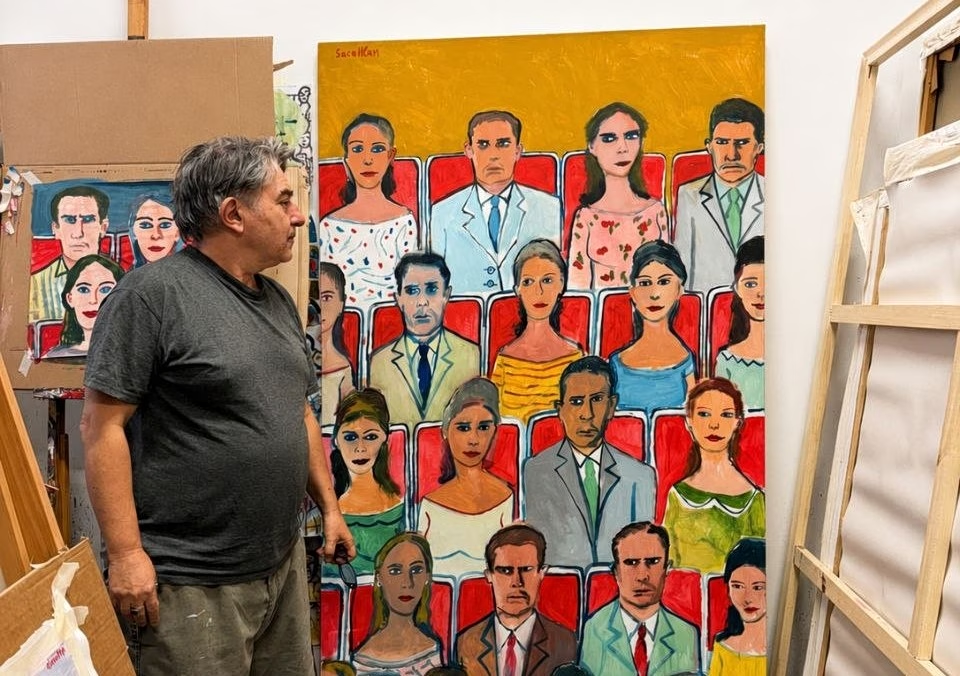
Edouard Sacaillan’s painting is difficult to confine to a single thematic or aesthetic category. At times, he turns his gaze towards bustling human gatherings, traffic jams, beaches, festivals and scenes from everyday life; at other times, he allows color to precede form, as if searching for that primordial state in which the image has not yet decided what it is going to become. In his works, human presence does not function as a simple narrative. It becomes a field of observation of collective experience, coexistence, but also of the fragile balance between individuality and the whole.
On the occasion of the exhibition “From Chaos to the World”, presented this summer at the Tinian Cultural Foundation in dialogue with the painting of Anna Maria Tsakali, Sacaillan returns to a concern that has occupied him for decades: how form is born. For him, chaos is not synonymous with disorder. It is life itself, the primordial state from which images, light, movement and, ultimately, painting emerge.
Throughout our conversation, the concept of movement constantly returns. Form, as Sacaillan perceives it, is not a static destination but a temporary balance within a continuous flow. Perhaps this is why he refuses to offer definitive definitions or easy answers. He prefers to approach each work as a new encounter with the unknown, where experience, memory, observation and instinct coexist without any of them claiming exclusivity. Edouard Sacaillan speaks about painting as a way of remaining in constant dialogue with the world — even when this world remains open, uncertain and undefined.
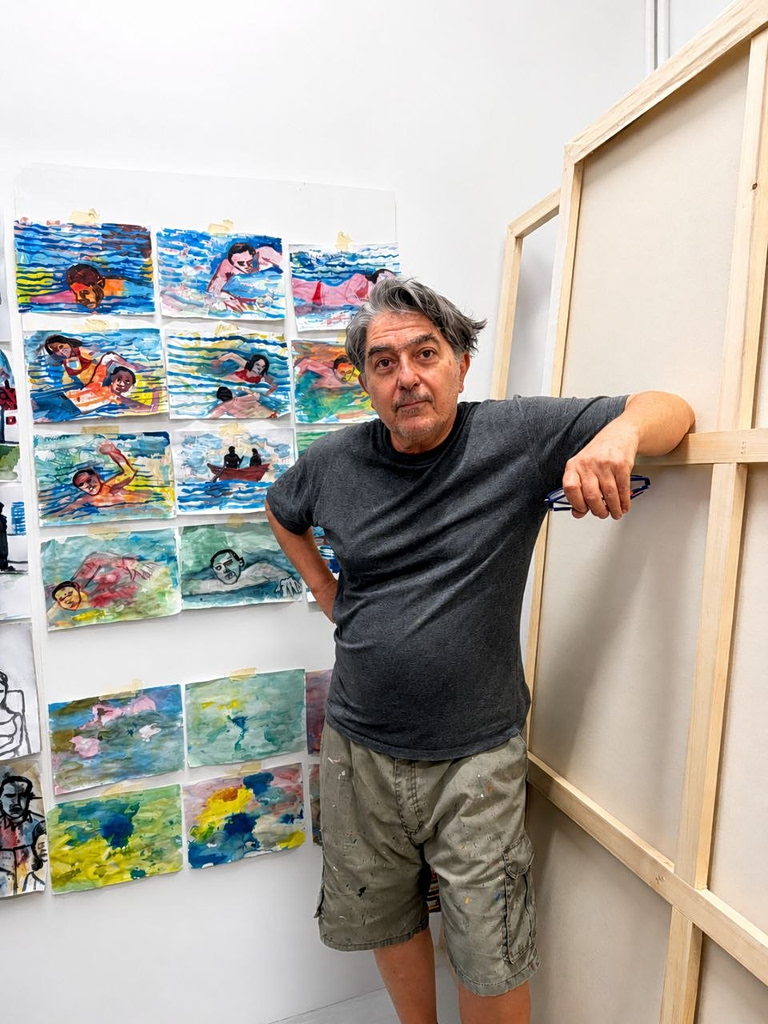
The title of the exhibition, “From Chaos to the World”, seems to describe a journey. What does this transition mean to you?
Chaos is something very specific for me. I do not use the word metaphorically. When I put the first colors onto the canvas, what appears is chaos. An event that does not depend on me, on my knowledge or on my will. It is something that exists before me and within which I also find myself. From that point onwards begins the attempt for it to acquire form. When we say “world” in painting, we mainly mean form, the shape. Not an imposed order, but the moment when something acquires substance without losing its origin in chaos. That is the difficult part. To give meaning, but only as much as is necessary, so that the form continues to carry within it this initial organic quality.
In the past, human beings believed they could control everything. They designed, organized, executed. Gradually, however, we realized that we are not omnipotent. Light changes, the body changes, reality is constantly transformed. This flow is life, and this is what I want to exist within painting as well.
Therefore, for you, chaos is not synonymous with disorder.
Not at all. It is a mistake that is made very often. The opposite of chaos is neither order nor disorder. Order and disorder are human constructions. Chaos is not a construction. It is life itself. It can be light, a wave, an earthquake, a movement of nature. It can be something that frightens you or something that fascinates you. But it is always something primordial. I cannot give you chaos. I can create disorder. Chaos already exists before us. This is what I try to encounter every time I begin a work.
How is this idea translated into your painting process?
Many times, I have no specific idea when I enter the studio. I feel empty. Then I simply throw colors onto the canvas and observe them. Just as I would stand in front of the sea or before a landscape. Afterwards, my own responsibility begins. That chaos has to become painting. It has to become my own work. Not because I want to impose myself upon it, but because I must take responsibility for it. Sacaillan, the artist, must take a position towards what has appeared. Form is not something I impose. It is something that emerges through a continuous dialogue with what already exists.
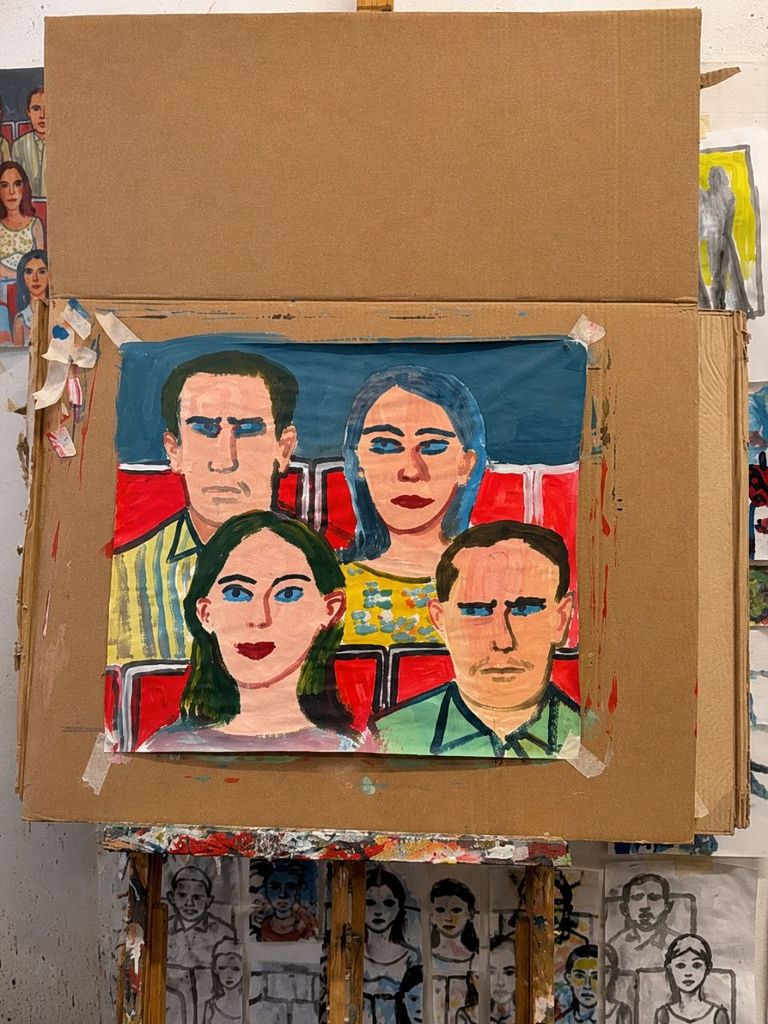
A work in progress. PANOS KOUGIAS/TO BHMA INTERNATIONAL EDITION
In the exhibition, you are in dialogue with Anna Maria Tsakali. How was this shared proposal born?
Anna Maria and I share common concerns and common questions. We share an anxiety about what it means to make painting today and how an exhibition can go beyond the narrow framework of simply presenting works. We did not begin by saying that we absolutely had to create a joint exhibition. The initiative came from the Tinian Cultural Foundation, which had been following our work and knew that we had presented joint exhibitions abroad as well. The people at the Foundation suggested that we develop this dialogue in Tinos, and we felt that there was a genuine reason for it to happen. Although we paint differently, there is a common core. We both begin from an open, organic state, before form. From that point onwards, each of us follows their own path.
What does it mean to you that this exhibition is presented in Tinos, a place with such a strong artistic as well as spiritual tradition?
Tinos is a very special island. It does not carry only an important artistic history. It also carries a profound theological history. It is a place where human beings come face to face with faith, with the notion of the miracle, with human weakness. This moves me deeply. I see people climbing on their knees towards the church seeking a source of strength. I do not approach this ironically. I understand it. In a different way, the artist does something similar. They do not choose an easy path. They insist on searching for a small miracle within painting, within light, within form.
People are constantly present in your work. Beaches, festivals, traffic jams, gatherings. Do you paint more what you see or what you remember?
Everything together. And unfortunately, I cannot do everything at the same time. I always feel a little fragmented. When I am in the mountains, I want to be completely there. When I am by the sea, I want to be inside the sea. When I paint people, I want to be among them. The ideal would be to be able to coexist with people, with animals, with plants, with light, with memories — all at once. It is not easy. Life forces you to choose, each time, only one fragment of it. I do not have the patience to work on the same subject for five years. I could perhaps devote myself exclusively to traffic jams or to the sea, but I would feel that I was functioning like a machine. I cannot work that way.
View this post on Instagram
If you could stand discreetly beside a viewer looking at your works, what would you like to hear them say?
I cannot step out of my own position and enter the position of the viewer. Perhaps this is also my greatest difficulty. I do not expect them to say that they understood the work. Nor do I expect them to explain it. I would only like them to feel that these people who exist inside the paintings are not decorative elements. I do not know whether this is recognized. Perhaps it is not. But I cannot complain because it is not recognized. I continue to do it because I do not know how to paint differently.
Are you concerned with the relationship between your work and institutions, collectors and, more broadly, the art world?
I am concerned with it, but not in the way many people think. Of course, an artist needs institutions, galleries and people who will support their work. They do not exist outside society. On the other hand, I cannot paint based on whether something will be accepted or not. Painting does not happen that way. Today, I see that popularity operates according to different terms. Painting, however, requires time. It requires learning how to see. It is like reading. If someone has not learned how to read a text, it is difficult for them to read a painting as well. People constantly see images, but that does not mean they read them. Photography, the screen and the rapid slogan have changed the way we stand before images.
Nevertheless, you continue to paint with the same persistence, without adapting to the trends of the time.
I do not know how to do anything else. If I changed my painting in order to become more liked, I would betray the reason why I started painting in the first place. I prefer to make mistakes within my own path rather than succeed by following a path that does not belong to me. Painting is not a strategy. It is a way of existing.
View this post on Instagram
You often refer to the painters who shaped you. What did you retain most from your years in Paris?
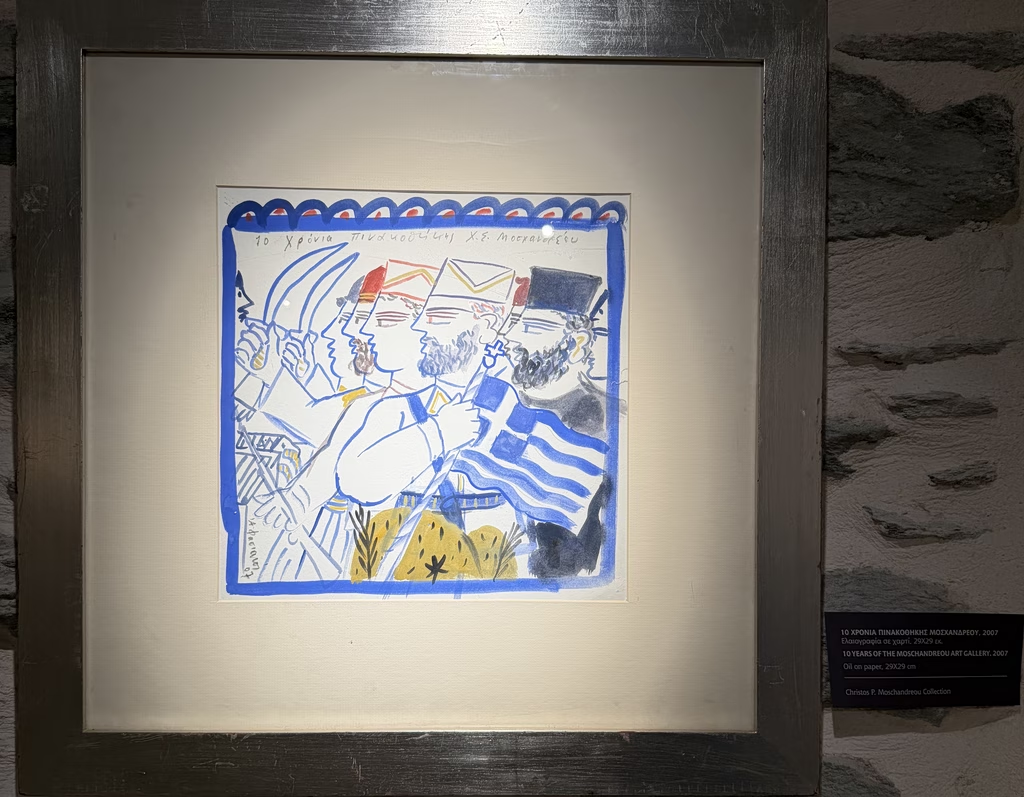
I remember pulling Moralis by the sleeve and telling him that I wanted to understand whether he was as great as Velázquez. It was naïve, but that was how I thought. In Paris, I met people such as Leonardo Cremonini, and later I had contact with Alekos Fassianos. But I never felt that painting could be transmitted through lessons. In the studio, you are on your own. It is a solitary work. Even when there are people around you, at the moment when you are painting, no one can truly enter what is happening.
You have said that you feel closer to Francis Bacon than to other painters. Why?
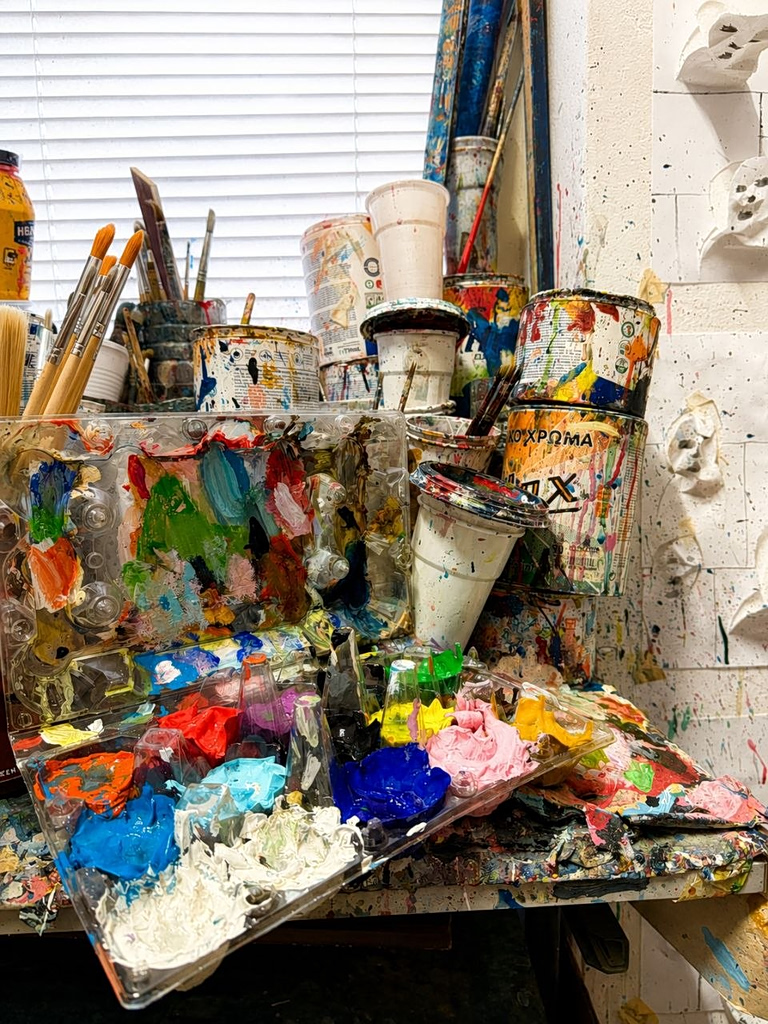
Because I am moved by the brutality he has towards the image. He does not try to beautify it or make it pleasant. There is an intensity that speaks to me deeply. It does not mean that I want to paint like him. It means that I recognize this difficulty of standing before reality without idealizing it. At some point, I abandoned the certainty of drawing and turned towards a more open way of creating. I owe this to a great extent to Cremonini. I went there determined to do what I believed was the right kind of painting: models, still lifes, academic discipline. At some point, however, I felt that all of this was leading me nowhere. I literally took rubbish, threw it onto the floor of the studio and began observing it. That was when something changed inside me. I realized that painting is not found only in great subjects. It is also found in the humblest things. In the traces that life leaves behind. From there began another journey that continues until today.
And this is perhaps where the notion of accumulation comes from, which we encounter both in your own works and in the work of Anna Maria Tsakali?
Exactly. Within those “rubbish” objects, I began to see gatherings of things, relationships, lives. Anna Maria follows this through flowers, nature and organic forms. I follow it through people. In reality, we are both speaking about the same thing: how many small existences create a world. I am interested in anonymous people. Not the protagonists. Those who usually pass unnoticed. I believe that is where the true human story lies.
If a young painter came to your studio today and asked you for advice, what would you tell them?
I would not give them any advice. I do not believe in the role of the teacher who distributes certainties. It would be arrogant on my part. I myself continue to live within my own doubts. So how could I tell someone else what the right path is? What the people I respected most taught me is precisely the opposite: not to trust certainties. Cremonini did not give me formulas. He forced me to doubt more. Let this be the only thing worth keeping for a young person. Not to fear doubt. To continue searching for their own path, even when they are not at all certain where it leads.