To mark the opening of “Cel d’or,” Stefan Bruggemann spoke with BHMAgazino about how his ideas take shape, the power of words, and the cultural identity of Ibiza, the island where he loves to live and work.
The exhibit “Cel d’or” seems inseparable from Ibiza itself, particularly from the island’s exceptional golden light. Was that light the starting point for the exhibit, and how did you “translate” something so fleeting into materials like gold and marble?
Ibiza’s golden light was without a doubt the starting point for ‘Cel d’or.’ It’s more than a visual phenomenon, since it carries an almost spiritual quality. Throughout the day, the light transforms the landscape, softens forms, deepens colors and creates moments that feel both timeless and fleeting.
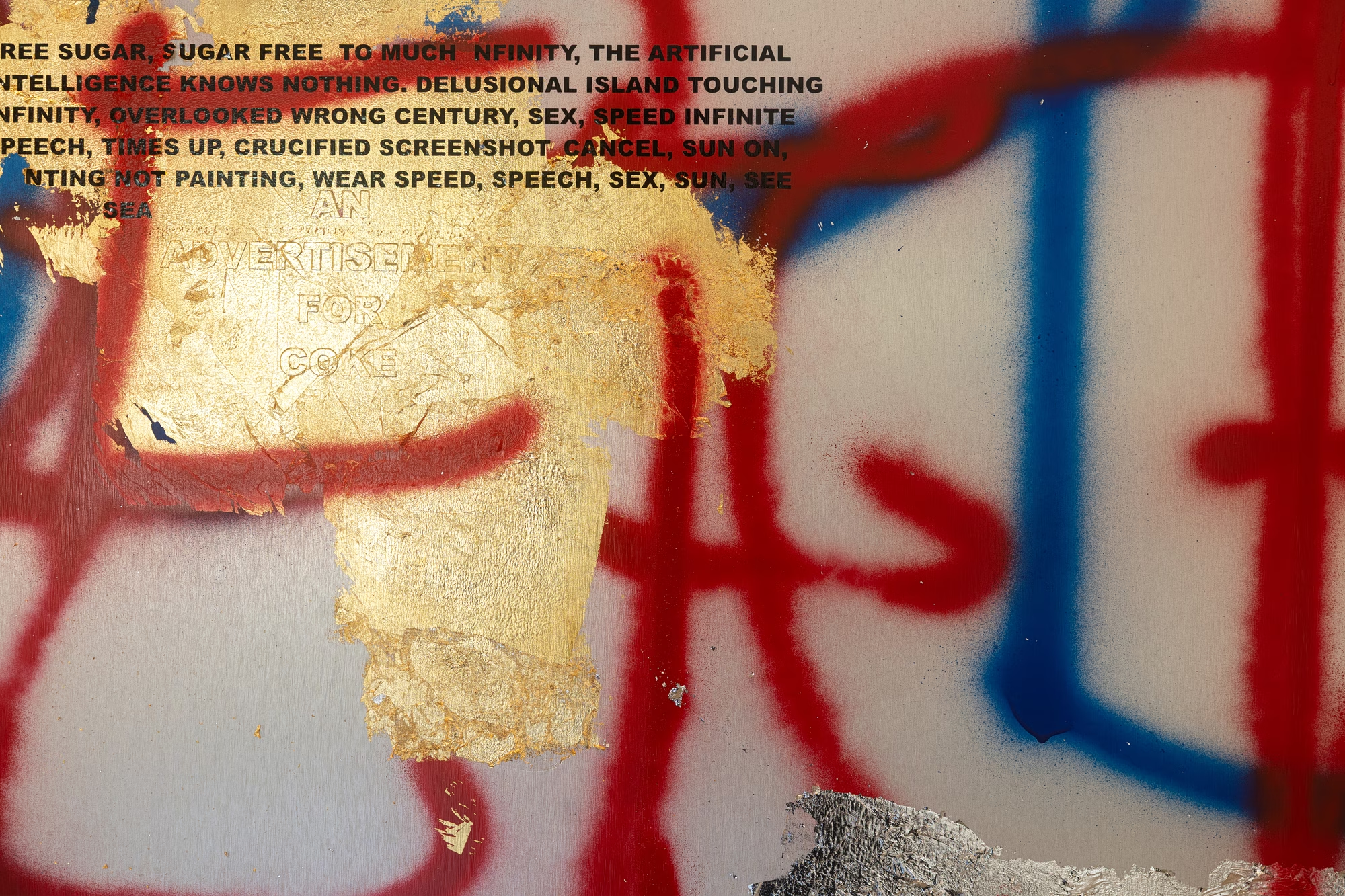
I wanted the exhibit to capture that feeling rather than simply depict the landscape itself. Gold leaf was a natural choice because it has a unique relationship with light. Unlike paint, it reflects and changes depending on where the viewer stands and how the light hits its surface, making every encounter with the work slightly different.
Beyond its physical qualities, gold carries deep symbolic meaning. Across different cultures it has been tied for centuries to the sacred and the divine, while also embodying ideas like value, wealth and permanence.
I was interested in bringing these spiritual and economic associations together, letting the material itself operate on multiple levels. Marble, by contrast, conveys a sense of permanence, strength and prestige.
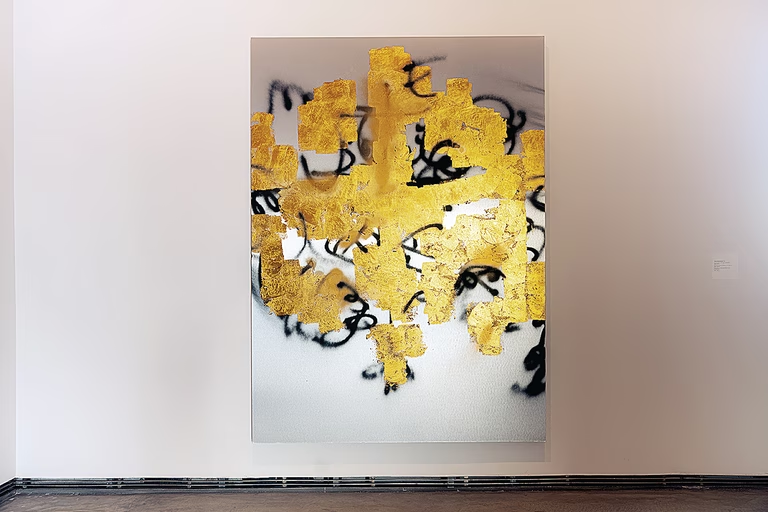
Photo Daniel Schaefer Studio
It’s a material that has carried some of humanity’s most enduring symbols for thousands of years, from temples and monuments to sculptures that embody collective memory and power.
I wanted to draw on that inherited symbolism, using marble not only for its physical solidity but for the cultural weight and timelessness it carries.
So the exhibit is built around the dialogue between the fleeting and the lasting, light and matter, the intangible and the monumental. My goal wasn’t to literally recreate Ibiza’s light, but to convey its emotional, spiritual and transformative presence through materials that carry their own history, symbolic weight and enduring power.
The exhibit was created specifically for the museum’s Sala d’Armes, where the architecture, history and natural light become part of the experience. Does the character of a space or museum shape how you develop your works? If so, at what point does the space start to function as a material within the exhibit?
I never treat architecture as a neutral backdrop. It has its own history, its own character and its own energy. Every space affects how I think about scale, light, materials and how people move through an exhibit. For ‘Cel d’or,’ the Sala d’Armes became part of the work itself.
Its shifting natural light activates the gold leaf throughout the day, while its solid stone architecture creates a dialogue with the marble. At that point, the space stops being just a backdrop and becomes another material, one that shapes the experience just as much as the artworks themselves.
Gold is often linked to wealth, beauty and excess, but it can also point to spirituality, strength and permanence. What does it represent for you in “Cel d’or,” and did you want to challenge how it’s usually perceived on an island so closely tied to luxury and pleasure?
Gold has always been misunderstood. Most people see it as a symbol of wealth or luxury, but those are only its most surface-level meanings. Long before it became a financial asset, gold was a spiritual material, used in temples, icons and sacred objects to symbolize light, transcendence and eternity.
In ‘Cel d’or,’ I wanted to bring back that deeper meaning. On an island where luxury is often reduced to consumption and spectacle, I was interested in asking whether gold could instead function as a tool for reflection.
Its value isn’t in its price, but in its ability to transform light and our perception. Maybe the most luxurious thing today isn’t owning some expensive object, but experiencing a moment of silence, beauty and complete presence. That, to me, is the real gold of Ibiza.
You move very naturally between painting, sculpture, architecture and large-scale installations, often letting a work expand across an entire wall or space. Do you start from an idea and then discover the form it needs to take, or do the material and space sometimes generate the idea itself?
I never start from a medium. I start from a question, and that’s my own form of writing. The idea itself chooses its form. Sometimes it becomes a painting, sometimes a sculpture, and sometimes it needs to take over an entire space.
Materials and architecture aren’t just tools. They think alongside me. The work emerges through that dialogue, not through a predetermined plan.
Language stays central to your work, but the words you use rarely offer a simple or fixed meaning. How do you decide which words or phrases deserve to take physical form, and what changes when language is no longer read on a page or screen but encountered through marble, gold, neon or spray paint?
I don’t choose the words. They choose me. A word becomes a work of art when it refuses to remain merely language. When it carries enough tension, contradiction or silence to demand a body.
I’m not interested in communication as an end in itself. I’m interested in transformation. Once a word leaves the page and becomes marble, gold, neon or spray paint, it stops being something simply read and becomes something the viewer has to reckon with.
It gains weight, scale and presence. At that point, language is no longer information. It becomes architecture, matter and experience.
Your work is often discussed within the history of conceptual and text-based art, though it also carries a strong physical, emotional and sometimes almost punk energy. How do you feel about your connection to that tradition, and why do you think art that incorporates language can have such a powerful effect?
I’m glad to be part of the tradition of conceptual and text-based art, because it taught us that ideas can take on physical form.
But I also feel the need to disrupt that rule. What defines my practice is the clash between the intellectual rigor of conceptual art and a punk attitude that refuses complacency.
That tension reflects the social and political moment we’re living in, one that demands both critical thinking and the courage to question established narratives. Language is powerful because it shapes how we perceive reality.
When words enter the space of art, they stop simply describing the world and start questioning it. For me, that’s exactly where their real power lies.
As one of the notable presences on Ibiza’s art scene, how do you envision the future of art on the island, and why do you think it’s currently going through such a dynamic period of artistic growth?
I think Ibiza is entering one of its most exciting cultural periods. The island has always been a laboratory for new ideas. Since the era of the hippie movement, it has challenged conventions in music, architecture, hospitality, nightlife, even in the way people choose to live.
Art is simply the next chapter of that story. The real opportunity lies in moving past the cliche of Ibiza as a luxury destination and recognizing it as a place where culture is produced, not just consumed. That takes ambition and a willingness to take risks.
I remain optimistic, because artists, institutions and collectors are starting to share this vision. If Ibiza stays bold enough to support ideas that challenge rather than ideas that reassure, it won’t just have an art scene. It will grow into one of the most important cultural voices in the Mediterranean.