 Μake us preferred on Google
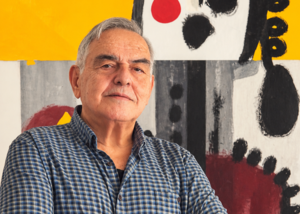
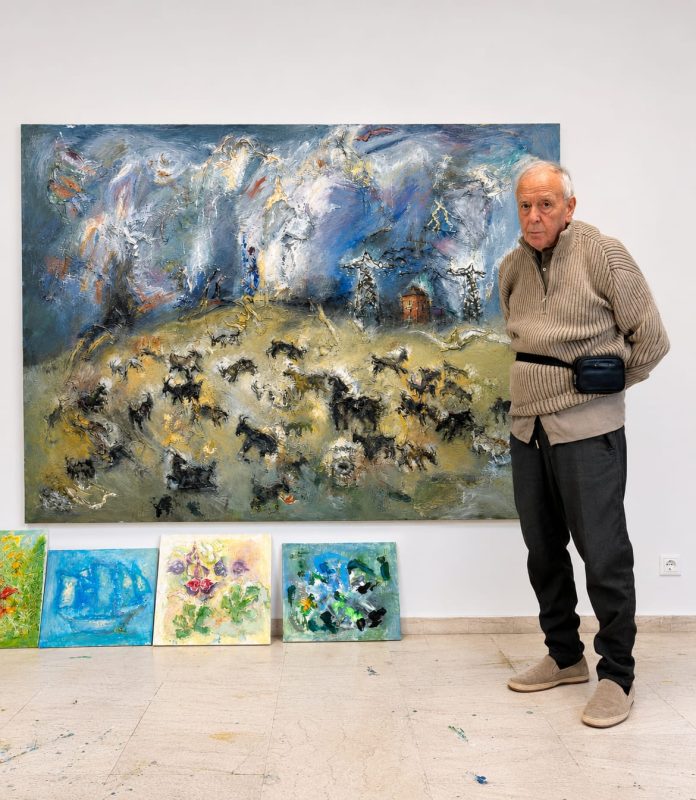
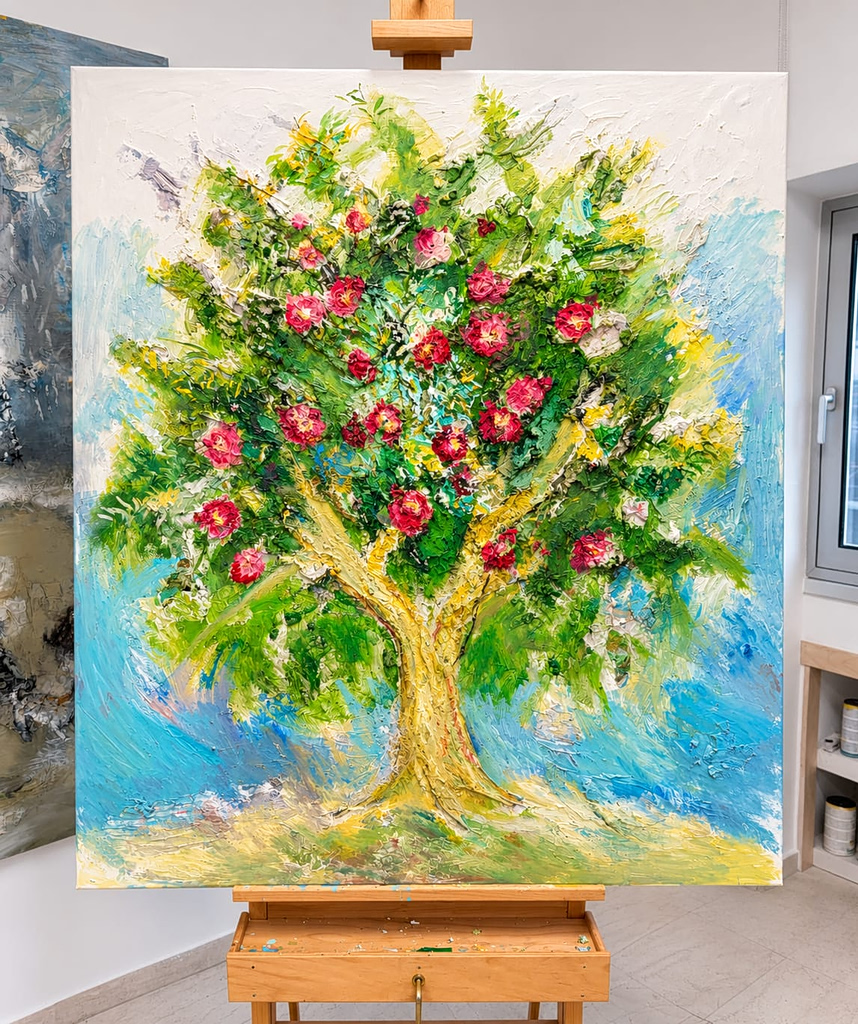
“I want something that isn’t trees again,” I tell him when we get to the photographs that will accompany our interview. Taking a look at the works around him, Yiannis Kottis suggests the olive trees, then a different painting. And just when I think we’ve agreed, he adds: “You could put a tree in, too, if you want.” It was likely naive of me to visit his studio and ask to leave the trees out.
I had arrived under the impression that I knew his painting, yet I struggled even to describe the surface of his works. “The materiality,” I offer. He looks at me, puzzled. I explain that I mean his rough, heavily textured impasto. “The matière, as they say,” he corrects me. From there, the conversation turns to his father, who was a plasterer. Kottis constantly returns to what he knows through his hands and his memory. Even when… In the end, I stop asking for photographs without trees.
Looking at his works, it occurs to me how easily we fall into the habit of attaching the “Greekness” label to painting that’s full of trees and fruit, animals and familiar landscapes. In Kottis’s case, however, the definition is simply insufficient. There is the memory of a place, certainly, but there is also the distance from it, the years abroad, the insistence on hard, physical work, and even the refusal to deem the ordinary any less interesting than the modern. These are the threads I attempted to follow in our conversation. A man’s journey toward discovering his own way of seeing this world.
You grew up in Kokkoni, Corinth; what’s stayed with you from those early years?
My father was a plasterer, as were my two brothers. He would take me along with him from a young age, so I wouldn’t become a layabout, as he used to say. I fetched water, helped out. It was not ideal for a child, but I learned how to work, and how to work with others. I still feel guilty if I’m not working.
When did you realize you wanted to paint?
It didn’t happen suddenly; it was an instinct. I remember a calendar with works by Spyros Vassiliou that I really liked. I didn’t get into the School of Fine Arts the first time I tried—I’d gone entirely unprepared. That’s how I found myself at the Doxiadis School. The graphic arts seemed too technical to me, but when I painted, I felt I was in my element.
PANOS KOUGIAS/TO BHMA INTL EDITION
What did Nikos Nikolaou and Yiannis Moralis teach you?
Nikolaou would send us out to paint in the open air. I’d go to Larisis Station and paint a train. He used to say that you didn’t need a beautiful landscape, just a good spot to sit. Moralis was extremely methodical. He’d sit beside us, teaching us composition, color and technique. He taught us the hands-on, craft aspect of our art. He loved his students, too, attending their exhibitions and helping them out when he could.
Your scholarship took you to Paris; did you want to leave?
Not especially. Moving from Kokkoni to Athens was already a massive step. But in France, I saw museums, exhibitions, other painters. Your fellow students would tell you, “go see this,” and you learned from it. At that time, we didn’t have as many opportunities here in Greece.
And how did you find your personal idiom when you were over there?
I know this will sound funny, but it’s true. I was in the studio one day, when I suddenly remembered my mother’s stuffed tomatoes and zucchini. And I said to myself, “that’s what I’ll do.” The trees of Corinth, the nature I grew up with, followed on from that. I liked Bonnard and Matisse, but I had to paint what I knew and what made me happy.
Was there also an element of nostalgia in this return to Greek imagery?
Perhaps. We would come back from Paris by coach, a two-day journey, and I was happy I’d get to see my homeland again and speak my language. I loved France too, but there are images you carry with you from childhood.
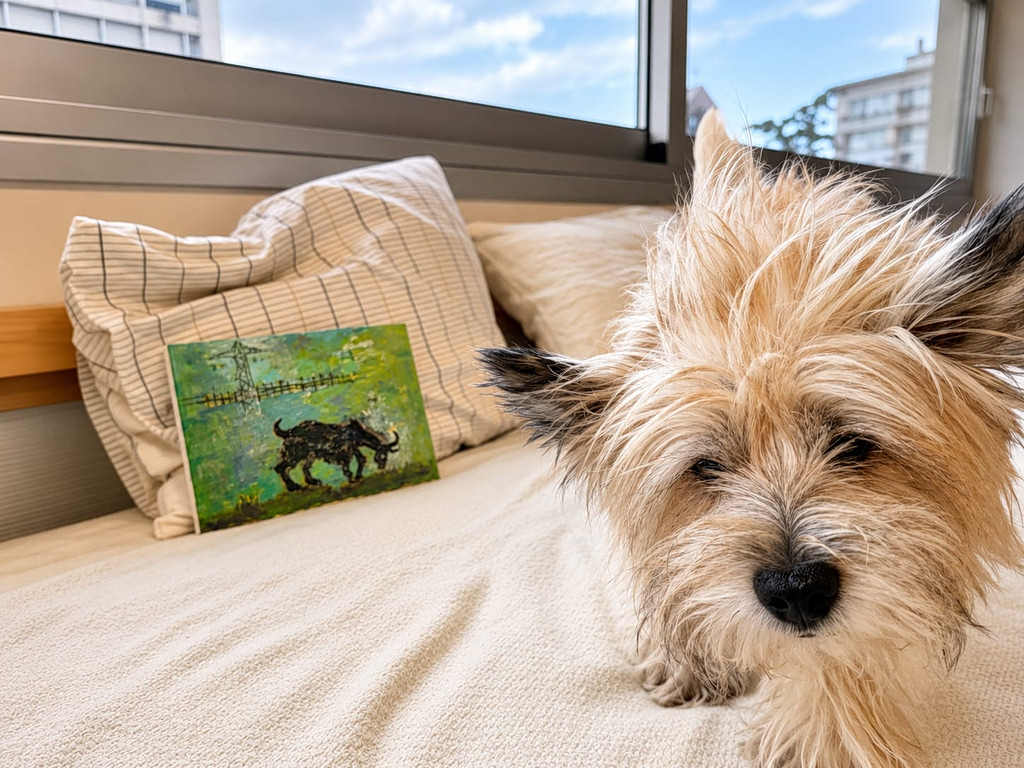
Milou, Yiannis Kottis’ beloved dog, next to one of his paintings. PANOS KOUGIAS/TO BHMA INTL EDITION
What did your distinction at the Salon de Montrouge in 1984 mean to you?
It was a good salon, difficult to get into. But it wasn’t something that changed my life. I was interested in working, in painting. Even major exhibitions require so much organization—getting the works together, finding them. I prefer the studio.
Why do bicycles appear so frequently in your paintings?
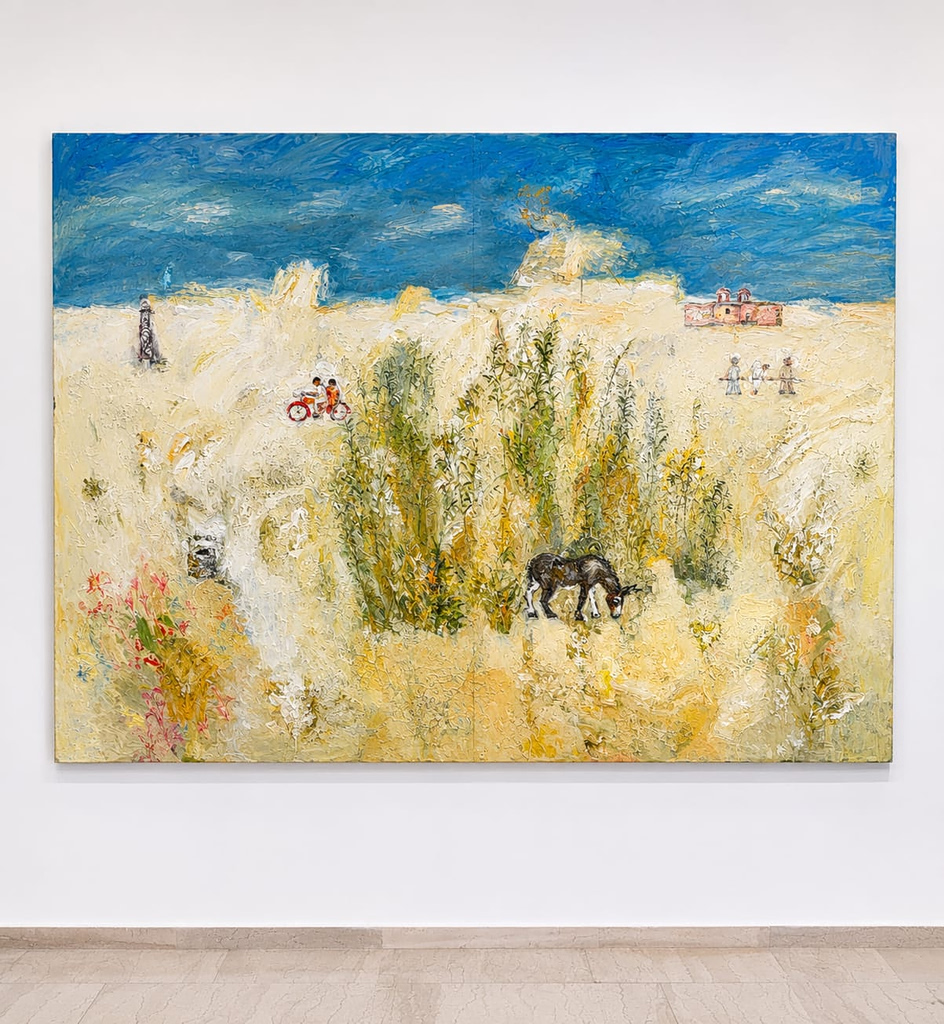
When I was a child, I desperately wanted a bicycle so I could get from Kokkoni to Velo. Those were difficult years, and it was my dream. It wasn’t that I wanted to create a nice motif; bicycles were something I’d loved.
Is the matière of your works connected to your father’s trade?
It could be. My father worked with surfaces like that. Perhaps something stuck. I have tried painting a smoother canvas, without matière, but it doesn’t work for me. As soon as I add a little more paint, something happens.
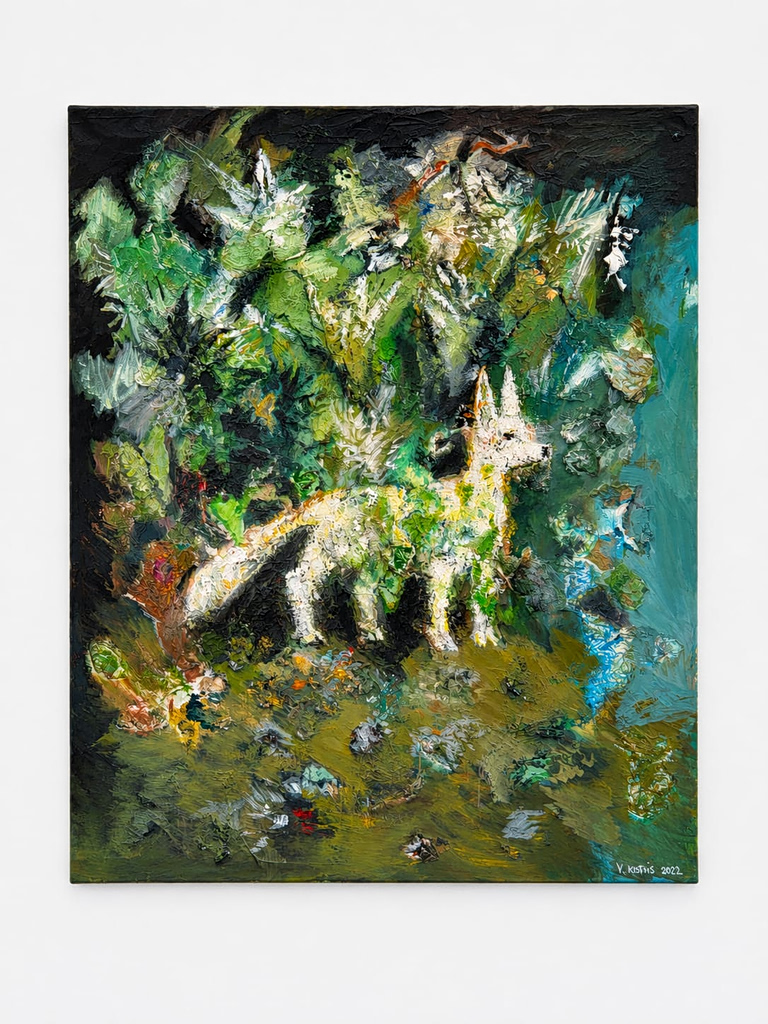
Your landscapes do not always correspond to recognizable places. Is that a conscious choice?
Yes, that’s exactly what I want. For the viewer not to know the location of what they’re looking at. It might have elements from Corinth, others from France, a storm, animals running. All of which comes out differently. I want my works to have something otherworldly about them. They take on a metaphysical quality.
PANOS KOUGIAS/TO BHMA INTL EDITION
What connects you so deeply to Hydra?
I first visited when I was a student. I was captivated. Hydra isn’t just the harbor everyone is familiar with. It has wonderful places higher up, behind the settlement. Later on, we acquired a house there. But just because I paint a mule doesn’t mean I’m painting Hydra. I do not like folkloric readings like that.
Your paintings have also circulated widely as silkscreen prints. How do you feel about this sort of reproduction?
It doesn’t bother me. People asked to turn works of mine into silkscreens, and I said yes. Sometimes, I didn’t even ask for money. I liked that my work could reach more homes and people who would never buy a large painting.
What’s your take on recurrent themes in painting?
Fassianos used to say that what you do must bring you joy. I agree. So you can return to a subject, just as long as you enjoy your work. If you only paint for fashion or celebrity, what’s the point?
What advice would you give a young person studying painting today?
I’d tell them to work at it. To learn drawing first, the basics, and then do whatever they want. I’d say they need to focus and delve deeper. And to know where you come from. If you don’t put your lived experiences to work, what you produce will be fake. Do whatever you want, as long as it is yours.
One of Yiannis Kottis’ famous pomegranate trees. PANOS KOUGIAS/TO BHMA INTL EDITION