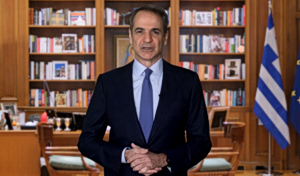
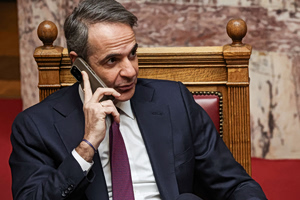
Greek prime minister launches formal process to revise the 1975 Constitution, proposing changes to ministerial accountability, public administration, higher education, fiscal safeguards and the role of the president, while calling for broad political consensus
A nationwide survey on voting intention shows the governing party holding its lead, as Greeks express skepticism toward a newly announced party by Maria Karystianou and a hypothetical return by former Prime Minister Alexis Tsipras
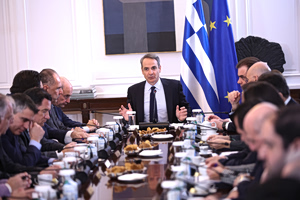
At the first Cabinet meeting of the year, PM Kyriakos Mitsotakis stressed political stability, wage increases, reforms for a citizen-friendly state and expanded voting rights for Greeks abroad, while his ministers outlined key legislative initiatives for 2026
Mounting pressure inside the ruling party is reviving scenarios once considered unlikely, from a cabinet reshuffle to early elections, as shrinking margins and geopolitical uncertainty leave little room for delay
As Greece’s center-left heads toward a pivotal party congress, internal disputes over strategy, leadership and post-election alliances risk defining PASOK more than its response to voters’ everyday concerns
Kyriakos Mitsotakis warned of mounting global instability and called for calm in transatlantic relations, as President Konstantinos Tasoulas stressed the country’s constitutional duty to uphold international law and peace.
John Mueller (1970), now Professor Emeritus of Political Science at Ohio State University, in his classic analysis of the popularity of presidents in the US, argued that the rise in popularity of political leaders in times of international crises is not due to a substantial change in citizens’ political preferences, but instead to a psychological […]
Where the government Is betting and how It will act in 2026. The projection of international instability risks and Maximos Mansion’s (the Greek Prime Minister’s office) assessment that the majority of citizens are unwilling to risk—or worse, lose again—the few gains they have achieved through great effort and sacrifice.
As Maria Karystianou moves toward electoral politics, reactions ripple across Greek parties, contributing to a rupture inside SYRIZA and the removal of one of its MEPs from the European Parliament group
With tractor blockades still in place, Athens hints at tougher enforcement while highlighting unemployment gains, wage hikes and tax relief in a bid to regain control of the political narrative
What has changed since last November, beyond increased fluidity and more active U.S. interest in the region? Around the Foreign Ministry, two approaches are observed
Amid a cost of living crisis, ongoing farmer protest and political fatigue, a pivotal pre-election year approaches, one that could redraw party lines, test old leaderships and introduce new, unpredictable players
Over half the respondents (54%) said the government’s top priority in 2026 should be inflation.
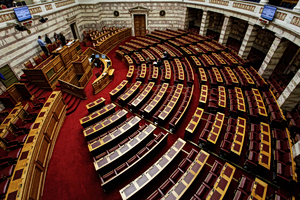
The magic of Christmas seems to have thoroughly passed through the surroundings of Parliament
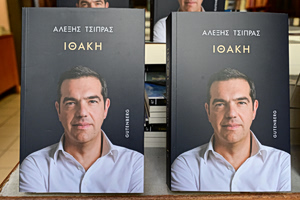
Tsipras’ new memoir traces the conflicts that shaped Greece’s crisis years, revealing a politician intent on revisiting his choices, redefining his image, and testing whether the country’s fractured Left still has room for him
From the Truman Doctrine to Obama’s rolled-up sleeves and today’s Mamdani moment in New York, Greece has long absorbed the political winds blowing from the United States—often belatedly, yet profoundly.
From Cold War intrigues to Kimberly Guilfoyle’s appointment, 80 years of U.S. envoys in Greece reveal a relationship defined by admiration, tension, and the constant test of diplomacy
Despite stable polling numbers, Greece’s ruling party seems trapped in insecurity and short-termism, while the opposition remains uninspired—leaving voters disenchanted ahead of the next election
Political figures across Greece paid tribute to Dionysis Savvopoulos, the singer-songwriter who shaped Greek music and public life for six decades, following his death at 81
Public opinion remains split on what the next government should look like: 44.8% favor a coalition, while 49.8% prefer a single-party majority, even if that requires repeat elections.