Travel days are stressful even under the best of circumstances. Add young children, winter weather and a sudden collapse of an entire national air traffic control system, and the result is something closer to chaos.
For travelers to and from Greece, Sunday was not just another disrupted holiday return. It was a systemic failure, one that stranded thousands of passengers across Europe and beyond, unable to get home, get to work or even get reliable information about whether their flights still existed.
Greek airspace was effectively shut down after a communications failure knocked out radio contact between air traffic controllers and aircraft. Departures and arrivals were suspended nationwide. Some outbound flights were later allowed to resume under strict limits, but a lot of inbound flights were diverted, turned back or canceled outright. At Athens International Airport, the country’s main aviation hub, the situation quickly became untenable.
A Busy Day Turns Into a Standstill
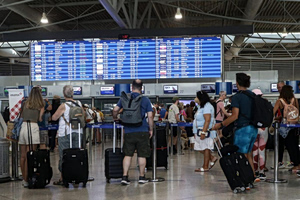
The timing could hardly have been worse. It was one of the busiest travel days of the year, with Greeks returning from holidays abroad and an equally large number of residents, expats and visitors trying to leave the country. Instead, airports filled with stranded families, exhausted workers and confused tourists.
More than 90 flights were affected in and out of Athens alone. Thessaloniki airport shut down entirely. Flights departing from Dublin, Barcelona and Paris were ordered to return to their points of origin. Services from Copenhagen, Amsterdam and Malta were canceled. Other arrivals were placed on indefinite standby, while flights into Athens were diverted to Turkey if they were not canceled outright.
By mid-morning, Greek airspace was nearly empty.
The View From the Terminal
That uncertainty was not theoretical. Many passengers, ourselves included, found out their flights were canceled not from the airline, but from departure boards in the various different airports across Europe ans beyond.
In our case, the airline app dutifully updated our gate information while failing to mention a far more relevant detail: the aircraft assigned to our flight had never even left Greece. Check-in was closed for a flight that would never depart. Calls to the airline went unanswered, overwhelmed by thousands of similar attempts. Social media channels offered little more than a generic suggestion to “monitor the website.”
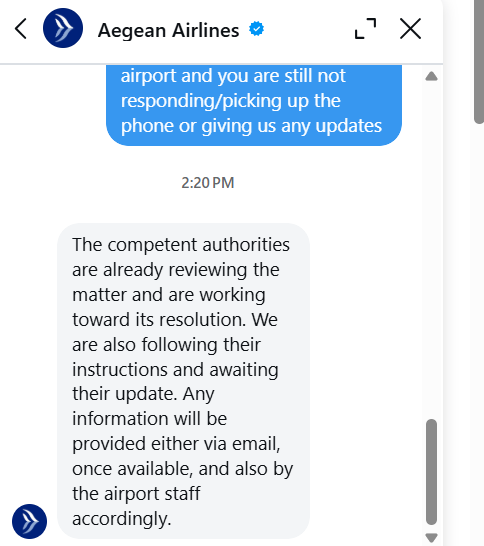
We were lucky. We waited and didn’t leave for the airport until we could confirm that a plane had actually departed Greece toward our destination. Many others were not so fortunate. Families with children, elderly travelers, and tourists unfamiliar with the system were left to play detective, refreshing departure boards, tracking aircraft online, and guessing whether they needed to find food, accommodation or alternative transport.
That should never be the customer’s responsibility.
Airlines Under Pressure, Passengers in the Dark
Greece’s national carrier, Aegean Airlines, found itself overwhelmed by the scale of the disruption. From an observer’s perspective, the strain was understandable. No airline causes a radar or communications failure. But from the passenger’s seat, especially at a time when ticket prices rise year after year while services shrink, the inability to provide timely, accurate information was harder to accept.
This was not about assigning blame for the technical fault. It was about communication. In a fast-moving crisis, airlines are still expected to tell passengers when flights are delayed or canceled, to staff help desks, to provide functioning phone lines and to offer clear guidance on next steps. For many stranded travelers, none of that materialized.
A Fragile System, Long Known
Sunday’s shutdown may feel like a “black swan” event -a sudden antenna or radar failure- but it landed on top of problems that have been documented for years.
As reported by TO BHMA International Edition, Athens’ air traffic control system relies on equipment that is more than two decades old. Spare parts are difficult to source. Staffing levels are stretched. Backup systems have failed repeatedly. In August, during peak tourist season, the failure of a terminal radar left controllers relying on a single remaining unit. A replacement part had existed for months but had not been procured in time.
According to air traffic controllers, Athens Airport has a nominal capacity of 22 arrivals per hour. In summer, by pushing staff to the edge of safe limits, that number rises to around 28. Peak demand can reach 45. The math does not work, and safety is not optional.
International airlines have noticed. Ryanair has publicly complained that more than one million of its passengers have been affected by Greek ATC delays this year alone, citing understaffing, outdated equipment and chronic mismanagement.
Tourism Rhetoric Meets Reality
Warm words about tourism’s contribution to the Greek economy do little to change the lived reality at the country’s main gateway. Athens International Airport has posted record passenger numbers, but infrastructure and airspace management have not kept pace. Each year, the strain becomes more visible, more disruptive and more costly, not just for airlines, but for passengers whose lives do not pause when a radar goes dark.
The scenes at airports across Greece on Sunday, overwhelmed terminals, unanswered questions, families stuck indefinitely, felt like a microcosm of a familiar national pattern: ambition without execution, plans without timelines, hope without redundancy.
Who Pays the Price?
As flights slowly resume, the practical questions remain unanswered. Who covers the cost of missed workdays, lost wages, extra hotel nights and rebooked tickets? How will airlines restore trust after leaving passengers to piece together basic facts on their own? And most importantly, how can authorities ensure that a single technical failure does not again bring an entire country’s skies to a halt?
Officials say an investigation is underway. Greece is working with neighboring countries to manage traffic. A “holistic action plan” for aviation modernization has been announced, with promises of new staff and upgraded systems, though some critical improvements would not be operational until the end of the decade.
In the meantime, thousands of travelers remain stranded or delayed, trying to get home before the workweek begins. Many now face sharply higher prices, as limited seat availability and scarce alternative flights drive fares upward.
For them, this was not an abstract policy failure or a line item in an EU compliance report. It was a canceled flight, a crying child, an unanswered phone call — and the unsettling realization that in 2026, one technical fault can still silence an entire country’s airspace.