Greece is once again facing a familiar paradox this summer. For the third year running, higher visitor numbers are not translating into the revenue tourism businesses had counted on, according to industry figures who had expected a stronger start to the season.
July disappoints in top destinations
The picture that emerged in July across some of the country’s most popular islands, including Santorini and Rhodes, was described as disappointing by stakeholders in the sector as a rise in visitor traffic failed to produce an increase in spending.
“Visitors came, but they were more restrained in their purchases, dining and entertainment,” tourism industry figures said, describing what several called a weak month in terms of spending.
Two main factors are being blamed for the shortfall. The purchasing power of European travelers has been squeezed, prompting many to travel on smaller budgets. At the same time, geopolitical uncertainty, particularly the war in the Middle East, is believed to have discouraged some visitors from booking trips to the region altogether.
The FIFA World Cup, hosted this summer in North America, also appears to have drawn away part of Greece’s usual British and American clientele. Industry sources say airlines were reportedly offered incentives to route American travelers toward World Cup host cities, both to fill stadiums and to help ensure the tournament’s commercial success, a push that is thought to have kept a meaningful number of Americans closer to home this year.
August brings a turnaround
The mood has shifted noticeably since the start of August. Traffic has picked up and business owners are reporting renewed optimism as the peak of the Greek summer holiday period drives higher occupancy and stronger demand. That improvement has raised hopes that at least some of the revenue lost in July can still be recovered.
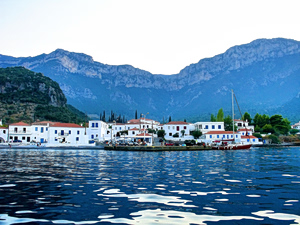
The islands currently seeing the strongest activity include Crete, Rhodes, Corfu and Kos, alongside Greek tourism’s two best known names, Mykonos and Santorini.
The real test comes in September
Even so, the industry’s attention is already turning to September and the broader question of extending the tourist season beyond the usual summer period.
According to tourism analytics firm Mabrian, Greece’s seasonality index stands at 72.9 percent, well above Spain’s 52.8 percent and Portugal’s 54.5 percent, a gap that underscores how concentrated Greek tourism revenue still is in the summer months.
That makes a strong September more significant than usual this year. A solid final push could help offset July’s underperformance and give the market extra time to make up lost ground. As industry figures frame it, the goal for Greek tourism is no longer simply counting how many visitors cross the border, but how long they stay, how much they spend and how far into the fall the season can be stretched.
Chasing wealthier travelers
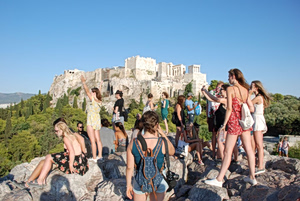
Behind the seasonal numbers lies a bigger strategic question: whether Greece can attract higher spending tourists on a more consistent basis. Industry figures say that will depend largely on the country’s ability to build proper tourism infrastructure well beyond Athens, which has undergone what several described as a genuine tourism boom in recent years.
That boom has been driven by the rapid growth of Airbnb listings, a wave of investment from internationally known five star hospitality brands, and the expansion of Athens International Airport, known locally as Eleftherios Venizelos Airport. The airport has added new routes and increased flight frequency from established markets such as the United States, helping fuel the capital’s rise as a year round destination.
Officials and industry figures are now hoping similar momentum can be extended nationwide. New rules under Greece’s forthcoming spatial planning framework for tourism, along with continued investment in public infrastructure to support the sector’s growth, are expected to upgrade the country’s overall tourism product and make it more attractive to higher spending travelers.
Greece continues to rank among the world’s most sought after destinations. TUI, Europe’s largest tour operator, recently named Greece alongside Spain as one of the two most popular destinations for travelers this summer, a signal that despite this year’s uneven start, the country’s broader appeal remains strong.
Source: OT.gr