
 Μake us preferred on Google
 Luxury handbags have gotten so expensive that they make $1,000 shoes sound like a deal.
At least to shoppers like Bryce Gruber, who said that was how she justified buying a pair of Miu Miu ballet flats this summer. Gruber, 42, who writes a shopping newsletter, had a visceral reaction to the $5,000 price tag of a small Bottega Veneta purse she was eyeing. To her, $1,070 ballet flats were way more reasonable.
Gruber’s purchase reflects a trend: Rising prices for luxury handbags, driven by increasing costs of labor and materials, are turning shoppers away from bags and onto shoes.
A medium Chanel flap bag, for example, now costs $11,700, up from $5,800 in 2019. As prices for the brand’s handbags have spiked, so has demand for its flats —like the $1,175 green croc-embossed pair that Lindsay Breen, a 34-year-old recruiter at a bank in Toronto, recently bought instead of a Chanel bag that she said cost as much as “a great family vacation.”
“Chanel flats sell like a pack of gum,” said Kelly Levian, founder of the Coveted, a concierge service that tracks down rare luxury goods for clients. Her team has sourced over 200 pairs of Chanel’s denim flats, which start at $1,075, since July.
Retail sales of luxury bags have fallen 10% since 2023, according to June 2026 data from Bain & Company, representing a loss of about $8 billion in annual spending. Luxury footwear sales have also been declining for a few years, but heels and statement footwear have shown early signs of recovery. “We expect sales to stabilize and eventually rebound,” said Bain senior partner Federica Levato.
The 2026 State of Luxury report released by McKinsey & Company and Business of Fashion predicted that footwear will be “a new, accessible ‘it’ item for clients to buy into a brand’s universe.”
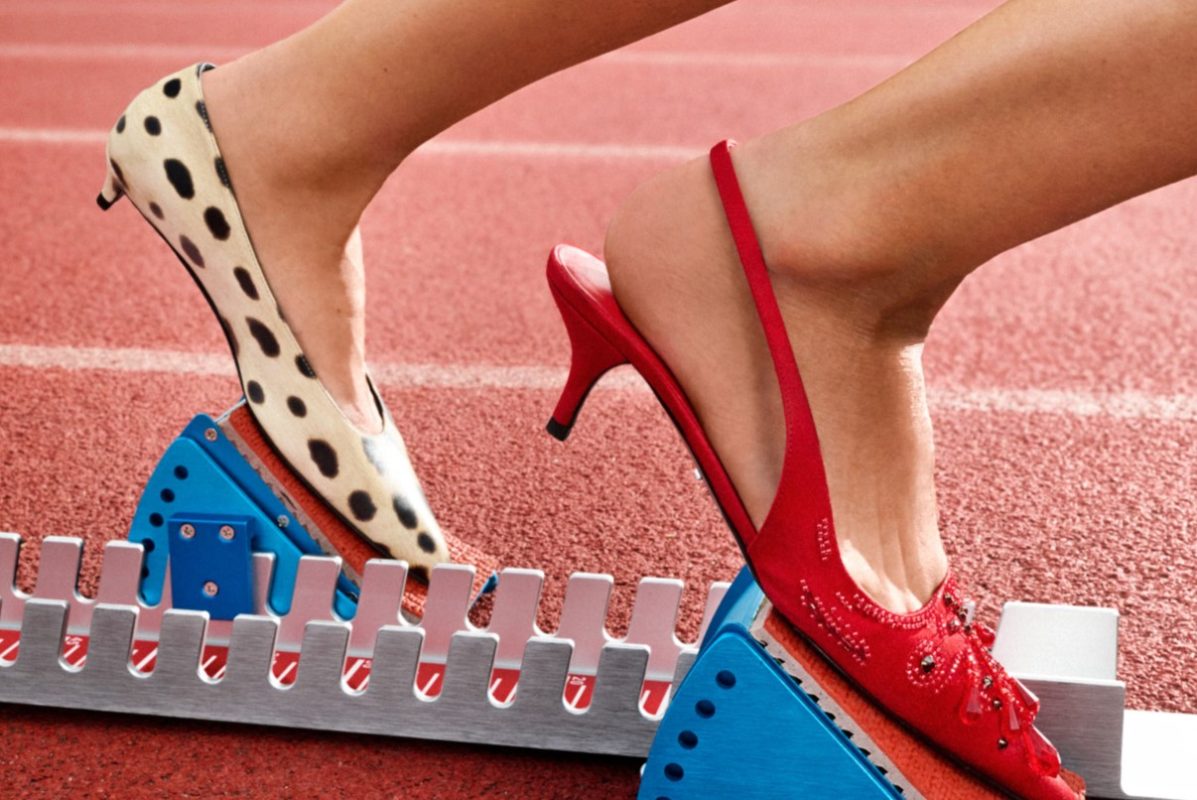
“I’ve always believed that shoes are going to be the new handbag,” said Catherine Holstein, founder and chief creative officer of Khaite. The brand’s handbag sales are healthy, but footwear sales are surging—up 100% this year compared to last, she said. “It’s easy for the luxury customer to spend $4,000 on three pairs of shoes impulsively,” Holstein added. But the same shopper will now “spend a year mulling over the same bag for $4,000. And still not buy it.”
Maegan Watson, a New York City stylist who dresses ultrahigh-net-worth families and executive women, said her clients aren’t buying as many handbags any more. “Not because they’re priced out, but because they can’t make sense of the investment,” Watson said.
Watson’s clients are more comfortable spending on luxury shoes, she added, because footwear completes an outfit more than a purse. The styles she buys frequently for her clients include Gucci Vittoria flats and Khaite’s Cecilia pumps.
Other ‘it’ shoes in recent years have included Alaïa’s $1,450 embellished Mary Janes, a silhouette that continues to sell well for the brand in fishnet mesh, paper straw and handbraided satin. Chloé, the bohemian French brand, had a smash hit this past summer with its $670 jelly mules, which followed in the footsteps of last summer’s hit: The Row’s $690 flip-flops .
Shoes like these have become the equivalent of popular handbags like the Fendi Baguette and Proenza Schouler’s PS1, which once defined micro-eras in fashion. With shoes at a lower price point than bags, shoppers may be more willing to experiment and not reach for the safest, most classic styles.
“There’s a real appetite for shoes with personality,” Jennifer Jones, the senior vice president of women’s accessories at Bloomingdale’s, said in an email.
Mytheresa, the luxury retail site, has seen an uptick in shoppers buying “party shoes” from Jimmy Choo and Christian Louboutin, as well “everyday shoes that replace sneakers” like Saint Laurent loafers and Phoebe Philo clogs, said chief buying officer Tiffany Hsu. Growth of the footwear category at the retailer has overtaken that of handbags, she added.
It’s not just luxury footwear that is getting a bump. The brand Larroudé has sold over 30,000 pairs of its $375 boat shoes since the style became available last year. “The retail price of our bestselling boat shoe is the equivalent of a keychain at some designer houses,” said co-founder Marina Larroudé.
But making a hit shoe has become trickier as algorithms oversaturate styles faster than ever. Some of the bestselling shoes right now at Tory Burch, whose logo-heavy Reva flats have waxed and waned in popularity over the years, are under-$500 slides, mules and wedges with abstract silver hardware—and no branding in sight. “I want to have interesting shoes that don’t necessarily have a logo or a brand DNA,” Burch said.
Otegha Uwagba, a 35-year-old writer in London, recently bought a new pair of Bottega Veneta heels on sale for about $480. She reasoned that shoes are more versatile than purses, she said, and is mostly buying handbags secondhand these days. “No one wants to feel like you’re being ripped off, and when you track the prices of handbags going up, you start to feel insane.”