 Μake us preferred on Google
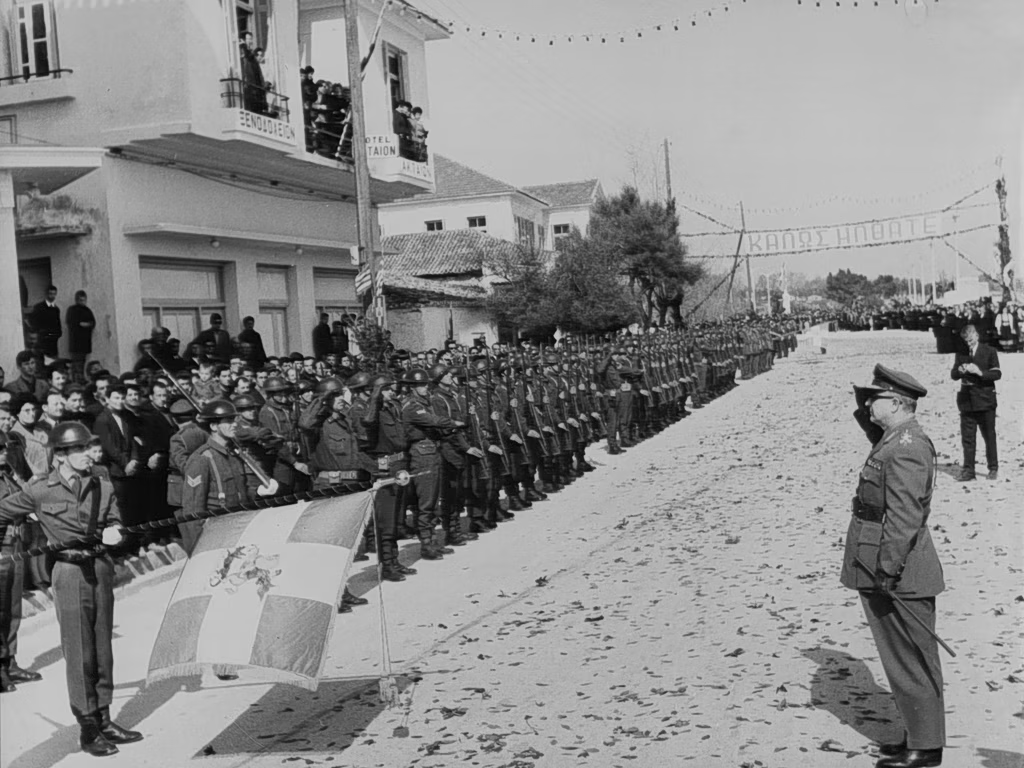
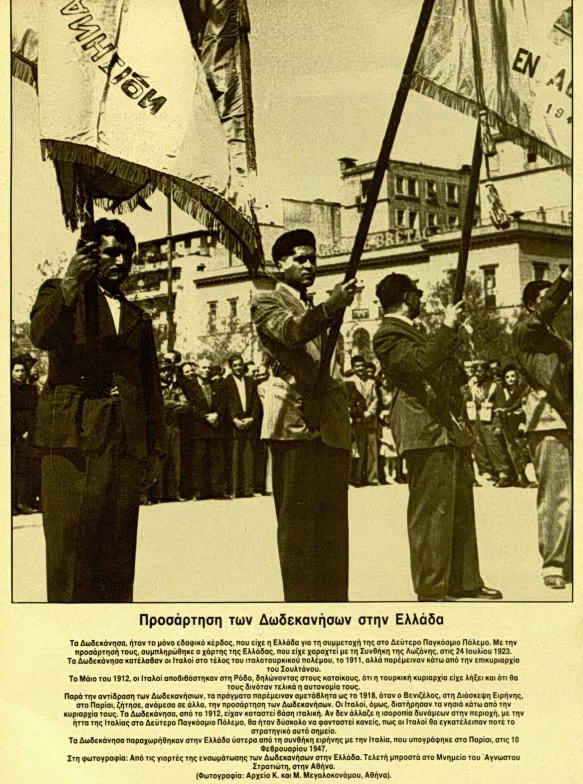
 On March 7, 1947, in the city of Rhodes, a historic ceremony marked the transfer of the administration of the Dodecanese islands to Greece.
The moment sealed the islands’ integration into the Greek state and represented the final major step in Greece’s territorial consolidation in the 20th century.
The atmosphere of those days is vividly captured in the pages of the newspaper To Vima dated March 29, 1947, through dispatches from the paper’s correspondents in Rhodes, journalists P. Palaiologos and Michalis Kyriakidis.
The headline itself captured the emotion of the moment:
“The national dream is fulfilled – The Greek flag will officially be raised the day after tomorrow in the martyred Dodecanese.”
The Administrative Transition
Alongside the excitement and emotion, however, the reports also documented the practical difficulties of integrating the islands into Greece’s administrative system.
According to the newspaper, the Greek government had already begun drafting legislation designed to facilitate the “assimilation” of the islands into the Greek state.
The report noted:
“The Political Council met yesterday at noon and dealt with various issues concerning the Dodecanese. It approved legislation that will facilitate their assimilation.
The bill, drafted on the basis of earlier legislation regarding the administration of the ‘New Lands’, was forwarded—after government approval—to the parliamentary committee for ratification.”
When asked whether, after the transfer of the military administration to Greece, free communication between the islands and the rest of Greece would be allowed, the government’s vice president, Konstantinos Tsaldaris, initially answered no.
Tsaldaris explained that until the islands were fully incorporated into Greece, they would operate under a special administrative regime.
Only after the new military governor had assumed his duties and studied the situation on the ground would he recommend appropriate measures regarding communications with the islands.

However, Admiral Ioannidis later informed a delegation of the Central Dodecanese Committee—including representatives M. Zervos, M. Kalogeropoulos, M. Volonakis, and L. Pteris—that the cabinet had ultimately decided:
- to allow free communication with the Dodecanese,
- to regulate transport links with the rest of Greece,
- and to lift restrictions on exporting essential goods to the islands.
Early Concerns
At the same time, Greek civil servants had already begun assuming administrative duties in Rhodes starting on March 10, following specific protocols.
But the newspaper’s correspondents also reported growing concern about potential organizational difficulties.
As they wrote, the local population had previously experienced the highly structured administration of a “European power” during the period of Italy’s rule over the islands (1912–1943), raising expectations for efficient governance from the Greek state.
“The absence of an informed and capable leader to guide the work raises concerns that difficulties and significant losses to the public interest may arise.
Apart from the removal of Mr. Tsigantes, officers of the Sacred Band who held important positions and were familiar with the plan for taking over the islands were also removed at the last moment.”
The correspondents added that many islanders believed the Greek government had to recognize something crucial:
Greece is being tested before a population that had experienced the administration of a European power and expects from Greece an even more efficient administrative performance.
The new leadership would immediately face complex issues, particularly transport and food supply.
A Promise of Equality and Democracy
The report also described the first proclamation the newly appointed military governor of the Dodecanese, Admiral Ioannidis, was expected to deliver to the population.
In it, he would promise equal rights, good governance, and respect for democratic freedoms.
“We are informed that the appointed military governor of the Dodecanese, Admiral Ioannidis, upon his arrival will address the people with his first proclamation, promising equality before the law and good governance, and expressing the hope that the period until the islands’ final annexation will be brief.”
Most administrative and commercial laws already in force would temporarily remain in place—except for fascist-era regulations from the Italian administration.
At the same time:
- Greek criminal law would immediately come into effect.
- Justice would be administered by Greek judges.
- Public order would be maintained by the Hellenic Gendarmerie.
The Dodecanese would be divided into four military districts, while civil servants appointed under Italian and British rule could remain in their posts if deemed suitable—provided they took a new oath of office.
The proclamation also guaranteed freedom of thought, private property, freedom of assembly and association, and all democratic liberties derived from the Constitution, regardless of religion, provided public order was not threatened.
Finally, residents were given three days to surrender any weapons.
Voices from the Island Communities
The newspaper also recorded statements from representatives of the islands’ different communities.
The Italian representative in Rhodes stated:
“I wish happiness and prosperity to the Greek people. I also hope that the Dodecanese—which for so many years was a source of disputes between Italy and Greece—will become a means of brotherhood between our two peoples, who live from the same sea.”
From the Turkish community, the Mufti of Rhodes, Sheikh Suleiman, acknowledged the delicate position of the minority but expressed optimism.
“With the belief that by respecting the laws and working diligently we will preserve our close ties with the Greeks, we welcome with particular joy the assumption of administration of the Dodecanese by heroic allied Greece.
These feelings are not formal—they arise from the hearts of all members of the Turkish minority.”
A People Celebrates
Despite efforts by the Greek government to limit public celebrations, the reports describe a population celebrating uncontrollably.
In Rhodes, receptions were being organized for the new governor. Delegations from villages across the island prepared to greet him at the airport and accompany him into the city.
The moment when the Greek flag would be raised was already seen as the historic culmination of a long struggle.
“The Turkish and Italian sailing ships in the harbor raised their flags. At these historic moments the thoughts of the people of Rhodes turn to Brigadier Tsigantes and the men of the Sacred Band who first landed in the Dodecanese during the war.”
The Sacred Band—an elite Greek military unit that fought alongside the Allies during World War II—had been among the first Greek forces to set foot on the islands as the Axis occupation collapsed.
For many islanders, that moment in March 1947 was not just a political transition.
It was the fulfillment of a national dream decades in the making.