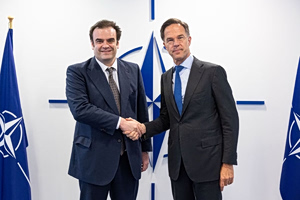
The European Council — the summit of EU member state leaders — currently convening in Brussels (proceedings began yesterday afternoon) comes in the wake of the US-Iran agreement that brings the grueling war to a close, an event that simultaneously reshapes the geopolitical landscape across the Middle East and on a global scale.
Alongside the war in Ukraine, Russia’s contentious activities, and trade relations with China, these developments form the main items on the external affairs agenda as leaders work to define the Union’s role on the world stage. On Ukraine, the EU intends to pursue “more active diplomacy,” including engagement in diplomatic processes and potentially direct contacts with the Kremlin. To that end, the appointment of a dedicated European interlocutor with Russian leadership may be on the table.
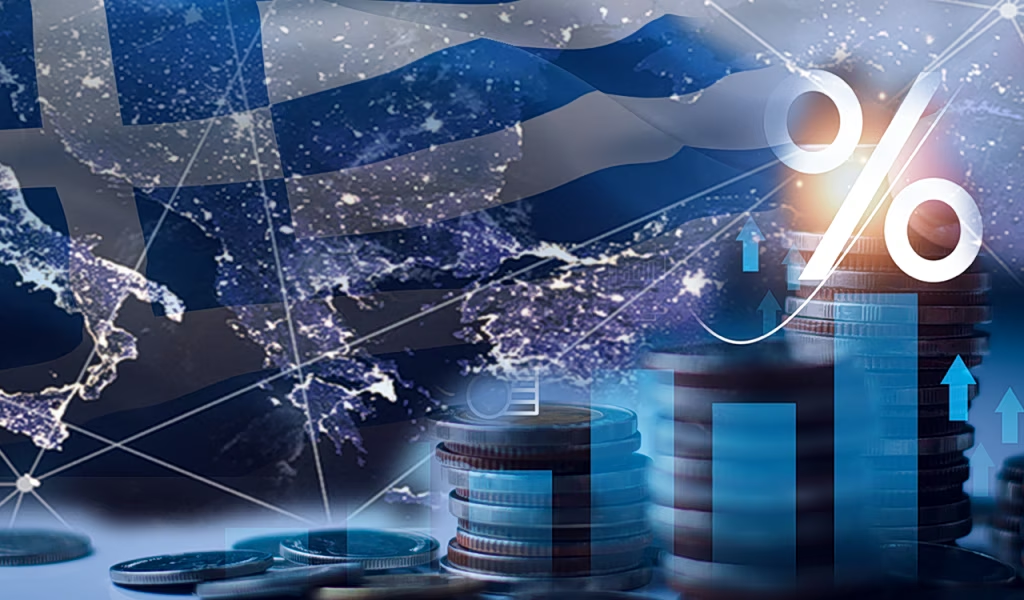
The issue that invariably “haunts” the European Council when it appears on the agenda, however, is the Multiannual Financial Framework (MFF), the EU’s long-term budget. The current summit has before it a new draft MFF for the 2028-2034 period, presented by the Cypriot presidency. As always, MFF negotiations divide North from South, the fiscally conservative from the budgetarily ambitious. And as always, Greece occupies a central position in these talks, pushing to strengthen agricultural policy and the structural policy of convergence and cohesion. In the current round of negotiations, Greece may also play a decisive, bridge-building role — in part because of its upcoming Council presidency in the second half of 2027, which looks set to be the presidency that will clinch the deal. And in part because Greece today is a country that, beyond cohesion and agriculture, has a stake in the development of new policy areas such as common defense, competitiveness, and energy.
Greece can also play a significant role in managing the new situation in the Middle East, including through the contribution of the Hellenic Navy to securing freedom of navigation through the Strait of Hormuz.
More broadly, on an important package of issues (unfortunately not all of them), Greece is now positioned to assume the role of honest broker, fostering what one might call “honorable diplomatic compromise” along the lines of the Eurogroup model. This applies, for instance, to the question of EU enlargement, which remains a standing item on the Council’s agenda. A prerequisite for developing that role is the rational management of the Turkey-within-the-EU question, with a clearer articulation of our strategic objectives. EU foreign policy chief Kaja Kallas, in her revealing interview with Ta Nea yesterday, emphasized that “it is important that we work together with Turkey.”
For its part, the European Parliament, in a recent report, condemned Turkey’s democratic backsliding while simultaneously recognizing it as a “key country for the Union” and an important partner. Given all of the above, Greece should move away from costless vetoes and recognize that, under specific conditions and conditionalities, deeper ties between Turkey and the EU serve both Greek and European interests — especially in the aftermath of the Iran crisis.
P.K. Ioakimidis is Professor Emeritus at the University of Athens, a former ambassador and foreign ministry advisor, and a member of the ELIAMEP advisory board. His new book, “Beyond Stereotypes: A New Progressive Foreign and European Policy,” is published by I. Sideris.