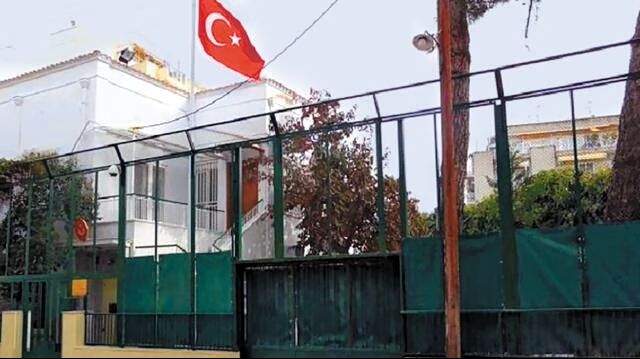
An NGO with allegedly close ties to Ankara has submitted a written statement to the UN Human Rights Council challenging official Greece’s treatment of the Muslim minority in Thrace, reviving a series of long-standing provocations by Turkey over minority identity, the status of muftis and the administration of religious institutions.
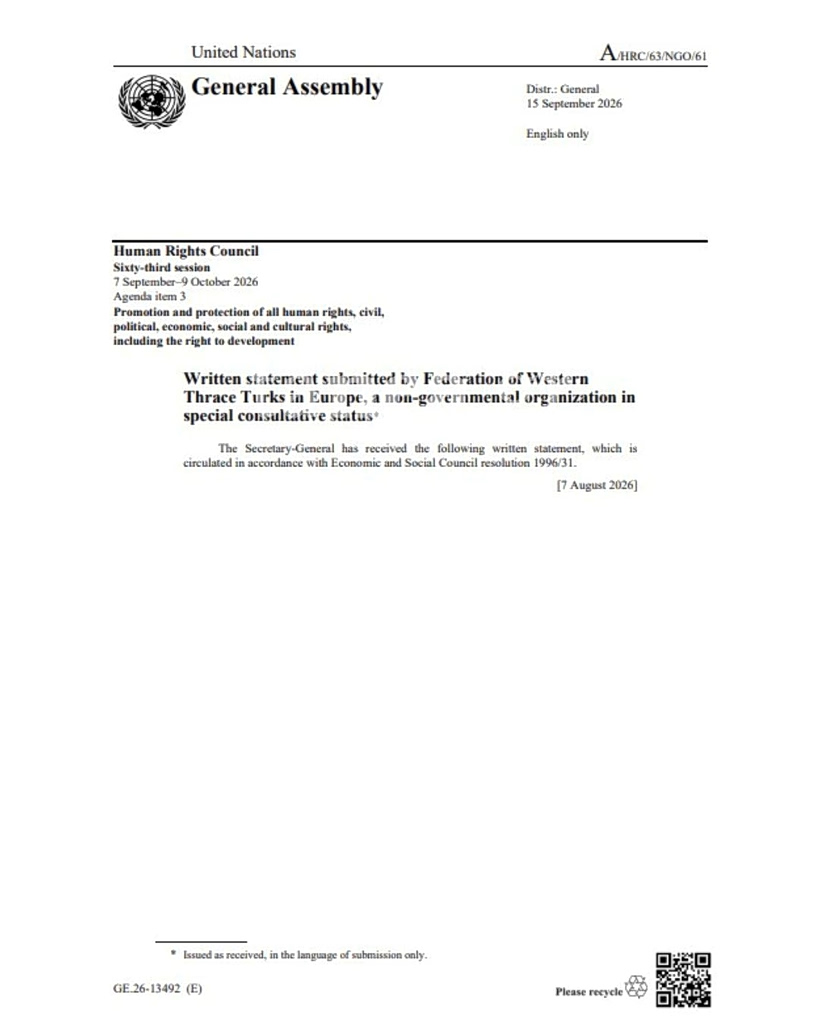
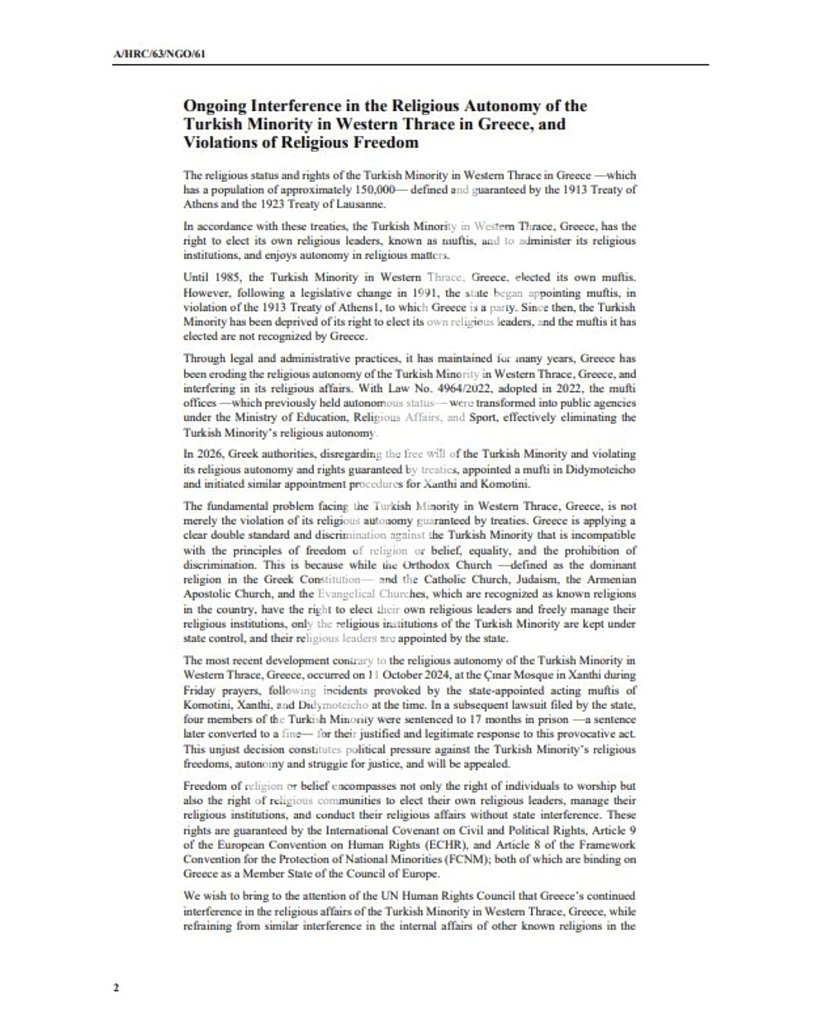
The statement, submitted by the self-described “Federation of Western Thrace Turks in Europe (ABTTF)” to the 63rd session of the UN Human Rights Council, accuses Greece of restricting religious autonomy and discrimination against the Muslim minority.
The organization’s submission refers to a “Turkish minority” of about 150,000 people, while Greece steadily points out that the Lausanne Treaty of 1923 recognizes a Muslim – “Moslem” in the original text – rather than ethnic minority in Thrace. The treaty established the legal framework governing the minority following the population exchanges between Greece and Turkey.
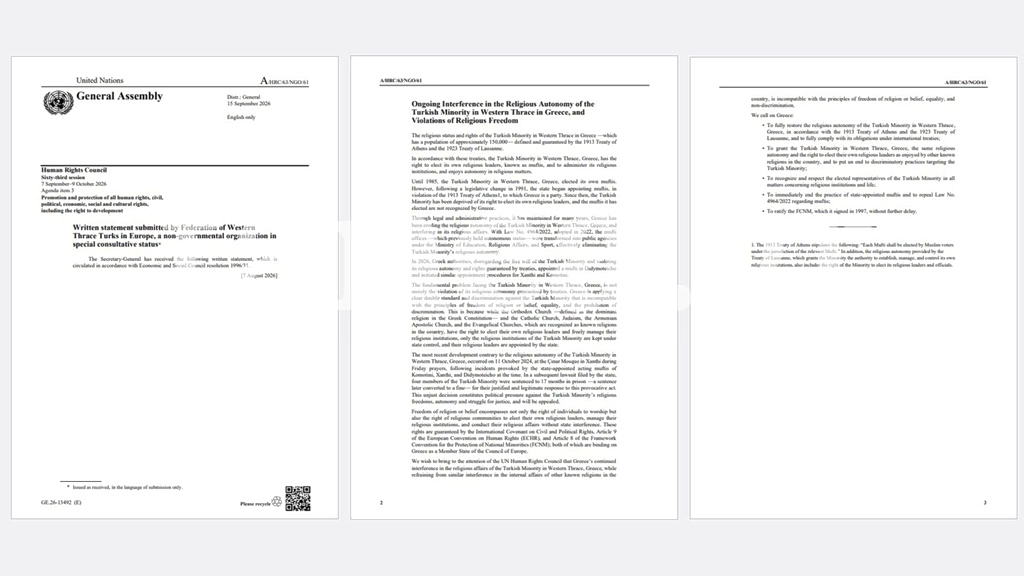
A central issue raised in the statement is the selection of muftis.
ABTTF calls for the restoration of the election of muftis by members of the Muslim community. Greek authorities, however, have argued that the current system reflects the special legal functions of the muftis, who can exercise judicial jurisdiction in certain family and inheritance matters under Islamic law.
Interestingly enough, muftis in predominately Muslim Turkey are appointed by the state.
The dispute also concerns legislation adopted in 2022 governing the religious estates. The NGO claims that the law transformed the “muftiates” into public services and curtailed their autonomy. The Greek government has presented the legislation as an effort to modernize their administration, strengthen transparency and provide institutional support while safeguarding religious freedoms.
Under the current system, muftis are selected through a process involving advisory bodies made up of local Muslim theologians and scholars. The government has said the procedure is intended to ensure merit-based appointments and limit political interference.
The organization also alleges unequal treatment compared with Greece’s Orthodox and Catholic churches and Jewish communities. The Greek position is that the comparison overlooks the distinctive judicial responsibilities assigned to muftis. Unlike other religious leaders, official and appointed muftis can exercise specific judicial functions, meaning their institutional status is not directly comparable with that of Orthodox Metropolitans and bishops, Catholic clergy or leaders of Jewish communities.
The statement further raises the 2024 incident at the Çınar Mosque in Xanthi, in which four members of the Muslim minority were convicted after an incident involving the official acting mufti of Xanthi. The organization describes the convictions as politically motivated.
The case followed an incident on Oct. 11, 2024, when a group sought to prevent the acting mufti from carrying out his religious duties. Greek authorities’ position is that the proceedings concerned acts of violence and disruption of a religious gathering rather than political activity.
The latest submission comes against the backdrop of a longstanding effort by Ankara to meddle in the characterization and institutional rights of members of the Muslim minority in Thrace, although the latter enjoy all the rights and privileges of Greek citizenship and the EU’s acquis. Greece uses the term “Muslim minority” in accordance with the Lausanne framework, while Turkey and organizations identifying with the minority’s Turkish identity have consistently used “Turkish minority”, ignoring a sizable community of non-Turkish Pomaks and Roma Muslims.
The dispute over terminology is closely linked to broader disagreements over religious leadership, the muftiates and the extent of their authority.
Athens has long maintained that the Muslim minority in Greece enjoys equal rights before the law and full protection of freedom of religious conscience and worship, compared with the near eradication of the ancient Greek (Rum) communities in Istanbul and the isles of Imbros (Gökçeada) and Tenedos (Bozcaada).