 Μake us preferred on Google
 Comments by Turkish Foreign Minister Hakan Fidan on the strategic Strait of Hormuz have drawn attention in Greece after Turkish media reported his remarks on navigation through the waterway, prompting renewed discussion of Ankara’s long-standing position on territorial waters in the Aegean.
Dışişleri Bakanı Fidan: (CAATSA ve F-35’ler) Biz bakanlar olarak bunları çözme konusunda uygun adımları atıyoruz. İnşallah yakında bir neticeye ulaşacağız. Bir sıkıntı olmayacağını düşünüyorum. pic.twitter.com/N35ZEgq4fR
— TRT Haber Canlı (@trthabercanli) July 10, 2026
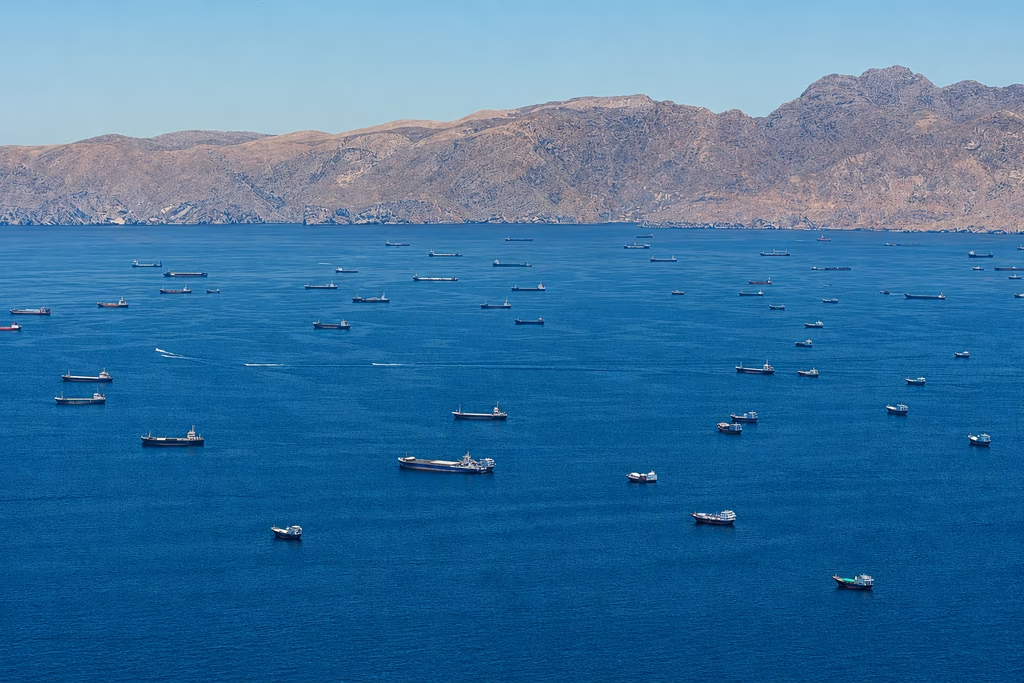
Discussing maritime traffic through the Strait of Hormuz, Fidan stressed the importance of keeping the waterway open for international shipping and said practical arrangements between Iran and Oman were needed to ensure freedom of navigation and prevent renewed tensions.
The discussion inevitably led back to one of the central issues in the long-running maritime dispute initiated and nurtured by official Turkey. While Ankara says it accepts the general principle that coastal states may establish a 12-nautical-mile territorial sea in many parts of the world, it claims the Aegean constitutes a “unique geographical and legal case” in which Greece should not be permitted to exercise that right unilaterally.
Under the United Nations Convention on the Law of the Sea (UNCLOS), coastal states are entitled to establish territorial waters extending up to 12 nautical miles from their baselines. Greece maintains that this right is unilateral and derives directly from international law, regardless of whether another state is a party to the convention.
Turkey, which has neither signed nor ratified UNCLOS, rejects that interpretation in the Aegean, arguing that extending Greek territorial waters to 12 nautical miles would fundamentally alter the maritime balance because of the sea’s geography and the proximity of numerous Greek islands to the Turkish mainland.
Since 1995, a resolution adopted by the Turkish grand national assembly has outrageously authorized the Turkish government to regard any Greek extension of territorial waters in the Aegean to 12 nautical miles as a casus belli, or cause for war. At the same time, Turkey applies a 12-nautical-mile territorial sea in the Black Sea and along much of its Mediterranean coastline.
The issue has become a central element of whats’ being increasingly described as “Turkography”—a term used to frame Ankara’s efforts to reshape the political and legal geography of the eastern Mediterranean and the Aegean through expansive maritime claims, revised cartographic narratives and shaky legal arguments challenging established interpretations of international maritime law.
Greek officials maintain that the right to extend territorial waters to 12 nautical miles is an inalienable sovereign right under international law and have repeatedly stressed that Athens reserves the right to exercise that entitlement whenever and wherever it considers appropriate. The Mitsotakis government has also reiterated that the only bilateral dispute suitable for judicial settlement is the delimitation of the continental shelf and exclusive economic zone, and that any such dispute should be resolved peacefully under international law, including through international adjudication where appropriate.
Maritime jurisdiction has returned to the forefront of Greek-Turkish relations in recent days amid renewed exchanges over maritime spatial planning, subsea infrastructure and regional energy projects. Greek officials argue that Ankara seeks to establish exceptional legal rules applicable only to the Aegean, while Turkey maintains that the sea’s particular geographic configuration requires a negotiated settlement rather than the automatic application of UNCLOS provisions.