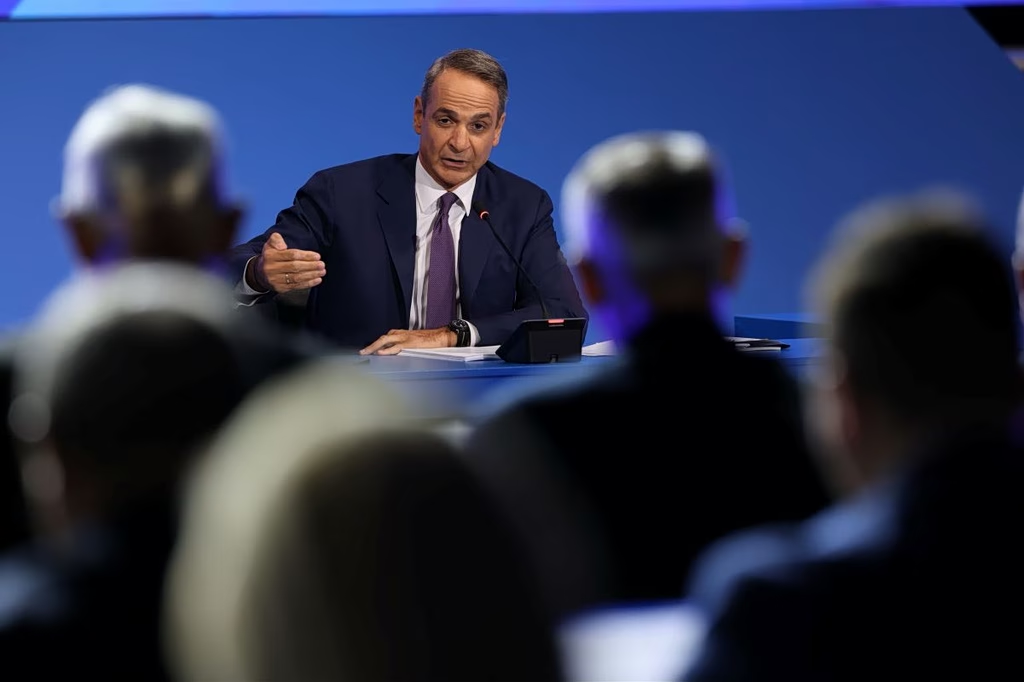
The head of Greece’s military, Hellenic National Defense General Staff (HNDGS) chief Gen. Dimitrios Houpis, has called for a fundamental reassessment of how European countries mobilize and sustain their military capabilities, arguing that the return of high-intensity warfare and rapid technological change have exposed weaknesses in traditional defense models.
Houpis made the remarks Thursday while speaking at the third IISS Prague Defence Summit, organized by the International Institute for Strategic Studies (IISS) in the Czech capital. The summit brought together political and military leaders, defense-industry representatives and experts to discuss European and Euro-Atlantic defense capabilities. The third plenary session, in which Houpis participated, was titled “Rethinking Military Mobilisation in Europe.”
Houpis said assumptions that had shaped European force structures over the past three decades were being tested by the return of high-intensity warfare and technological disruption. He argued that military preparedness could no longer be viewed solely as a matter for the armed forces, but required institutional reforms, infrastructure investment and closer links between civilian society and the military.
He also identified four interconnected elements of modern mobilization: the specialization and social integration of conscripts, education and technological infrastructure, civilian-military coordination and technological modernization.
Greece view
Turning to Greece, Gen. Houpis outlined reforms being pursued under the Armed Forces’ “Agenda 2030” strategy and changes to military service, including the development of an “active voluntary reserve.” He said the approach seeks to place conscripts geographically according to their origins and permanent residence, improve their access to modern technologies and accelerate their transition from training to operational roles.
Gen. Houpis said Greece aims for 70% of conscripts to achieve operational integration within 14 weeks, with training increasingly incorporating drones, cyber capabilities, artificial intelligence and other advanced systems.
He also emphasized the role of civilian expertise in defense planning, particularly in areas such as cybersecurity, logistics, data analysis and communications. Agreements with private-sector professionals during peacetime, he said, could create pools of expertise that could be rapidly mobilized during a crisis.
Another priority was what he described as “total defence” or a “whole-of-society” approach. Military facilities, transport hubs, government cloud infrastructure and industrial capabilities, he said, could be designed for dual use, serving civilian purposes in peacetime while supporting military mobilization during a crisis.