
 Μake us preferred on Google
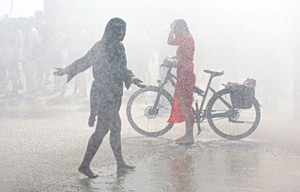
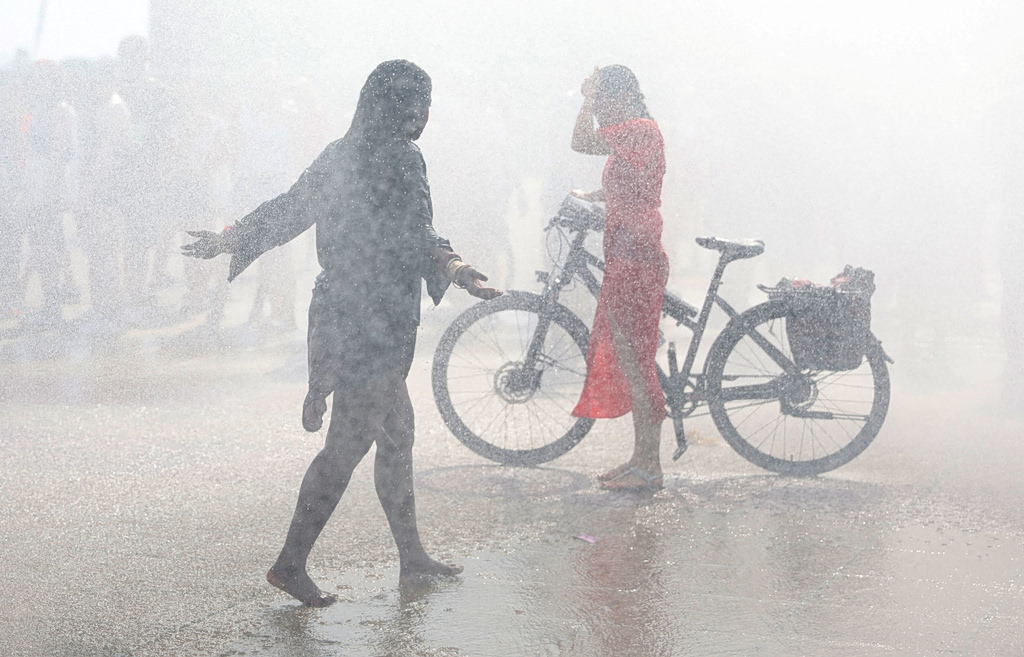
 More than 1,300 deaths, 150 million people living under conditions of extreme heat, and power grids under severe strain: this year’s heatwaves in Europe mark a critical moment for understanding the impacts of climate change.
This summer’s heat records have far outpaced previous ones, both in absolute numbers and in duration. On Friday, June 26, Basel recorded its highest June temperature ever, 38.8 degrees Celsius.
That same day, Germany set a new record high of 41.3 degrees Celsius. In the town of Palluau in western France, the mercury hit 43.8 degrees Celsius.
“In the past week, Paris recorded as many days above 40 degrees Celsius as it did across 120 years of record-keeping through 2019. This is a milestone scientists expected to see around 2050, not this soon,” said Stavros Dafis, a physicist and meteorologist, researcher at the METEO unit of the National Observatory of Athens, and member of Climatebook, summing up the dystopian picture that has emerged.
He added that we are still only at the start of summer, and that nothing like this has been observed before in modern records.
What This Summer Holds for Greece and the Rest of Europe
According to Kostas Lagouvardos, head of the METEO unit and research director at the National Observatory of Athens, Western Europe’s third heatwave is expected to begin this coming weekend.
“It will bring very high temperatures for several days, most likely centered on France again,” Lagouvardos said, adding that if the forecasts hold true, this would mark the third major heatwave of the summer in Western Europe, both in duration and intensity.
Meanwhile, the second major heat wave has recently shifted to the northern Balkans, from Romania to Bulgaria, with temperatures there approaching 40 degrees Celsius.
Fortunately for Greece, conditions in July are expected to be cooler thanks to strong meltemi winds, though this doesn’t rule out periods of high heat. While Greece will see relatively high temperatures this week, with the mercury locally reaching 37 to 38 degrees Celsius, including in Attica, Lagouvardos describes these as typical for early July. Temperatures are expected to drop again this coming Saturday and Sunday.
Dafis doesn’t expect Greece to see a heatwave as intense as those of 2024 or 2025 anytime soon, because Western Europe currently lacks the cold air masses needed to reach as far as Africa and then push very hot air toward the Greek region.
The Mechanism Behind Western Europe’s Heatwaves
According to Dafis, the main driver behind the unusually high temperatures in Western Europe was unusual activity among low-pressure systems in the North Atlantic, which created the conditions for an anticyclone to form over Western Europe.
This mechanism stems from the large temperature gap between the northern and central Atlantic, which fuels increased activity from low-pressure systems west of Europe. These systems, in turn, set the stage for persistent high-pressure ridges and very high summer temperatures over the continent.
Why So Many Deaths?
Regarding the thousands who have died from the heat, with the highest toll recorded in France, Christos Giannaros, assistant professor in the Physics Department at the University of Ioannina, notes that the most vulnerable groups are children, the elderly, and people with underlying health conditions.
The fact that the heatwaves began as early as May also played a key role, since people’s bodies hadn’t had time to gradually acclimate to summer conditions. According to Giannaros, populations in these countries simply aren’t accustomed to such intense heat, and for places like England and northern France, it’s something entirely unprecedented.
As for how heat can actually cause death, Giannaros explains that the human body, in trying to shed excess heat, begins to overwork itself. Past a certain point, this starts to affect vital functions, especially the heart, which can lead to cardiac collapse and death. Compounding the danger, people were exposed to extreme heat stress without relief, since temperatures stayed high even overnight, leaving the body no chance to cool down and recover.
Global Warming Is Outpacing Scientific Predictions
Scientists have spent decades preparing the public for a hotter future, but according to Dafis, that future is arriving even faster than forecast.
This is partly because small local shifts in atmospheric circulation follow mechanisms that climate models don’t always capture. Even scientists themselves admit they’ve been caught off guard by heatwaves arriving this early in the summer. In the past, high temperatures were mainly confined to July and August, lasted for shorter periods, and affected a much smaller geographic area of Europe.
One development that particularly puzzled scientists, Dafis says, was the striking temperature records in northwestern France, a region typically cooled in summer by westerly winds and the relatively cold Atlantic. But even the ocean’s surface waters were unusually warm this year.
Another record that stood out was the sea surface temperature in the Gulf of Lion, off the coast of southern France near Montpellier and Marseille, which came in 8.5 degrees Celsius above normal seasonal levels for the Mediterranean, a figure with consequences for both the natural environment and the region’s economy.
Scientists’ first major shock this year, however, came from the heatwave that hit the United States and Canada in North America this past April, when temperatures climbed nearly 20 degrees above seasonal norms. Dafis notes that this points to a pattern in Northern Hemisphere atmospheric circulation that extends well beyond Europe.
Air Conditioning, Climate Resilience, and Fossil Fuels
The lack of air conditioning in regions hit by the heatwaves has become a major talking point. Dafis points out that hospitals in Germany don’t even have air conditioning. At the same time, both Dafis and Giannaros note that air conditioning is itself part of the problem, since it contributes to rising greenhouse gas emissions.
Giannaros points to concrete solutions: a stronger focus on the green transition, more urban greenery, better heatwave warning systems, and more robust action plans for when these events strike, along with greater readiness to help the most vulnerable.
Dafis brings the political dimension into the conversation, arguing that as long as fossil fuel lobbies continue working against the growth of renewables and new green technologies, the climate damage will continue. He also points to the recent rise of the far right, noting that in countries like Italy and France there’s growing investment in far-right narratives that deny global warming altogether, with the United States as the most glaring example.
Looking ahead, Dafis says the near future holds troubling scenes. Scientists are sometimes dismissed as alarmist, accused of frightening people unnecessarily, he says, but when people start living through what they once only saw in disaster films, that’s when they begin to understand what’s coming.