 Μake us preferred on Google
 Prime Minister Kyriakos Mitsotakis has moved up the timing of his annual policy address at the Thessaloniki International Fair (TIF), giving the government and New Democracy more room to maneuver in case early elections come into play. The fair, is where Greek prime ministers traditionally unveil the government’s flagship economic package for the year ahead.
September is shaping up as a decisive month for greek political parties, with everyone drawing up its own plans. But it is Mitsotakis, not the opposition parties, who is expected to make the first moves this fall.tt
New Democracy enters the fall with a clear lead in opinion polls, but also with a steady erosion of support as traditional voter bases have drifted away. Party officials describe a two track approach for the period after Thessaloniki: going on offense in areas where lost ground can be recovered, and playing defense mainly on cases tied to allegations of corruption.
An Early Start to the Fall Debate
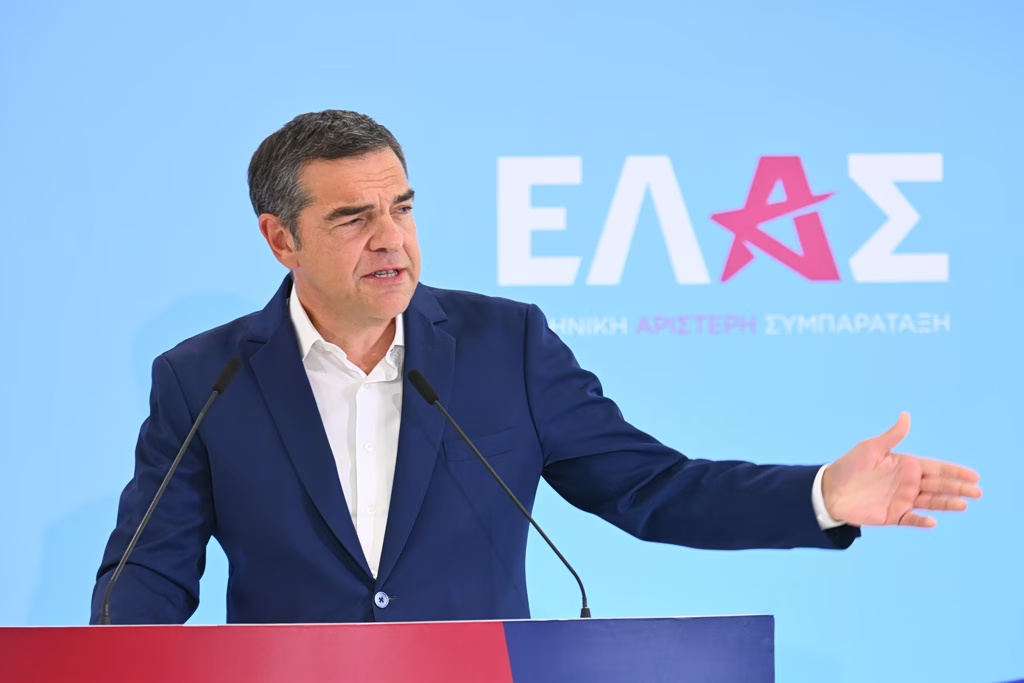
Political sparring typically cools in mid August in Greece, but this year has been different. An interview that the former PM Alexis Tsipras gave to the news site in.gr opened the September debate early, according to party officials, who say the coming economic announcements from party leaders will be aimed squarely at the middle class, self employed professionals and small business owners.
A Package Worth More Than 1 Billion Euros
Mitsotakis’s team has been working on both the fiscal details and the political rollout of what officials describe as an expanded package worth more than 1 billion euros for this year’s fair. Aides say the measures need time before their effect is felt by voters, a lesson drawn from last year, when a sizable TIF package failed to move the polls until January, once the pledges had actually taken effect.
That timing is one reason officials close to the prime minister favor holding elections in 2027 rather than sooner, a position Mitsotakis has also stated publicly. Waiting would give this year’s measures time to register with voters before they go to the polls.
The government’s first target for relief is the self employed and freelance professionals, a group where New Democracy has lost significant ground. Measures are also being pencilled in for vulnerable households, families, young people and pensioners. Under discussion are changes to Greece’s presumptive taxation system, which estimates income based on assets rather than declared earnings, along with adjustments to advance tax payments, new incentives and easier access to financing. For lower income households, the plan includes another increase to the minimum wage and additional measures to boost disposable income.
One of the government’s toughest challenges is that voters tie the cost of living not only to international crises but to what they see as weak enforcement against profiteering by businesses. A preliminary agreement with Greek supermarkets has functioned as a stopgap, and officials say further interventions are coming, aimed at shedding the government’s image as reluctant to confront powerful business interests.
Migration and a New Push on Return Hubs
The government’s offensive extends beyond the economy. Officials say the same push carries into migration, a front where recent developments abroad, including the crisis at Ceuta, Spain’s North African enclave, have worked in Athens’s favor. Migration Minister Thanos Plevris has raised his public tone and is accelerating both domestic and international moves.
On Sept. 4, Greece will join Germany, Austria, the Netherlands and Denmark in Copenhagen to discuss a plan for return hubs outside the European Union for asylum seekers whose applications have been rejected. Technical teams are expected to travel to Africa before the end of the month, with Uganda emerging as the favored location for the first such hub, targeted for 2027.
The government also plans to highlight the European dimension of its migration policy at the Thessaloniki fair, arguing that Mitsotakis’s proposals for stricter migration controls have gained traction in broader EU discussions.
The harder line on migration serves a second purpose closer to home: limiting defections to New Democracy’s right flank, where a new party by former Prime Minister Antonis Samaras is rumored to be in the works and remains an unknown factor. As the prime minister’s office works to stem the leaks on the right flank, it is also expected to intensify its attacks on Tsipras. Officials believe a sharp, direct confrontation with Tsipras could create the kind of two way political dynamic that failed to materialize with PASOK leader Nikos Androulakis, and could help consolidate support, particularly among centrist voters.
The Difficult Fronts Ahead
Beyond its offensive strategy, the government will be forced onto the defensive on several fronts this fall.
The most immediate is civil protection. This year’s wildfires have already caused significant damage, and the fire season is not yet over. Pressure is mounting on prevention, recovery efforts and, in particular, the pace of reconstruction projects.
Next comes a crowded fall court calendar. It opens with the OPEKEPE case, the farm subsidy fraud scandal, which involves four separate trials of New Democracy MPs: Katerina Papakosta on Oct. 2, Chrhstos Mpoukoros on Oct. 27, Maximos Senetakis on Oct. 30 and Kostas Skrekas on Nov. 12. The trials will keep the scandal in the headlines just as the government tries to win back rural voters.
The wiretapping scandal, in which the Predator spyware was used to surveil journalists, politicians and business figures, also continues to weigh on the government. Despite a third consecutive decision by Greece’s Supreme Court to close the case without charges, and the backlash that decision triggered, the surveillance affair remains an ongoing political liability. On Dec. 11, a related case involving four private individuals reaches the Athens Court of Appeals, with Israeli businessman Tal Dilian seen as a key figure who could bring new revelations.
Two cases connected to the 2023 Tempi train disaster, in which 57 people lost their lives, are also moving forward. A deputy prosecutor at the Supreme Court has recommended that former minister Christos Triantopoulos be referred to Greece’s Special Court on charges of breach of duty, along with regional governor Kostas Agorastos and three other defendants. Th Greek Judicial Council is expected to rule on the referral this fall. Separately, the investigation into Kostas Ach. Karamanlis, who was transport minister at the time of the disaster, over his role in the crash remains ongoing.
PASOK has also raised questions over Greece’s “recycling kiosks” program after authorities ordered the recovery of nearly 40 million euros linked to irregularities in EU co financed projects. Separately, the European Public Prosecutor’s Office is investigating allegations of inflated costs for digital water meters installed by municipalities and municipal water utilities. If that investigation reaches New Democracy linked local officials, it would give the prime minister’s office another difficult front to manage, this time involving EU funds.
Foreign Policy and a Watchful Eye on Turkey
Foreign and defense policy will also feature prominently in the government’s messaging at the Thessaloniki fair, including new arms purchases, the modernization of Greece’s armed forces and closer ties with France, the United States and the EU. Energy policy is set to feature in the TIF address, with an exploratory drilling project in the Ionian Sea as the government’s first concrete step.
At the same time, Athens is closely watching Turkey’s expanding regional influence. A recent agreement between Turkey, Saudi Arabia and Pakistan, referred to as the Mecca Agreement, has added to that footprint. Greek officials are also tracking a Turkish parliamentary bill related to Ankara’s “Blue Homeland” maritime doctrine, and preparing for reaction from Turkey once Greece issues new navigational warnings, known as NAVTEX notices, tied to a planned Greece to Cyprus undersea cable.
On the Cyprus issue, expectations remain low given Turkey’s continued push for a two state solution, a position rejected by both Greece and the Republic of Cyprus. The United Nations General Assembly, meeting in the final ten days of September, could create an opening for informal five party talks on Cyprus or a new meeting between Mitsotakis and Turkish President Recep Tayyip Erdogan.
Libya is part of the same regional picture, with Turkey pressing authorities in eastern Libya to ratify a maritime boundary memorandum signed with Tripoli. Looking across the Atlantic, Athens is keeping a low profile ahead of November’s U.S. midterm elections, monitoring the relationship between President Donald Trump and Erdogan as well as the status of F35 fighter jets. Greece’s next diplomatic step with Washington is a sixth round of the U.S. Greece Strategic Dialogue, with Athens hoping to secure a visit from Secretary of State Marco Rubio.