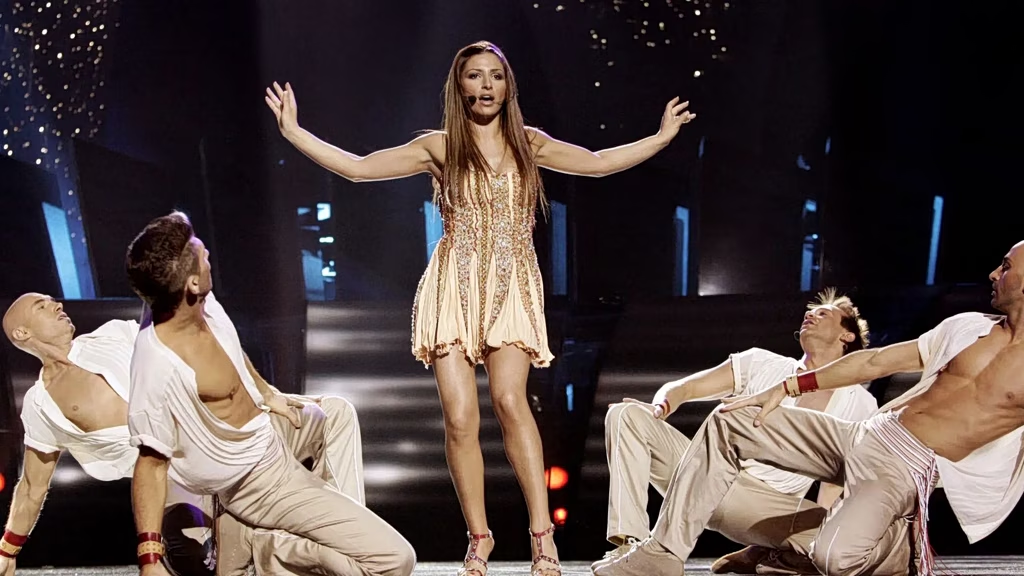
This year marks the 70th anniversary of Eurovision, and the controversy surrounding Israel’s participation in the contest is a timely reminder that the colorful celebration, often criticized in recent years for being deliberately apolitical, has never been truly separate from its political context.
The Israel Question
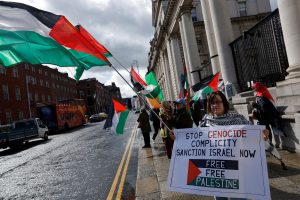
The defining issue of this year’s Eurovision, which began on Tuesday, May 12 and concludes on Saturday, May 16, is the withdrawal of five countries: Spain, Slovenia, the Netherlands, Ireland, and Iceland. Their exit followed the European Broadcasting Union’s decision last December to allow Israel’s participation, despite strong objections from the public broadcasters of those same countries, who had been pushing for Israel’s exclusion over the Israeli military’s bloody offensive in Gaza.
The military campaign, condemned by humanitarian organizations and governments as genocide, began in the wake of the terrorist attack carried out by Hamas against Israel on October 7, 2023, and has since resulted in the deaths of more than 72,000 people according to local Palestinian authorities.
Beyond the genocide allegations, Tel Aviv has also come under fire for violating Eurovision’s own code of conduct. According to a New York Times investigation, Israel managed to finish second in 2025 by exploiting the contest’s lax voting rules, which until last year allowed each person to vote up to twenty times.
Analyzing data from Spain’s popular vote, the newspaper calculated that the 47,570 votes cast for Israel’s entry could have come from as few as 2,379 individuals. This is not far-fetched, the Times reported, since the Netanyahu government had been treating the song contest as a soft power tool, reportedly channeling $100,000 in 2018 to promote Netta Barzilai’s entry and $800,000 in 2024 behind Eden Golan’s. Barzilai won the 2018 contest, while Golan placed fifth overall but second in the public vote. The final rankings are determined by combining the public vote with each country’s professional jury vote, in a competition expected to draw around 170 million viewers.
From the Cold War to Conchita Wurst
This is far from the first time politics has surfaced at Eurovision. From Yugoslavia’s debut in 1961, when the then-federated Balkan nation became the first socialist country to participate, to Austria’s boycott of the 1969 contest hosted by Spain in protest against Francisco Franco’s fascist regime, the pan-European festival had been overstepping the boundaries of pure entertainment from its earliest years. Greece’s withdrawal in 1975 followed Turkey’s debut, which came just months after Turkey’s invasion of Cyprus on July 20, 1974.
In the decades that followed, the political dimension took the form of neighborhood diplomacy through voting, with blocs of countries such as the Scandinavians, the Balkans, and the Greece-Cyprus alliance forming closed mutual support groups and exchanging high scores. On the subject of scores, Turkey’s withdrawal in 2013 was driven by the preferential treatment given to what were then the “Big Five,” namely Germany, Spain, France, Italy, and the United Kingdom, which automatically qualify for the final as the competition’s largest financial contributors.
Meanwhile, politics in the more traditional sense had been making a comeback since 2001 and Estonia’s victory. The then-prime minister of the Baltic nation, Mart Laar, framed the moment historically, saying his country had freed itself from the Soviet Union through song and would enter Europe the same way. More instances of geopolitical symbolism followed, including Ukraine’s 2016 win, with lyrics referencing the violent deportation of the Crimean Tatar population in 1944 that also served as a pointed reference to Russia’s annexation of Crimea in 2014.
Russia was ultimately banned from the competition in 2022 following its invasion of Ukraine, while Belarus had been excluded a year earlier after its proposed entries contained lyrics with overtly political content mocking anti-government protests against Alexander Lukashenko. Politics of a different kind was at play in 2014 with the victory of Conchita Wurst, the drag persona of Austrian singer Thomas Neuwirth, whose win was interpreted by conservative quarters as a blow to the values of the traditional family.
The Present Moment
Returning to today, Stefán Jón Hafstein, chair of the board of Iceland’s public broadcaster, described the situation to the New York Times as a “takeover of Eurovision by Israel.”
On the other side of the argument, Vienna’s mayor Michael Ludwig called Eurovision a “festival of solidarity” and defended Israel’s right to participate. Israeli officials pushed back sharply, with Culture Minister Miki Zohar calling the boycott a “shameful and hypocritical act.”
Eurovision director Martin Green insisted at a press conference that the contest must remain a non-political artistic event, adding that Israel’s state broadcaster had been instructed to remove footage urging viewers to vote ten times. This position is somewhat contradictory given that two separate demonstrations are scheduled in the coming days: one on May 15 to mark the Nakba, commemorating the violent displacement of more than 700,000 Palestinians in 1948, and another in support of Israel’s participation in the contest.