 Μake us preferred on Google
 Today the telephone is so ingrained in our daily lives that it’s hard to remember it was ever considered a marvel of technology. We use it to work, stay informed, make payments, take photos, send messages, and talk to people on the other side of the world. But reaching that level of familiarity required passing through many stages: from scientific experiment to luxury item for the privileged few, from state infrastructure to professional tool, from the home landline to the cellphone as a symbol of a new era.
The pages of the Historical Archive of “TO VIMA” and “TA NEA” trace this long journey as both a technological and a social evolution. Through news reports, features, and advertisements, they reveal how the telephone entered people’s lives, sparked both excitement and frustration, and gave rise to entirely new habits.
Before Alexander Graham Bell
The history of the telephone begins, of course, long before it reached Greek citizens. An issue of “ATHINAIKA NEA” from January 14, 1934, recalls that the invention of the telephone is associated with Graham Bell, who applied for a patent in 1876.
However, the same article mentions an earlier figure: Philipp Reis, the man widely considered to have invented the telephone before Graham Bell. As the piece explains, while Bell was the first to build a practical device, Reis was the first to conceive the idea of converting sound waves into electrical signals and then back into sound, the fundamental principle on which all telephone technology rests.
Reis’s Wooden “Ear”
Reis’s contraption consisted of an imitation of the human ear, first made of wood and later of cork, with a small hole cut into it. Over the hole was stretched a piece of animal membrane, the same kind used as the casing for sausages. Onto this membrane was glued a thin sheet of platinum, upon which two metal tips rested lightly, carrying the current from a battery. This assembly served as the receiver of sound waves and was connected by wire to the transmitter.
From this handmade device sprang one of the great technological adventures of the 19th and 20th centuries.
A Delayed Arrival in Greece
In Greece, however, the telephone did not arrive immediately. As journalist Lena Papadimitriou wrote in “TO VIMA” on March 10, 1996, on the occasion of the 100th anniversary of Greek telephony, the technology arrived in the country a bit behind schedule. The article places the real debut of domestic telephony in November 1895, just a few months before the first modern Olympic Games in Athens.
The timing was no coincidence. The Greek state needed infrastructure to serve athletes, journalists, and visitors. As the article describes, the government of Charilaos Trikoupis treated the construction of these facilities as a vital priority, scrambling to catch up with the pace of progress before the Games.
A Government Matter
The legal groundwork had been laid with Law BKZ’ of 1892, and by January 1896 the first two central telephone offices were opened, one in Athens on Lykavittos Street and one in Piraeus. Athens received 60 “telephone stations” and Piraeus 30. The term “telephone device” had not yet come into common use.
The first numbers were entirely a government affair. According to the same feature, the first nine lines were assigned to the government, with the rest distributed among public services, the Police, the Judiciary, the Palace, the Prefecture, and the Observatory. The telephone had not yet entered the average citizen’s home. It was a tool of administration, power, and organization.
The Backlash
It did not take long for that to generate public frustration. The debate over whether telephony should be state-run or privately operated began almost as soon as the first lines were installed.
A March 1996 issue of “TO VIMA” reprinted a piece from the newspaper “Estia” dated June 8, 1895, which expressed outrage at the delays, essentially complaining that the residents of Athens were living without a telephone in 1895, condemned to read jealously in European papers about its spread and use elsewhere, while even the Chinese were making use of it in their daily lives.
A Phone for the Few
The new technology seemed remarkable but remained extremely expensive. The annual subscription for a line in Athens came to 250 drachmas, 200 in Piraeus, and 150 in Nea Faliro, all significant sums relative to the wages and daily earnings of the era. As a result, telephones were far more commonly found in coffeehouses, clubs, and shops serving an upscale clientele than in private homes.
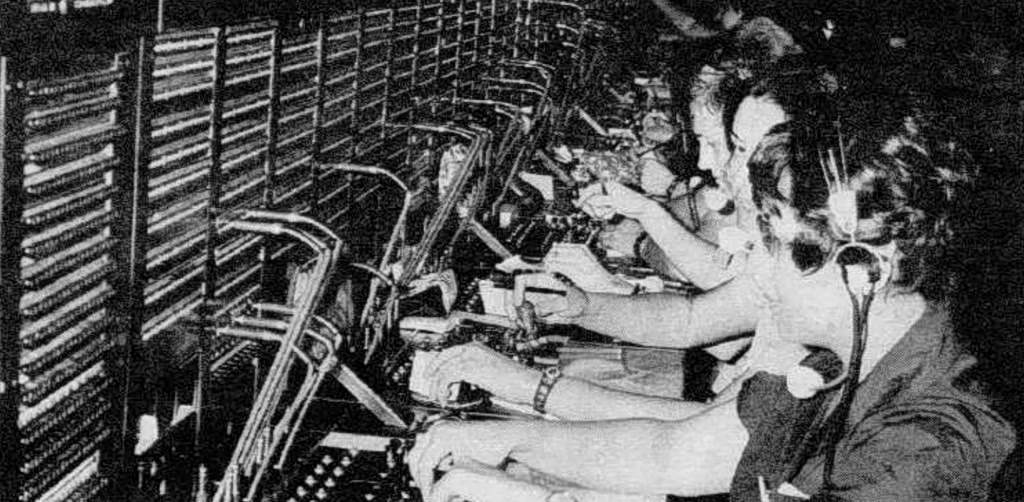
The provinces lagged even further behind. In 1907, Patras got its first local telephone exchange with capacity for a hundred subscribers. In 1908, the corps of Greek female telephone operators was established, and in 1911 the first telephone exchange of meaningful scale opened in Athens. In 1912, another milestone arrived: the first long-distance telephone line. In 1914, the service combining post, telegraph, and telephone was transferred to the newly formed Ministry of Communications.
The Turning Point of 1930
The major turning point came in 1930, with a contract signed with Siemens-Halske for urban and suburban communications and the founding of AETE, the Greek Telephone Company. During the 1930s, automatic telephone exchanges were installed in Athens and in cities across the provinces. The telephone began to shed its image as a luxury item and transform into a necessary piece of infrastructure.
World War II violently interrupted this progress. As Papadimitriou wrote, the war caused massive damage to the country’s entire telegraph and telephone network, and upon the withdrawal of the Occupation forces, the automatic telephone exchanges in Corfu, Trikala, Pyrgos, Lamia, Elefsina, and Elliniko were completely destroyed.
The Founding of OTE
The reconstruction and unified organization of telecommunications in Greece came a few years later with the establishment of OTE (the Hellenic Telecommunications Organization). As the article noted at the time, the true history of the Greek telephone was only just beginning.
Even so, the transition to mass telephony was far from easy. In the 1960s, ’70s, and ’80s, the telephone became an object of desire and, very often, of great patience. Demand so far outstripped the available infrastructure that waiting for a line could take anywhere from months to years, and this became an enormous social and political issue, famously tied to the practice of using political connections to jump the queue.
From Telex to the Satellite Dish
In the years that followed, telephony became intertwined with postwar Greek development. In 1957 the telex service launched; in 1965 the automation of long-distance telephone exchanges was completed; in 1968 the underwater cable between Greece and Italy was laid; and in 1970 a satellite antenna was installed at Thermopylae. In 1978, the first digital network appeared, and in 1989, a videoconferencing service was introduced. The telephone was no longer just a voice medium but had become a network for data, business, and international connectivity.
“The End of the Wired Connection”
In the 1990s, the chapter of mobile telephony opened. In “TO VIMA” of April 18, 1993, St. Chaikalis wrote about what he called the end of wired communication, noting that futurists and urban planners were already arguing that the spread of wireless telephony would have direct implications for the functioning and shape of cities. The new telecommunications, the article said, promised independence for the subscriber and new degrees of freedom for businesses.
The piece also voiced the great public question of the moment: when would all of this actually happen? It highlighted the delays in the Greek market, noting that mobile telephony would not begin operating in Greece until late 1993, several years after it had taken off in most other European countries.
The First Mobile Phones in Athens
Panafon was planning to launch in July, with coverage stretching from the northern suburbs to Elefsina, Piraeus, and Vouliagmeni. The cost, however, remained steep: initial subscriber expenses were estimated at 250,000 to 300,000 drachmas, with a monthly flat fee of 10,000 drachmas and approximately 100 drachmas per minute of conversation.
Despite the cost, Chaikalis foresaw broader adoption ahead, writing that the mobile phone was no longer just a privilege of the wealthy but was evolving into a tool for the middle class.
During that same decade, telecommunications also became a stock market event. In “TO VIMA” of March 10, 1996, K. Tsaousis described in a report on the “dusting off” of OTE the preparations for listing the organization on the Athens Stock Exchange. Telecommunications were by then being treated as a market with serious international investment appeal.
The Era of the Ten-Digit Number
The next major change for the Greek public came with the introduction of the ten-digit numbering system. In “TO VIMA” of January 19, 2002, P. Bouloukos wrote that making a phone call would from that day forward be more complicated and time-consuming, as all holders of OTE landlines would now have to dial ten digits to reach anyone, whether locally or anywhere else in the country. The subscriber numbers were being expanded by adding the area code digits and a zero, converting them to ten-digit strings.
Under the new system, a seven-digit Athens number became 01-0-1234567, while a six-digit Thessaloniki number became 031-0-123456. The new system, already in use across many European countries, was deemed necessary to address a shortage of available numbering resources.
One of the most emblematic changes of this period was the birth of the “210” prefix for Athens. On January 20, 2002, the familiar “01” that had identified the capital for decades gave way permanently to the new ten-digit prefix, while Thessaloniki’s “031” became “2310” and Patras’s “061” became “2610.”
Four years later, in June 2006, an advertisement from the National Telecommunications and Post Commission in “TO VIMA” presented the ten-digit system as a genuine engine of growth, creating room for more numbers and enabling new companies to enter the market. It added simply that people’s habits would change just a little, a sentence that neatly captured the entire history of the telephone.
To this day we continue to witness new technological shifts that initially cause disruption but ultimately become part of everyday life.