 Μake us preferred on Google
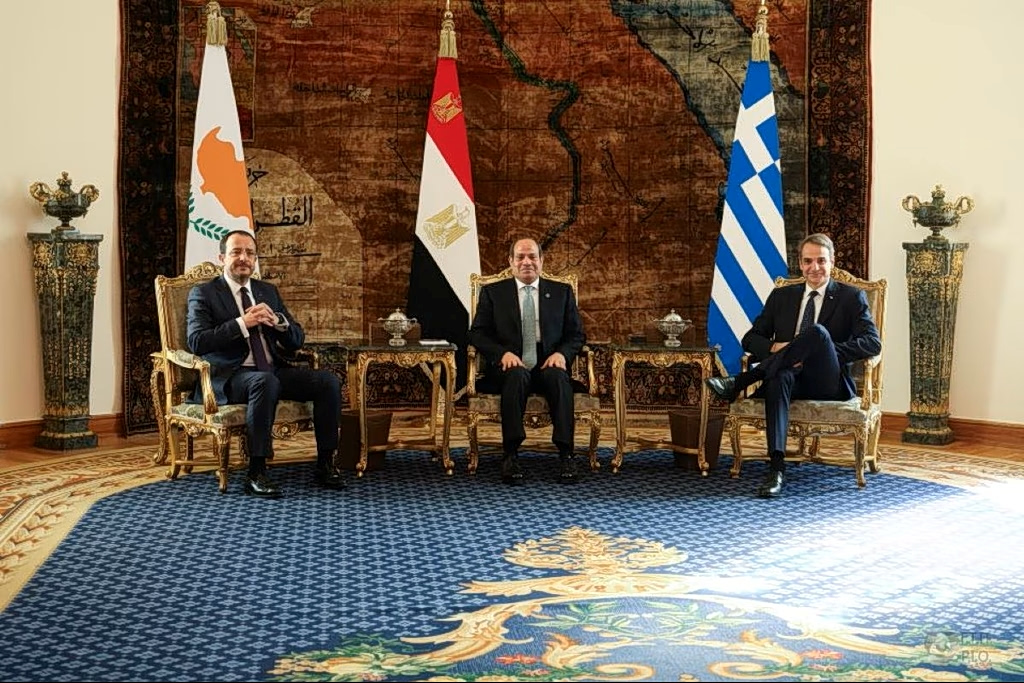
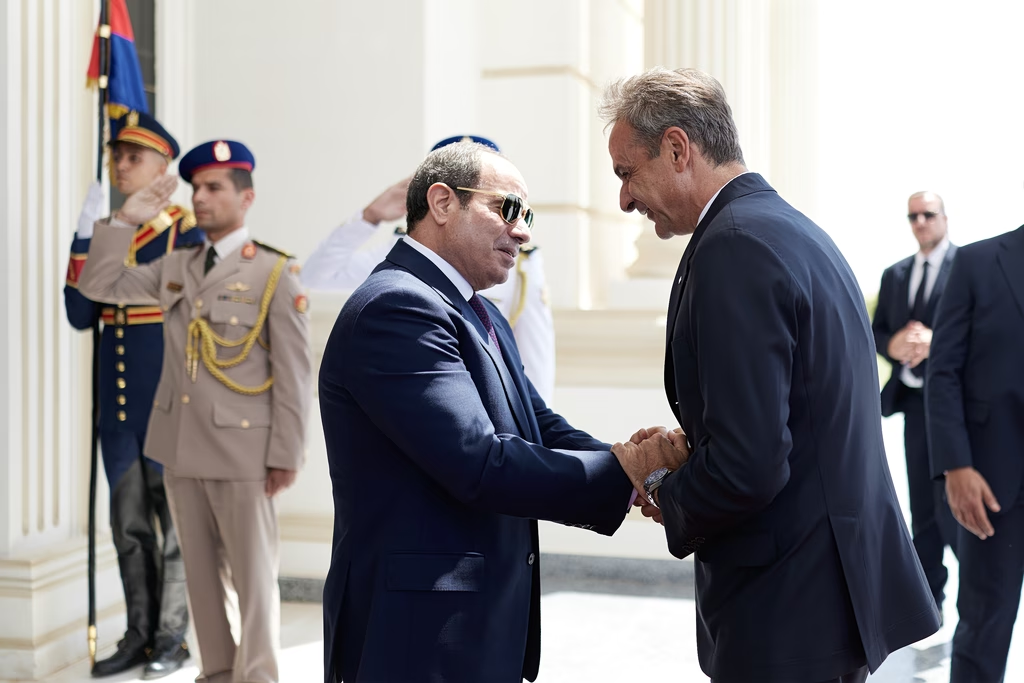
 Greek Prime Minister Kyriakos Mitsotakis, meeting host Egyptian President Abdel Fattah al-Sisi and Cyprus President Nikos Christodoulides highlighted the strategic importance of their countries’ cooperation for stability in the eastern Mediterranean and the wider region, following a trilateral summit at the WWII landmark of El Alamein on Tuesday.
The meeting came after a one-on-one discussion between Mitsotakis and al-Sisi, with the bilateral talks covering the strategic relationship between Athens and Cairo, maritime zones, energy, relations with Libya, illegal migration targeting Greece, regional security and the still-unresolved issue surrounding the renowned Orthodox Christian Monastery of St. Catherine in Egypt’s Sinai Peninsula.
The three leaders later sat for the trilateral meeting, with security, energy, the Cyprus issue, Gaza, Libya and Egypt’s relationship with the European Union among the main issues on the agenda.
Mitsotakis described the Egypt-Greece-Cyprus partnership as a positive model for cooperation in the eastern Mediterranean, arguing that the three countries’ coordination had become particularly important amid a fluid geopolitical environment.
He said the talks covered both bilateral relations and regional developments, with security and stability forming the central themes. The prime minister also pointed to the 2020 Greece-Egypt maritime-zone agreement as an example of how such issues can be addressed through dialogue and respect for the sovereign rights of states.
Eurokinissi
Athens has consistently presented the agreement as evidence that maritime boundaries can be settled on the basis of international law – a point directed at an increasingly revisionist Turkey – while maintaining that dialogue should not come at the expense of sovereign rights.
Mitsotakis said Greece does not seek confrontation but wants stable relations based on international law, while remaining prepared to defend its positions. The approach reflects Athens’ broader policy of combining dialogue with a firm insistence on international legality and opposition to unilateral actions that create faits accomplis – yet another nod to Ankara’s behavior.
Mitsotakis response to Ankara
Mitsotakis’ remarks in El Alamein also came in response to comments made a day earlier by Turkish President Recep Tayyip Erdogan, who warned that Turkey would not remain passive in the face of what he described as “hostile actions” in the region. The remarks were widely seen in Greek media as a message directed, among others, at Athens.
Without naming Erdogan directly, Mitsotakis responded by stressing that Greece does not threaten other countries and seeks stability through functional good-neighborly relations based on international law. At the same time, he made clear that Athens does not equate stability with concessions or acceptance of faits accomplis.
The Greek prime minister said the country was prepared to both defend its positions with confidence and to engage in dialogue, presenting the two approaches as complementary elements of a responsible foreign policy.
Greece-Egypt energy, security agenda
Energy was a central element of the bilateral and trilateral discussions, with Mitsotakis describing the planned undersea power interconnection between Greece and Egypt, known as GREGY, as a project of strategic importance for regional energy connectivity.
The proposed link would connect Egypt’s grid with Greece and potentially provide a route for Egyptian renewable energy to European markets. Athens and Cairo have been advancing the project as part of a broader effort to strengthen energy ties between Egypt and the EU.
The leaders also discussed the development of natural gas resources by the Republic of Cyprus and the use of Egyptian infrastructure to process and export Cypriot offshore gas toward European markets. The cooperation gives Egypt an increasingly important role as a regional energy hub and creates an additional link between the three countries and the European market.
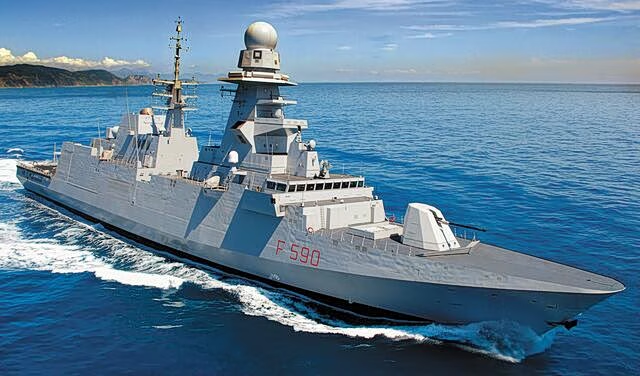
The bilateral meeting between Mitsotakis and al-Sisi also addressed maritime security and the situation in the Red Sea and Suez Canal. Greece has contributed naval assets to the EU’s ASPIDES operation, which was established to protect commercial shipping from attacks in the Red Sea.
Source: Eurokinissi
Libya and irregular migration were another significant part of the Greek-Egyptian agenda. Athens supports Libya’s territorial unity and a political settlement to end the stalemate in the strife-plagued country, while seeking closer coordination with Cairo over migration flows, especially the problem of migrant boats departing Libya for Crete. Along these lines, he welcomed Egypt’s role in addressing the issue.
The two leaders also discussed the pending issue concerning the legal and property status of the Monastery of St. Catherine in Sinai, which has been a sensitive matter in Greek-Egyptian relations over the past year.
Cyprus, Gaza and regional security
Additionally, Mitsotakis reiterated Greece’s support for a just and lasting peace in Gaza based on a two-state solution and highlighted Egypt’s central role in efforts concerning the enclave’s future.
He also reaffirmed Greek support for Lebanon’s armed forces and stressed the importance of developments in Libya, while the broader regional discussion included Syria, Sudan and Red Sea security.
Regarding Cyprus, Mitsotakis said a viable settlement of the long-running dispute was essential to peace and stability throughout the eastern Mediterranean. He also emphasized the importance of secure maritime routes and respect for international law.
Cyprus President Christodoulides said the trilateral partnership, established in its current format in 2014, had developed on the basis of mutual trust and common objectives and had expanded into an increasingly broad strategic framework.
He identified stability, security, connectivity and wider regional cooperation as the principal pillars of the partnership, while calling for a de-escalation, an end to hostilities and the peaceful settlement of disputes in the eastern Mediterranean and wider Middle East in accordance with international law.
Al-Sisi backs deeper energy and economic ties
Egyptian leader Al-Sisi described the trilateral partnership as an important framework for regional coordination and emphasized its potential contribution to peace and stability.
He placed particular emphasis on energy cooperation, highlighting both the Greece-Egypt electricity interconnection and Egypt’s cooperation with Cyprus on natural gas exploitation. Egyptian infrastructure could provide a route for Cypriot gas to reach European markets, reinforcing Cairo’s position as an energy hub and giving the three countries a common strategic interest in strengthening regional connectivity.
The Egyptian president also called for greater investment cooperation with Greece and Cyprus in areas including technology, tourism, industry, health, education and infrastructure.
On Gaza, al-Sisi reiterated Egypt’s opposition to the displacement of Palestinians and backed the establishment of an independent Palestinian state along the 1967 borders and with East Jerusalem as its capital.
Referring to Libya, he supported a political settlement and the withdrawal of foreign forces, while on Syria he stressed the importance of preserving the country’s unity and territorial integrity. The talks also addressed the situation in Sudan and security developments in the Red Sea.
A strategic partnership with a broader regional role
The El Alamein meeting underscored how the Greece-Cyprus-Egypt relationship has evolved beyond a diplomatic coordination mechanism into a broader strategic partnership encompassing energy, infrastructure, security, investment and regional diplomacy.
For Athens, the relationship with Cairo also has a specific bilateral importance. The two countries’ maritime-zone agreement, cooperation on energy and security, coordination on Libya and migration and Greece’s role in strengthening Egypt’s relationship with the EU have made Egypt a key partner in Athens’ wider eastern Mediterranean “calculus”.
The trilateral framework, meanwhile, provides Greece and Cyprus with a mechanism for coordinating with Egypt on regional issues while giving Cairo closer links to the EU through two member states.
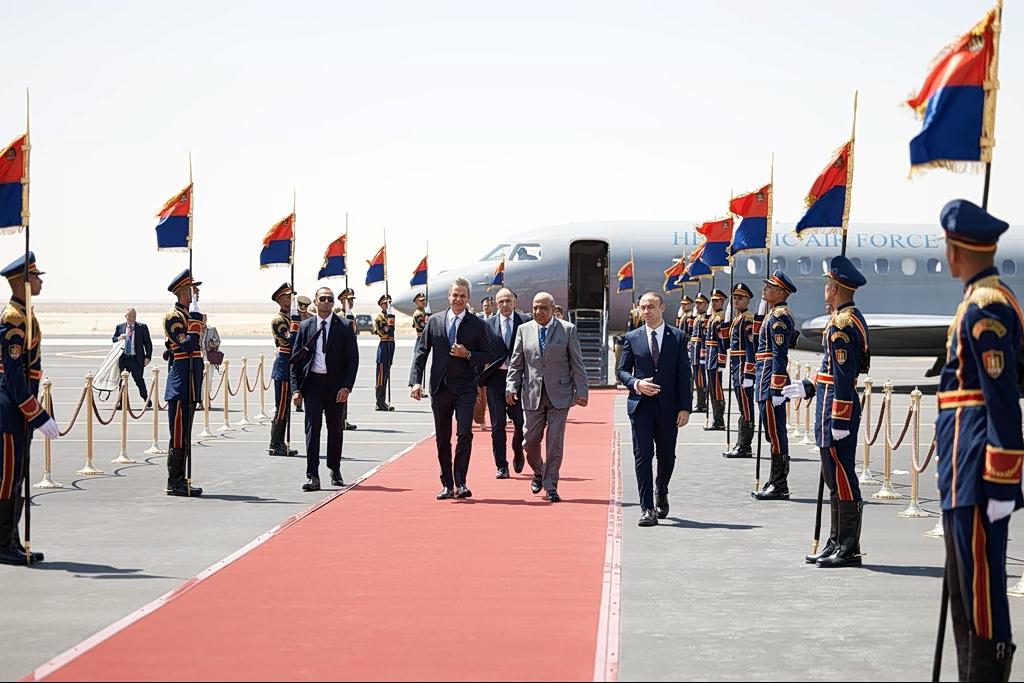
Mitsotakis arrived in El Alamein to military honors. His meeting with al-Sisi was held two months after an earlier visit had been postponed.