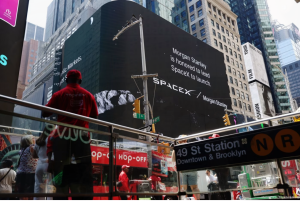
Japanese moon transport company ispace said on Wednesday it would start a new lower-cost lunar cargo business using the Starship heavy rocket and moon lander developed by Elon Musk’s SpaceX, offering moon ride-share services.
Tokyo-based ispace has bought 500 kg (1,102 lb) of capacity on a starship that would land on the moon as soon as 2030, and will build a lunar surface vehicle that can host payloads from worldwide riders to the moon, the company said. According to the Bangkok Post, the price tag for that capacity was US$50 million.
A new “bus” service to the lunar surface
The service is being described by ispace as a “lunar access integrator.” The new service provides moon bound “buses” and can complement ispace’s ongoing development of dedicated lunar landers, or “taxis,” to the moon’s surface, said ispace Executive Vice President Hideari Kamiya.
SpaceX, for its part, welcomed the expanded partnership. Starship is a reusable transportation system which, unlike Falcon 9, includes a spacecraft that Musk’s company plans to take to the moon and eventually to Mars. Stephanie Bednarek, SpaceX’s vice president of commercial sales, said in a statement that the integration services give smaller payloads a pathway to secure a ride to the moon today, and that the company looks forward to supporting ispace and its customers as they help expand access to the lunar surface.
Part of a broader lunar traffic buildup
The arrangement between ispace and SpaceX is not an exclusive one. NASA plans to use Starship’s first lunar landing in 2028 as part of its Artemis program to send astronauts back to the moon, and U.S. lunar rover startup Astrolab has also booked space on a future Starship flight. ispace’s Hakamada noted that SpaceX approached the company first with the integrator business idea.
Separately, NASA’s own Starship-based lunar lander program has been evolving. According to reporting from Basenor, NASA reshuffled the Artemis timeline significantly in May 2026, redesignating Artemis III as a Low Earth Orbit demonstration flight focused on testing docking between Orion and the Starship Human Landing System, while the crewed lunar landing has moved to Artemis IV, now targeted for 2028. An uncrewed HLS demonstration landing on the lunar surface is targeted for around mid-2027.