
 Μake us preferred on Google
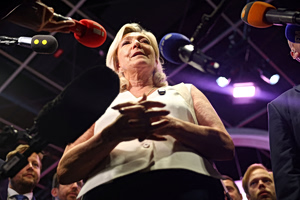
 Marine Le Pen, who gambled everything by deciding to run in the French presidential election despite her conviction on appeal, is beginning her campaign, defying criticism from her opponents and the risk that her bold legal wager could fail.
The leader of the far right National Rally (RN) took a walk through the market in La Flèche, a town in central France that has been run by her party since March. She was accompanied by Jordan Bardella, who would replace her as a candidate if she were unable to run herself, and who would become her prime minister if she wins the 2027 presidential election.
Running despite the conviction
On Tuesday, Le Pen upended the course of the campaign by announcing her candidacy for the Élysée Palace just hours after the Paris Court of Appeal upheld her conviction in the case involving the misuse of European Union funds.
The reduction of her period of ineligibility to 45 months, 30 of which suspended, allows her to run as a candidate.
She was also sentenced to three years in prison, one of them to be served with an electronic ankle monitor, though she has said she would campaign “without the bracelet,” since she plans to appeal to a higher court, a move that would suspend enforcement of her sentence.
Uncertainty over the outcome
Her choice, described as risky by the French news agency AFP, has triggered intense and complicated legal debate. It rests on a strategy built around a race against time, betting on the significant delays typical of French judicial proceedings.
By running despite her conviction, Marine Le Pen, who had previously called for politicians convicted of such offenses to be barred from office “for life,” now exposes herself to criticism from her rivals.
For now, it is difficult to predict how voters will respond to her candidacy.
There could be a “rallying effect around her base,” since “those who like her will say, ‘what determination,'” pollster Brice Teinturier of Ipsos-BVA told AFP. But he added that he believes scandals always do damage in the end.
The Court of Appeal found Marine Le Pen, the National Rally, and ten other individuals guilty of setting up a scheme in which people who were actually working for the party were paid as parliamentary assistants to members of the European Parliament.
The court estimated the total financial harm to the European Parliament from the scheme at 2.8 million euros over the period from 2004 to 2016.