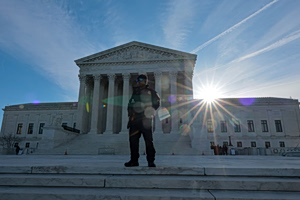
The US Supreme Court is due to rule today, Tuesday, on whether to let President Donald Trump restrict birthright citizenship, one of the central priorities of his immigration crackdown, in a case touching a right that has long been woven into the fabric of American society.
A lower court had blocked Trump’s executive order directing federal agencies not to recognize citizenship for children born in the United States if neither parent is a US citizen or lawful permanent resident, commonly known as a green card holder.
The Supreme Court previously handed Trump an initial procedural win in this fight last year, in a ruling that limited the power of federal judges to block presidential policies on a nationwide basis. That earlier decision, however, did not resolve the underlying legality of Trump’s order itself.
The court’s conservative majority has sided with Trump on several other major immigration matters since he returned to office.
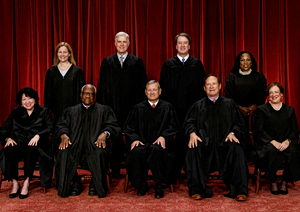
U.S. Supreme Court justices pose for their group portrait at the Supreme Court in Washington, U.S., October 7, 2022. Seated (L-R): Justices Sonia Sotomayor, Clarence Thomas, Chief Justice John G. Roberts, Jr., Samuel A. Alito, Jr. and Elena Kagan. Standing (L-R): Justices Amy Coney Barrett, Neil M. Gorsuch, Brett M. Kavanaugh and Ketanji Brown Jackson. REUTERS/Evelyn Hockstein
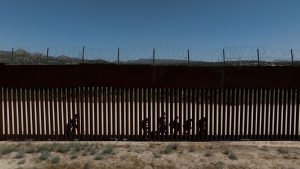
On June 25, for instance, it cleared the way for the administration to strip hundreds of thousands of Haitian and Syrian immigrants of humanitarian protections that had shielded them from deportation, and on the same day it backed the government’s authority to turn away asylum seekers at the southern border when officials determine crossings have become too overwhelming to process.
Today’s ruling, in the case known as Trump v. Barbara, is expected to be among the most consequential of the court’s term. Oral arguments were heard on April 1, and several justices, including some conservatives, sounded skeptical of the administration’s position at the time.
Under the executive order at the center of the case, signed on Trump’s first day back in office, birthright citizenship would generally be limited to children born to US citizens or lawful permanent residents. Currently, under the 14th Amendment, nearly all children born on US soil automatically become citizens regardless of their parents’ immigration status, a principle that traces back to the landmark 1898 case United States v. Wong Kim Ark.
If the court allows the order to take effect, new federal guidelines would kick in, and a US birth certificate alone would no longer be sufficient proof of citizenship for children covered by the policy. According to the Migration Policy Institute, an estimated 255,000 children born each year to noncitizen parents could be affected, with critics warning some children could effectively become stateless.
House Minority Leader Hakeem Jeffries has said the ruling could carry far-reaching consequences nationwide.