 Μake us preferred on Google
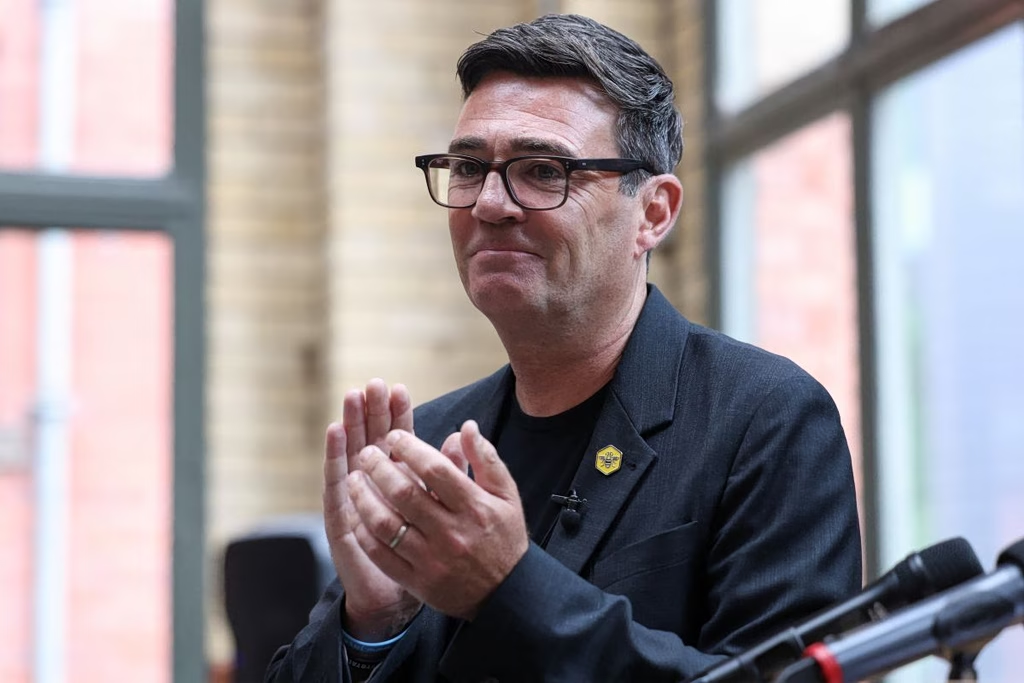
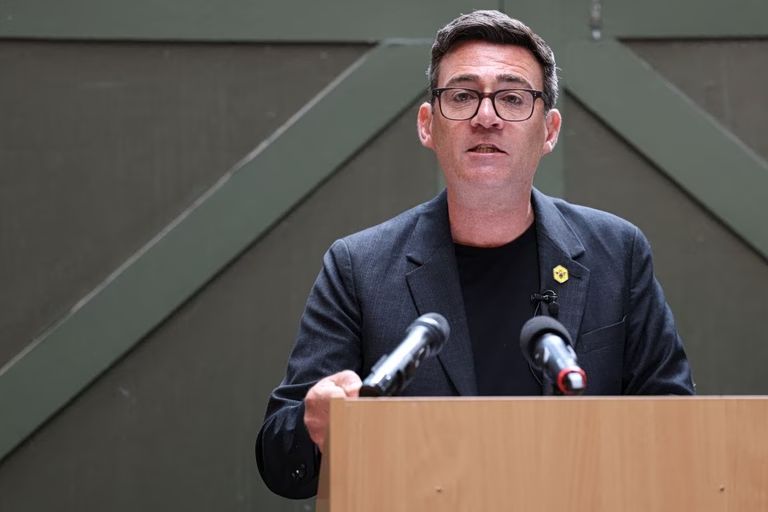
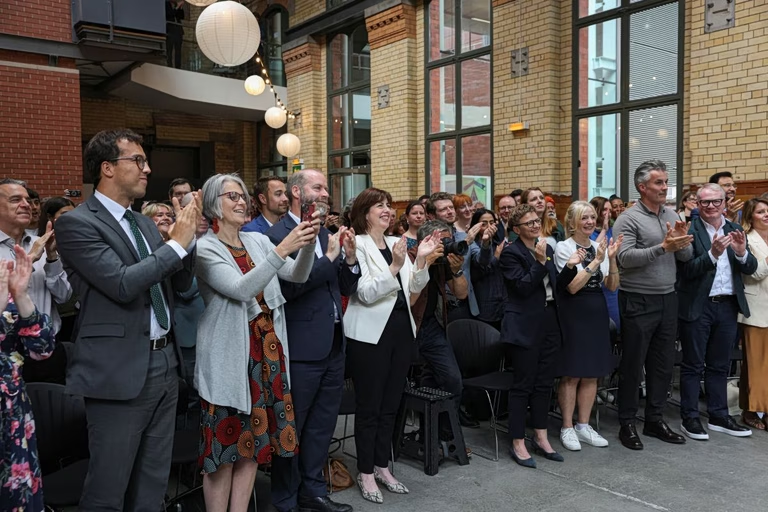
 Andy Burnham chose the People’s History Museum in Manchester to deliver his first major policy speech, running 36 minutes, as a Labour leadership candidate and the overwhelming favorite to succeed Keir Starmer as Prime Minister.
According to the latest polls, Burnham is currently the most popular politician in the United Kingdom. A man who was Mayor of Manchester just three weeks ago, was sworn in as MP for Makerfield last Monday, and could be Britain’s seventh Prime Minister in the past decade within three more weeks.
The choice of city and venue was deliberate. The museum is dedicated to the history of popular struggles and democracy in Britain, and it provided the ideal backdrop for his central political argument: a radical redistribution of power from Whitehall to the regions.
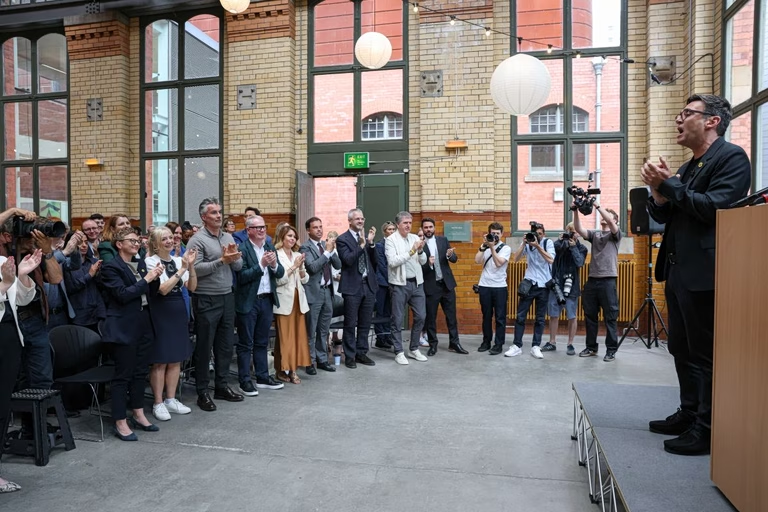
The speech, which began shortly after 11:30 in the morning and which his close aides describe as the “foundational text” of his future government, was not limited to policy announcements. It included self-criticism as well.
“My generation of politicians, including myself, must take responsibility. We were not good enough. But instead of being honest about that, parties kept playing the same game: blame, confrontation, and politics as performance.
We need a new determination to raise the living standards of every person in this country. And we have to accept that to fix the economy and the country, we have to change the way politics is done,” he said.
The speech was an attempt to redefine the country’s model of governance, arguing that Britain does not merely need a change of government but a change in the way it is governed.
Burnham said: “Britain will not achieve the growth it needs unless every region has the ability to contribute. That is why we have to change our way of thinking. Growth cannot be imposed from the top down. It has to be built from the bottom up.” This is what he called “Manchesterism.”
The most significant announcement concerns the creation of a new “Number 10 North,” a government hub in Manchester that will operate alongside Downing Street and coordinate development policy across all regions of the United Kingdom.
He explained: “Number 10 North will not exist to concentrate power in Manchester. It will exist to make power flow outward. To the Midlands, the South West, the East of England, London, the North East, Yorkshire and the Humber, and here in the North West. It will also help Scotland, Wales, and Northern Ireland gain more power through deeper devolution.”
Burnham committed to spending a significant portion of his time there, sending the message that political power will not sit exclusively in London.
He also announced the largest transfer of responsibilities from Whitehall to local authorities in modern British history. Mayors and local councils are expected to gain expanded powers in areas including:
- social housing,
- post-16 vocational education,
- local development,
- transportation,
- support for unemployed people,
- and youth employment policy.
For Burnham, devolution is not an administrative reform but a fundamental tool of economic growth.
Members of the Burnham team told this correspondent: “We know the UK economy has a growth problem. Right now, most of the weight falls on London, but London cannot deliver on its own all the growth the country needs. What we heard today is a proposal grounded in what has already worked in Manchester: the fastest-growing economy, rising productivity, and a genuinely collaborative, bottom-up approach to policymaking. The challenge is whether that model can be scaled nationally, bringing decision-making closer to local communities where it can make a real difference in people’s lives, in housing, education, transportation, and the services they need to thrive.”
The Big Bet on the “Lost Generation”
One of the central points of the speech concerns the nearly one million young people currently outside employment, education, or training.
Burnham argues that the current system is fragmented. Schools, colleges, employment services, local councils, and health services operate without coordination, with the result that no one takes real responsibility for helping young people back into the labor market.
His proposal would give regional mayors the responsibility and the resources to design locally tailored employment programs suited to the needs of each area. It is an approach rooted more in prevention than in welfare spending cuts.
Senior Labour figures told this correspondent that “this direction, from schools, colleges, and universities through to local labor markets and employers, has real potential. However, we also need to make sure it does not lead to large inequalities, and that some areas do not fall further behind. So there are significant opportunities here, but we also need to be careful about what might follow.”
The Economic Strategy: Continuity in Fiscal Discipline
Despite the sweeping announcements, Burnham sent no signal of fiscal loosening. He made clear he will maintain the fiscal rules established by Rachel Reeves.
This means day-to-day public spending will continue to be covered by tax revenues rather than new borrowing, and public debt will need to keep falling as a share of GDP.
In other words, Burnham is not proposing a return to the large public spending programs of Labour’s previous decade in power. Instead, he aims to make better use of existing resources through devolution and greater efficiency.
Moments before his speech, Conservative leader Kemi Badenoch had warned that Britain was heading “toward a summer of chaos and a hard economic reality ahead, with public spending completely out of control.”
More Power for the Regions
The speech reflects Burnham’s own political journey. As Mayor of Greater Manchester, he built a reputation as someone who fought for greater autonomy from London, particularly during the pandemic.
He is now attempting to scale that model across the entire country. His philosophy can be summed up in the phrase “good growth in every postcode.”
This means local communities would be empowered to make their own decisions on investment, transportation, education, and development, rather than waiting for directives from the central government.
Burnham said: “With this approach to housing, with more council homes across the country, we will make a decisive shift toward a state that prevents problems rather than simply managing them after the fact. We will adopt a national Housing First strategy, as has been successfully implemented in Finland. Because if you do not give people a good home, what chance do they have of a good life?”
What This Strategy Could Mean for Future Policy
Today’s speech offers several signals about the governing model Burnham is likely to pursue if he becomes Prime Minister.
First, devolution appears set to be the defining reform of his government. Rather than a powerful central state, he favors a model in which regions manage a substantial share of public policy.
Second, his economic policy appears to remain close to the 2024 Labour line. He is not proposing radical changes to taxation or abandoning fiscal discipline, which is likely intended to preserve market confidence.
Third, a shift toward a more active social state is taking shape. Rather than focusing on benefit cuts, he proposes investments that will reduce long-term welfare dependency, primarily through employment.
Fourth, he is expected to continue policies of reindustrialization, infrastructure investment, and expansion of social housing, all of which have already featured in his public messaging.
Burnham said: “Imagine if every area could build homes that people can actually afford. Imagine if we could cut energy costs for families and businesses. Imagine good growth in every postcode. And hope in every heart.”
The Challenges That Remain
Despite the coherent political vision, several critical questions remain unanswered.
He has not yet clarified who will take on the Treasury, a choice that will substantially determine the credibility of his economic strategy. He has also not presented a specific funding plan for many of his pledges, and he is already under pressure to increase defense spending in a period of heightened global tensions.
It should be noted that Keir Starmer will present the long-awaited Defence Investment Plan, which had been at the heart of one of his government’s deepest crises, on Tuesday. At the time of Burnham’s speech, the British Prime Minister was holding a scheduled meeting with NATO Secretary General Mark Rutte at Downing Street.
Moreover, his commitment to strict fiscal rules significantly narrows the room for new public spending, which may make it difficult to deliver such an ambitious devolution program.
The opposition is already arguing that his proposals simply shift power from one group of politicians to another, without directly addressing issues such as taxation, productivity, or defense.
A Different Model of Leadership
The Manchester speech shows that Andy Burnham is seeking to differentiate himself from Keir Starmer more in terms of how he governs than in terms of overall economic direction.
His core message is that growth cannot continue to depend almost exclusively on London and southeast England. He believes that reinvigorating the regions can serve as the engine for raising productivity and improving living standards nationwide.
If he does take over as Prime Minister in the coming weeks, his first major political test will not only be whether he can deliver the devolution he is promising, but also whether he can combine that ambition with the fiscal discipline he is equally committed to maintaining. The balance between those two objectives is expected to define his time in office and determine whether his vision of a “new Britain” can be turned from political rhetoric into governing reality.