
 Μake us preferred on Google
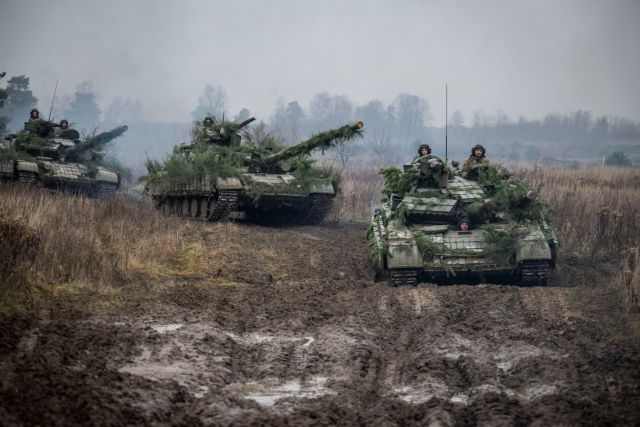
 The European Commission, the EU’s executive arm, on Thursday proposed a reform of the EU’s military planning and procurement, aimed at making the bloc ready for combat by the end of the decade.
The Defence Readiness Roadmap 2030 sets out four priority joint defense procurement projects, and a target to boost the joint acquisition of arms to 40% by the end of 2027, up from around 20% currently.
The EU says that member states coming together will allow them to afford more advanced weapons faster.
The plan is the latest effort by the EU to boost its defense capabilities amid worsening relations with Russia. Last month, Russian drones were detected inside Poland’s airspace, and three Russian fighter jets entered Estonian airspace without permission, amid other sightings.
“Militarised Russia poses a persistent threat to European security for the foreseeable future,” the document states.
EU foreign-policy chief Kaja Kallas told a press conference in Brussels on Thursday that Russia has no capacity to launch an attack against the EU at present, but it could become ready in future years. Even if the war in Ukraine ends, “danger will not disappear”, she said.
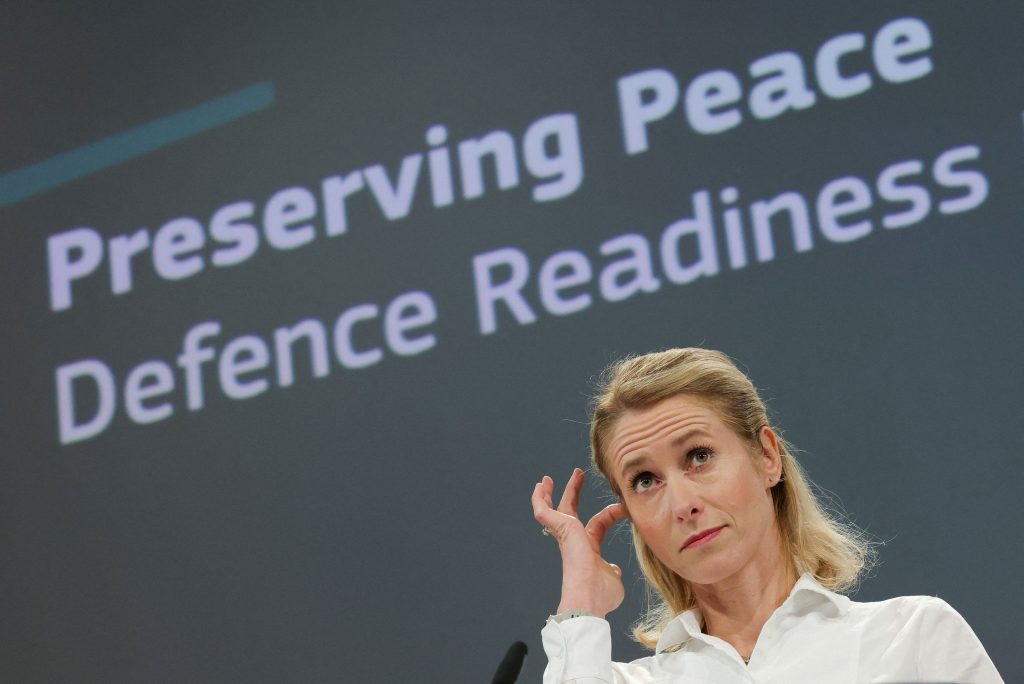
EU High Representative for Foreign Affairs and Security Policy Kaja Kallas presents “Defence Readiness Roadmap 2030”, during a press conference in Brussels, Belgium October 16, 2025. REUTERS/Yves Herman
Under the strategy, the EU will invite its member states to form voluntary coalitions, which will identify the military equipment that they want to buy together. Every coalition will be led by one or two EU countries.
To address the most urgent capability gaps, the EU executive body has proposed four projects, but said member states would be able to come up with additional ones.
These priority projects include the European Drone Defence Initiative, aimed at enabling EU countries to better detect and intercept enemy drones breaking into their airspace, by jointly acquiring radars, acoustic centers, anti-warfare systems, machine guns and low-cost anti-drone rockets, among other equipment.
EU countries on the bloc’s eastern border face the greatest direct threat of airspace violations from Russia and Belarus, but any EU member state can be at risk, the roadmap said.
A second program, called the Eastern Flank Watch, will focus on integrating air defense and counter-drone systems with a set of ground defense systems such as anti-tank weapons, and maritime security in the Baltic and Black Seas.
Under the European Air Shield program, EU countries are set to create a multi-layered air defense system.
The fourth program, called the Defence Space Shield, aims to procure equipment to better protect the EU’s satellites.
The coalitions should be formed by early next year, with projects launched in the first half of 2026, according to the plan. Contracts with defense companies should by signed by the end of 2028, while the military equipment should be delivered by 2030.
To support this military build-up, the EU in March proposed a loans program to boost joint defense procurement, worth 150 billion euros ($174.73 billion).
Shares in EU defense companies rose in afternoon trade in Europe, following the presentation of the roadmap.
Italy’s shipbuilder Fincantieri, which produces warships and advanced systems for underwater warfare, gained 2%, while Italy’s aerospace and defense group Leonardo and France’s Dassault Aviation, maker of the Rafale fighter jets, both gained 1.6%. Rheinmetall, Germany’s biggest arms maker, went up 1.3%.