 Μake us preferred on Google
 KYIV, Ukraine— Iryna Tkhoryk knew things were really bad in her cozy, three-room apartment here when frost formed on the inside handle of her balcony door, and she could see her own breath.
The 60-year-old pet-store manager now walks around swaddled in several layers topped by a long pink hoodie, wearing four pairs of socks and a hot-water bottle around her neck to cope with temperatures that are at best around 50 degrees Fahrenheit inside and 10 degrees outside.
The situation in Tkhoryk’s apartment building on Tychyna Avenue is familiar across Kyiv and other large cities, such as Odesa and Dnipro, as four years of Russian airstrikes have devastated Ukraine’s electricity grid and disrupted heating.
The strikes have left millions without electricity for most of the day and thousands of homes with heating that barely works. The situation is particularly acute in the capital , Kyiv, where blackouts had, until late last year, largely been a bearable annoyance that residents could weather with power banks, candles and battery-powered torches.
Ukrainian President Volodymyr Zelensky said a million Kyiv residents were without power and more than 4,000 apartment buildings without heating as of Tuesday evening. Kyiv authorities said about one-fifth of the city’s three million residents had fled the city this month, citing cellphone data. Authorities closed schools in the capital until February because of the energy situation.
The result, however, hasn’t been the societal collapse that Russia has long sought by attacking civilian infrastructure. Instead, Ukrainians are showing the resilience and make-do attitude that have frustrated Moscow’s efforts to pummel them into submission.
Ukrainians like those in Tkhoryk’s building are huddling around stoves with their gas burners on, using cars to charge cellphones and store frozen food, and springing into action when power comes back on to charge cellphones and use their washing machines.
Tkhoryk recalled the words of her grandmother who survived first a Soviet-imposed famine that killed millions in Ukraine in the 1930s and then World War II.
“Well, we survived as best we could,” she recalled her grandmother saying. “We did what we could—we raised the children, we boiled grass, melted snow—we did everything.”
Tychyna Avenue, named after a Ukrainian poet, and its neighborhood represented the new Ukraine that emerged during the hardship of transitioning to capitalism after the fall of the Soviet Union. The area has everything expected of a modern European city: small restaurants, schools, playgrounds and a mall, all within walking distance on the eastern bank of the Dnipro River.
After the Russian army retreated from the outskirts of Kyiv in March 2022, life here settled into a new normal as residents grew accustomed to a war in which the most tangible impact was constant air alerts and worries about family on front lines. But in March 2025, a drone slammed into Tkhoryk’s building, starting a fire that burned a woman alive.
Tkhoryk remembers hearing a loud explosion, rolling off the bed and racing to get her two dogs to the relative safety of the bathroom, away from external walls.
“There are people screaming, and you can’t do anything,” she said. “That’s probably the scariest thing.”
The energy crisis has permeated the neighborhood since it took hold late last year when Russia intensified strikes on power stations and other infrastructure. Now, the nearby grocery store isn’t as reliable as usual, with its opening hours dependent on generators powering it. The private sauna on the river that was once a traditional leisure activity now mostly provides a chance for a warm shower.
Heating for the building that depends on electrical pumps to pipe hot water has been badly disrupted.
It has all come during a particularly cold winter, with heavy snowfalls and temperatures around 6 degrees Fahrenheit or lower since early January.
Daryna Prokopenko , a lawyer during the week and tattoo artist on weekends, lives in Tkhoryk’s building and has devised ways to ensure that her boyfriend and their sons, ages 4 and 1, survive.
The four burners on her gas stove heat the room a bit—hardly safe, but badly needed, she said.
The unpredictability of the power cuts has shaken Prokopenko’s daily routine. When she reaches for her phone early in the morning, her eyes dart to the Wi-Fi symbol. If it is on, she races to charge every power bank, laptop and lamp, as the power can go out any minute. If there is laundry to do or cooking, she springs into action at the first sign of electricity back in the building.
“When the light comes on, I get a burst of energy and strength—you have to tidy up the mess here, wash the dishes there,” she said.
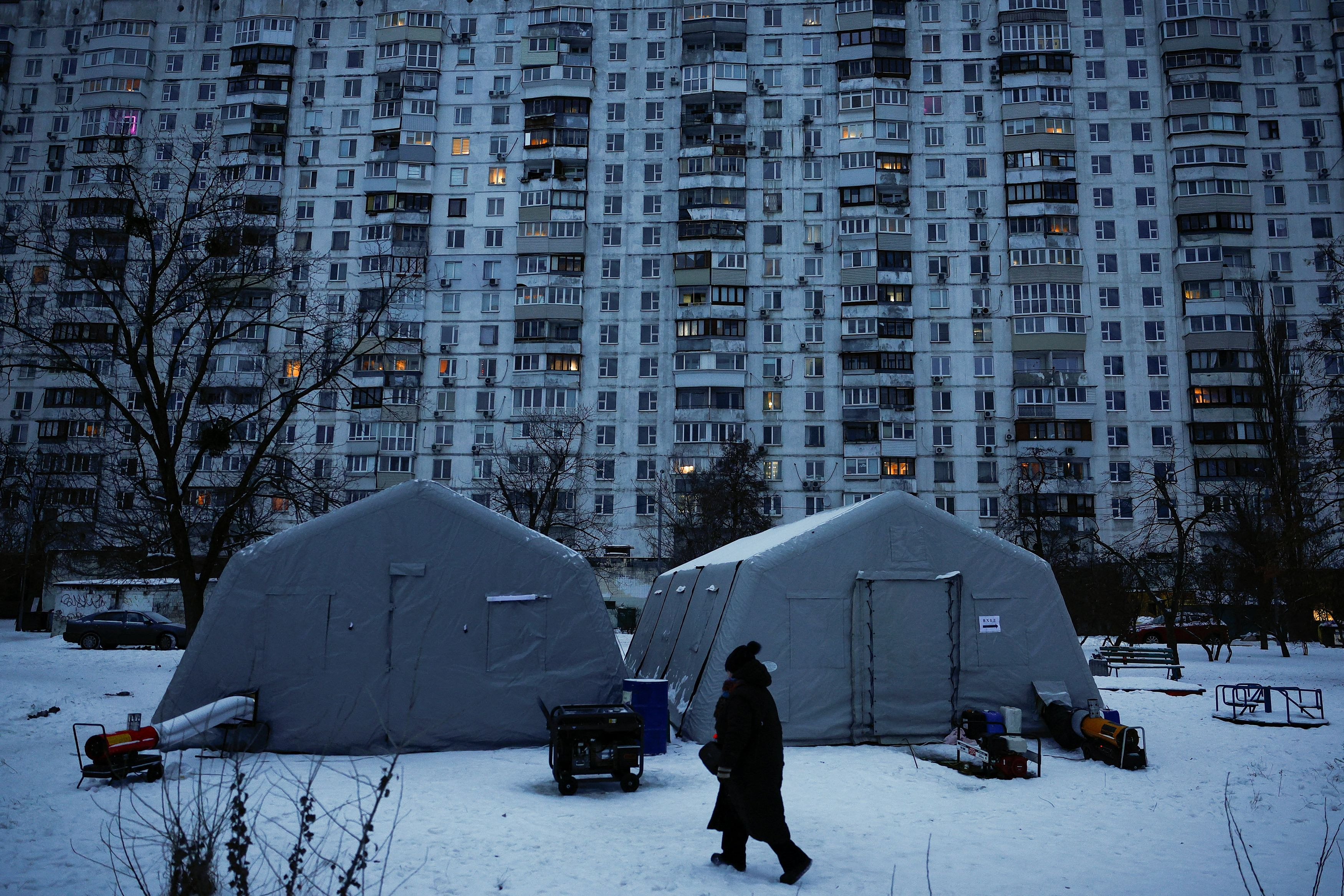
Cars work as both charging stations and freezers, with frozen dumplings and other products stored in their trunks. Christmas trees still strung with lights brighten apartments during power cuts. Children on break from school charge family devices at government-run “invincibility points,” large tents that run on generators to provide heat and electricity.
For Viktoriia Tokarieva, an accountant from the eighth floor of the Tychyna Avenue building, one nearby tent became a makeshift office when her apartment lost power for a week. While Tokarieva worked, her 4-year-old daughter hung out with a psychologist and watched cartoons, as her kindergarten was too cold to open.
Anastasiia Samofal, a 27-year-old translator from the second floor, taped her 22-pound power bank to an old shopping cart to haul it to the tent. A few weeks ago, there was enough electricity for her to watch the long-awaited finale of “Stranger Things” on Netflix. Now, power is strictly for essentials.
“It’s so dark that you can’t read, and there’s no light to sit on the phone for long, because then I’ll have to go downstairs to recharge it,” she said. “The only entertainment is cooking because I cook and warm myself up at the same time.”
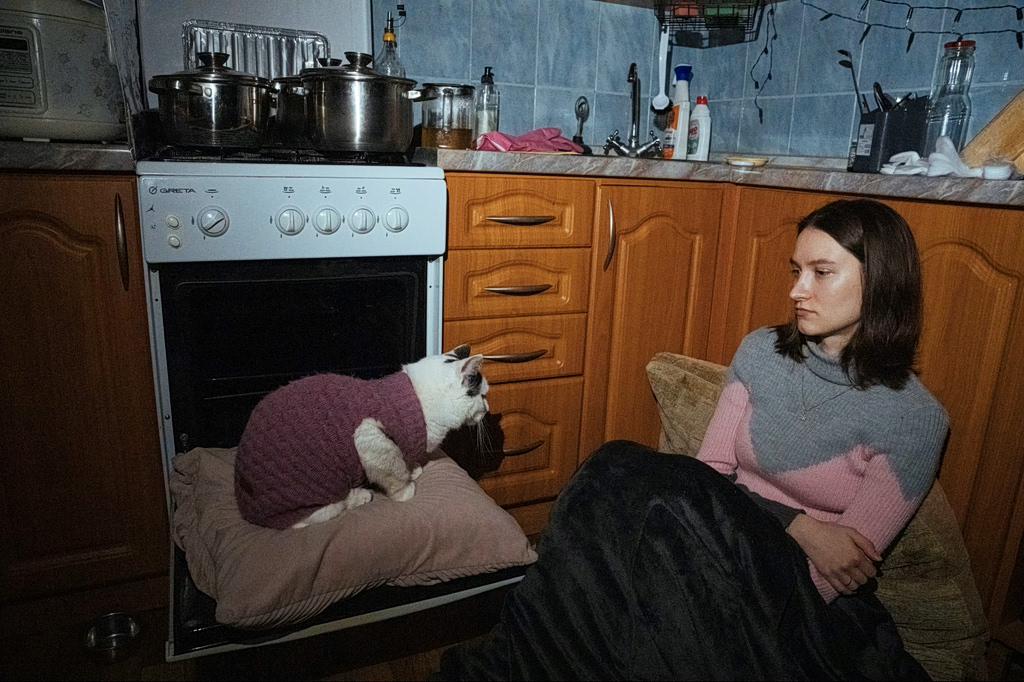
Samofal sits in her kitchen to try to keep warm. Photography by Emanuele Satolli for WSJ.
She hangs out on pillows surrounding her gas stove with her cat Murchyk, which now always wears a little sweater. To wash the dishes, Samofal uses a tip she saw online: wearing winter gloves under rubber ones to wash plates in cold water.
It is even harder for those taking care of young children on their own. Olha Kosova’s husband is in the military, and the power cuts made it hard to heave the heavy stroller up to the fourth floor and heat water to bathe her 1-year-old daughter. She left the building for her parents’ house in the Kyiv suburbs, where power outages are rarer and she could get more help.
“The war has been going on for years, and every year, it gets harder and harder,” Kosova said. “I wouldn’t even move out of that apartment if I didn’t have a child. I want to give her a warm home, and I want her to always be clean.”
Technicians are working grueling, 12-hour shifts to get the lights back on. Vadym Buhlak, who is employed by DTEK, Ukraine’s largest private power company, said he and colleagues had restored electricity to a building last week that had been without power for 10 days.
“They were practically praying for us,” he said, recalling residents bringing out tea and candy to thank his team.
DTEK said it has been fielding tens of thousands of calls a day asking for help.
“Russia is using winter as a weapon to try and trigger a human catastrophe in Ukraine. Every part of the energy system is being attacked at a level that’s incomparable with anything we’ve seen since 2022,” said DTEK Chief Executive Maxim Timchenko .
There is no indication that the Kremlin has broken Ukrainian morale. Early on Saturday evening, the Tychyna Avenue neighbors huddled around a fire for an impromptu barbecue.
Laughter rang out in the dark streets. Children ran around without a care as neighbors caught up with acquaintances old and new. One cautioned that her food contribution—some sausages—was still frozen.
“No way to unfreeze them,” she said, laughing.
The group made a toast with glasses of vodka and whiskey for warmth. They broke into song, a Ukrainian patriotic march that has become an anthem of resistance to Russia.
“For some reason, our glorious Ukraine is in sorrow,” they sang. “Hey-hey, we shall cheer up our glorious Ukraine!”
Write to Anastasiia Malenko at anastasiia.malenko@wsj.com